BI-Agent lifts LLM accuracy on real business intelligence tasks
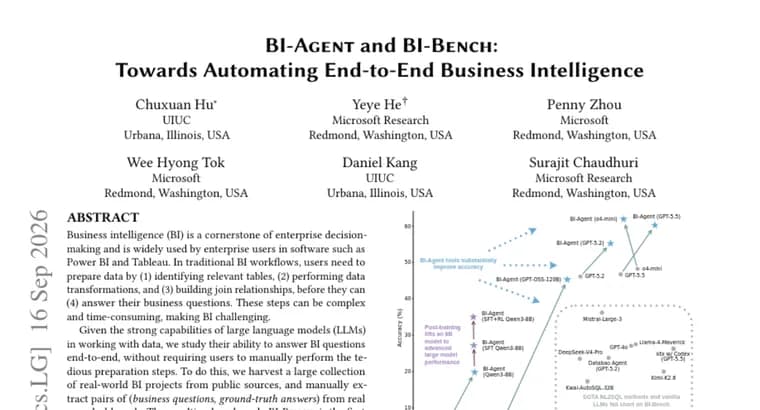
Researchers built BI-Bench, described as the first benchmark to systematically test whether large language models can handle business intelligence end to end, without a human first preparing the data. Traditional BI work in tools like Power BI and Tableau requires a user to find the relevant tables, transform the data, build join relationships between tables, and only then answer a business question; BI-Bench checks whether an LLM can do all of that on its own. The benchmark was assembled by collecting real-world BI projects from public sources and manually extracting question and ground-truth answer pairs from actual user dashboards. Testing frontier LLMs directly on BI-Bench, the researchers found they perform poorly, with less than 50% accuracy. To close that gap, they built BI-Agent, a tool-augmented system that breaks a BI workflow into subtasks over structured data, such as searching, joining and transforming tables, and orchestrates specialized data-management methods across the different stages of a BI task. Giving vanilla LLMs this BI-Agent scaffolding produced accuracy gains of up to 40 percentage points. The team then built a post-training framework that synthesizes training trajectories from real BI projects, and used it to further train BI-Agent with both supervised fine-tuning and reinforcement learning; this post-trained version of BI-Agent added gains of up to 30 points on top. The source text does not say what baseline that further 30-point gain is measured against, how many questions or projects make up BI-Bench, or who the authors are.
Key facts
- BI-Bench is presented as the first benchmark to systematically test LLMs on end-to-end business intelligence, using question and ground-truth answer pairs manually extracted from real user dashboards.
- Frontier LLMs tested directly on BI-Bench score less than 50% accuracy.
- BI-Agent, a tool-augmented system that decomposes BI workflows into subtasks like search, join and transform, lifts vanilla LLM accuracy by up to 40 percentage points.
- A post-training framework synthesizes training trajectories from real BI projects and fine-tunes BI-Agent with both supervised fine-tuning and reinforcement learning, adding gains of up to 30 points on top.
- The source does not specify the baseline for that further 30-point gain, the size of BI-Bench, or the authors' identities.
Why it matters
BI work is normally gated on tedious data prep: finding the right tables, transforming them, wiring up joins, before a question can even be asked. BI-Bench is the first attempt to measure, systematically, whether an LLM can skip that prep and answer real BI questions on its own, and the headline finding is that today's frontier models mostly cannot: under 50% accuracy on questions drawn from real dashboards. BI-Agent is the proposed fix, and the fact that tool augmentation alone buys up to 40 points, with post-training adding more on top, is offered as evidence that the gap is closable rather than fundamental.
Who it affects
Enterprise users who currently do this data prep by hand in tools like Power BI and Tableau are the intended beneficiaries of any eventual automation. More immediately, the work speaks to researchers and engineers building agentic systems for structured data work, since BI-Bench gives them a concrete, dashboard-derived yardstick and BI-Agent's subtask decomposition (search, join, transform) is a reusable pattern for that kind of workflow.
How to use it
This is a research paper introducing a benchmark and an agent architecture, not a shipped product; the source gives no pricing, release date or availability details, so none should be assumed. What is described is the mechanism: BI-Agent orchestrates specialized data-management methods across the stages of a BI workflow, and a separate post-training framework synthesizes training trajectories from real BI projects to further train it via supervised fine-tuning and reinforcement learning.
How solid is it
The benchmark's grounding is its strongest point: questions and answers come from real BI projects and real user dashboards rather than synthetic tasks. The accuracy figures are specific and stated as ranges ("less than 50%", "up to 40 percentage points", "up to 30 points"), which is honest but also leaves the ceiling unclear. The source text does not disclose how many questions or projects make up BI-Bench, does not name authors or institutions, and does not give a publication date, so independent verification of scale and provenance is not possible from what is visible here.
Risks and caveats
The two headline gains are not measured against the same baseline: the 40-point gain is for vanilla LLMs given BI-Agent tooling, but the source does not state whether the further 30-point post-training gain is measured against the vanilla LLM or against the non-post-trained BI-Agent, so the two numbers should not be added together. The benchmark's size and composition are also undisclosed in the visible text, which limits how much can be said about how representative it is of real enterprise BI work.