BiSAT aligns separate semantic and acoustic branches for speech LMs
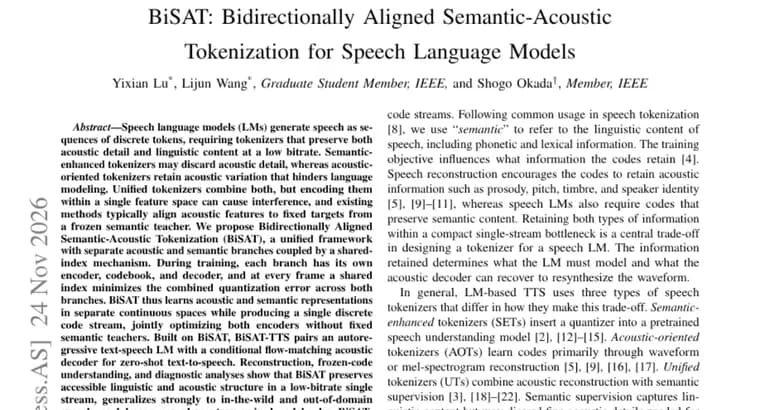
Speech language models generate speech as sequences of discrete tokens, so the tokenizer behind them has to preserve both acoustic detail and linguistic content at a low bitrate. The authors of a new paper describe a trade-off. Semantic-enhanced tokenizers may lose acoustic detail, while acoustic-oriented ones keep acoustic variation that makes language modeling harder. Unified tokenizers combine both, but representing the two in a single feature space can cause the objectives to interfere with each other. Existing approaches also typically align acoustic representations to fixed semantic targets taken from a frozen teacher model.
Their proposal is Bidirectionally Aligned Semantic-Acoustic Tokenization (BiSAT), a unified tokenization framework with separate acoustic and semantic branches aligned by a shared-index mechanism. It learns the two kinds of representation in separate continuous spaces while producing a single discrete code sequence. Both encoders are optimized jointly, without relying on fixed semantic teacher targets.
On top of the tokenizer the authors built BiSAT-TTS, a zero-shot text-to-speech system made of an autoregressive text-speech language model and a conditional flow-matching acoustic decoder.
According to the abstract, reconstruction tests, downstream understanding tests and diagnostic analyses show that BiSAT effectively preserves semantic and acoustic information in the code stream, performs well on in-the-wild and out-of-domain speech, and learns complementary codebook representations. The authors add that understanding results obtained with frozen codes support the feasibility and potential of using the codes for reward modeling in reinforcement learning post-training. BiSAT-TTS, they report, performs comparably to state-of-the-art TTS baselines built on speech language models while using less training data. Audio demos are available at https://seekmind-lab.github.io/bisat-demo.
Key facts
- BiSAT uses separate acoustic and semantic branches, aligned by a shared-index mechanism, and produces a single discrete code sequence.
- Both encoders are trained jointly, without fixed semantic targets from a frozen teacher.
- BiSAT-TTS, a zero-shot text-to-speech system, pairs an autoregressive text-speech language model with a conditional flow-matching acoustic decoder.
- The authors report that BiSAT-TTS performs comparably to state-of-the-art speech LM-based TTS baselines with less training data.
- Audio demos are online; code-based reward modeling for reinforcement learning post-training is presented as a potential use.
Why it matters
A speech language model works with whatever its tokenizer passes on. If acoustic detail is lost, the model cannot rely on it; if too much acoustic variation remains, language modeling gets harder. Unified tokenizers try to serve both goals, but the authors argue that a shared feature space can set the two against each other. BiSAT's answer is to keep the representations in separate continuous spaces, tie them together through shared indices, and still emit one code sequence. It also drops the reliance on fixed semantic targets from a frozen teacher, letting both encoders learn together.
Who it affects
The work is aimed at the problem faced by people building speech language models and text-to-speech systems, especially those choosing or designing a speech tokenizer. The authors' mention of reward modeling also makes it relevant to anyone exploring reinforcement learning post-training for speech models, though they describe that only as feasible and promising.
How to use it
You can listen to the audio demos at https://seekmind-lab.github.io/bisat-demo and judge the output by ear. The abstract mentions no release of code or model weights; the demos are the only linked material. For design ideas, the main elements to study are the two separate branches, the shared-index alignment and the joint training of both encoders.
How solid is it
These are the authors' own claims as summarized in the paper's abstract. It names three kinds of evidence for the tokenizer: reconstruction, downstream understanding and diagnostic analyses. It gives no numerical results, bitrate values, codebook sizes or dataset sizes. The TTS comparison is described as comparable performance, not as a win over the baselines, and those baselines are not named.
Risks and caveats
The claim of using less training data is not quantified, so the size of that saving is unknown from the abstract. The languages covered are not stated. Reinforcement learning post-training with code-based reward modeling is not reported as carried out; the authors point to results with frozen codes as support for its feasibility and potential.
“BiSAT-TTS performs comparably to state-of-the-art speech LM-based TTS baselines with less training data”
— The authors, in the paper's abstract