DemoFoundry uses coding agents to make photorealistic robot data
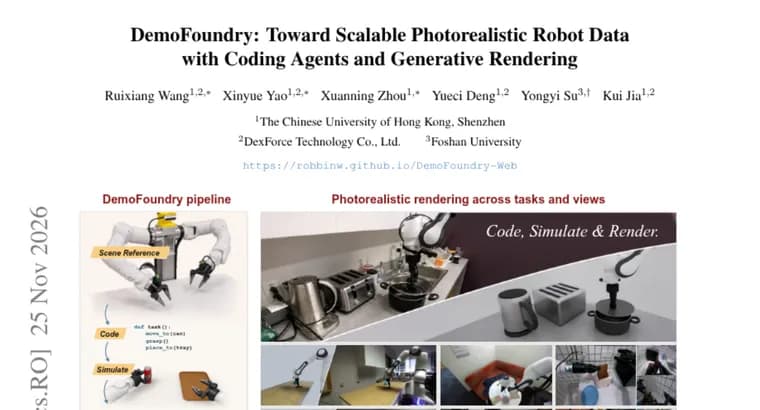
A paper presents DemoFoundry, an automated framework that couples coding agents with generative rendering to synthesize robot demonstrations that are meant to be both photorealistic and physically grounded.
The authors start from a data problem. Scaling robot learning, they argue, requires demonstrations that combine realistic visual observations with reliable action supervision. Synthesis based on simulation faces a substantial visual gap relative to real environments. Video-only generation, in turn, struggles to keep interactions physically consistent and to provide action labels that line up with the footage.
In DemoFoundry, coding agents have two jobs. They build aligned pairs of real and proxy videos from existing robot episodes, which are used to train a video renderer. They also write executable interaction programs that generate new demonstrations. Given a scene reference and a task instruction, an agent reconstructs the geometry relevant to the task and writes a control program, without requiring human demonstrations of the target task.
Running that program in a physics simulator produces proxy videos with matching robot states and actions. The video renderer then translates the proxy videos into photorealistic observations consistent with the scene, which reduces the need to model the appearance of each scene in detail. Automated checks on task execution select the successful trajectories for rendering and policy learning.
According to the authors, experiments show better visual quality and better consistency between actions and video. Policies trained on the generated demonstrations outperform training on raw simulation and approach the performance of training on the same number of real demonstrations.
Key facts
- DemoFoundry is an automated framework that couples coding agents with generative rendering to synthesize robot demonstrations.
- Agents build aligned real and proxy video pairs from existing robot episodes to train a video renderer, and write programs that generate new demonstrations.
- From a scene reference and a task instruction, an agent reconstructs relevant geometry and writes a control program with no human demonstrations of the target task.
- A physics simulator yields proxy videos with aligned robot states and actions, and the renderer turns them into photorealistic observations.
- The authors report that resulting policies beat raw-simulation training and approach training on an equal number of real demonstrations.
Why it matters
The authors frame the work around a trade-off in robot data. Scaling robot learning needs both realistic images and reliable action labels. In their account, simulation looks substantially different from real environments, while video generation on its own has trouble with physically consistent interactions and aligned actions.
DemoFoundry splits the work. A physics simulator supplies states and actions, and a trained video renderer supplies the realistic look. Coding agents connect the two by preparing the renderer's training pairs and writing the programs that drive new demonstrations.
Who it affects
The work is most relevant to people who train robot policies and need demonstration data, and to those building simulation or video generation pipelines for that purpose. It is also a case for anyone tracking coding agents: here they reconstruct scene geometry and write robot control programs.
How to use it
The design as described runs in steps. Existing robot episodes are turned into aligned real and proxy video pairs to train the renderer. For a new task, the agent takes a scene reference and a task instruction, rebuilds the relevant geometry and writes a control program. The program runs in a physics simulator, automated checks pick the successful trajectories, and the renderer converts their proxy videos into photorealistic ones for policy learning.
No code, model or dataset release is mentioned.
How solid is it
These are the authors' own claims about their own system. They cite experiments showing improved visual quality and action-video consistency, plus policy results that beat raw-simulation training and approach training on real demonstrations.
No numerical results are given in the text behind this account: no success rates, quality metrics or size of the remaining gap to real demonstrations. The baselines for the visual quality and consistency gains are not specified either. Treat the results as unverified until the details can be checked.
Risks and caveats
The framework's independence from human data has a limit. The statement about needing no human demonstrations applies to the target task, and existing robot episodes are still used to train the video renderer.
Performance is described as approaching that of an equal number of real demonstrations, which is not a claim of matching or exceeding it. Only trajectories that pass the automated task checks go on to rendering and policy learning. The source does not say whether the policies were evaluated on real robots or only in simulation.
“Policies trained on the generated demonstrations outperform raw-simulation training and approach the performance of training on an equal number of real demonstrations.”
— The authors of the DemoFoundry paper