DAWIN neuron beats Neural CDE on 9 of 11 tasks in new paper
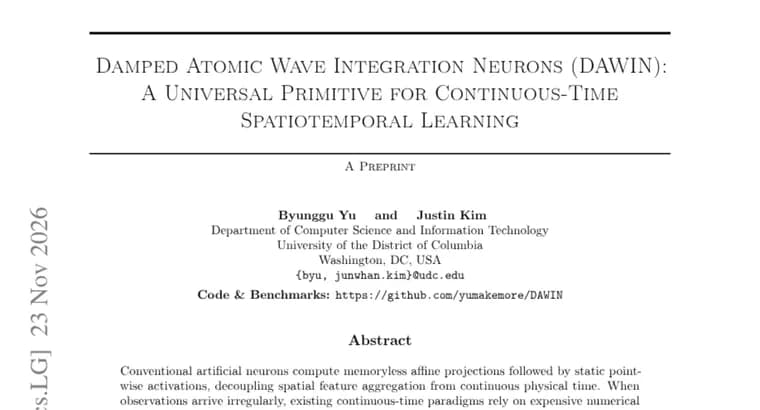
A new paper introduces the Damped Atomic Wave Integration Neuron, or DAWIN, a continuous-time building block meant to replace standard neural layers in MLPs, Transformers and graph neural networks. The authors start from a complaint about conventional artificial neurons: they separate the aggregation of spatial features from continuous physical time, which limits their ability to model irregular observations.
DAWIN couples a spatial projection with a wave excitation that depends on elapsed time. It then integrates that signal into a local complex state through closed-form damped evolution, so no numerical differential equation solver is needed. On the theory side, the authors show that DAWIN generalizes static sinusoidal and memoryless wave neurons on inputs augmented with time intervals. They also derive closed-form gradients and establish bounded-input bounded-output stability, provided damping is positive and sampling intervals stay bounded away from zero.
The implementation, called DAWINLinear, is an associative prefix scan written in Triton. It accumulates in FP32 and reaches O(log L) parallel depth for a sequence of length L.
The evaluation covers 11 parameter-matched tasks spanning irregular oscillators, MuJoCo dynamics, pedestrian trajectories and clinical sequences from PhysioNet 2012. DAWIN outperforms Neural CDE on 9 of them and a ReLU-MLP on 8. It records the lowest error on dense clinical dynamics, an NRMSE of 0.9531, winning across all 10 seeds, and ties for the best mortality prediction at 0.9993 AUROC. To test whether the model really uses timing, the authors shuffled the elapsed intervals. Error rose by 58.2% to 77.4% on selected dynamics tasks, against 0.06% on a control task where time is irrelevant.
On NVIDIA B200 GPUs, parallel wave integration speeds up inference by up to 2,630 times compared with DAWIN's own serial implementation. In the tested configurations, it also cuts peak GPU memory by up to 97.6% relative to Mamba.
Key facts
- DAWIN is a continuous-time neural primitive proposed as a replacement for standard layers in MLPs, Transformers and graph neural networks, with no numerical differential equation solver.
- Across 11 parameter-matched tasks, the authors report that it outperforms Neural CDE on 9 and a ReLU-MLP on 8.
- On dense clinical dynamics it posts the lowest error, 0.9531 NRMSE, winning on all 10 seeds, and it ties for the best mortality prediction at 0.9993 AUROC.
- Shuffling elapsed intervals raises error by 58.2% to 77.4% on selected dynamics tasks, compared with 0.06% on a time-irrelevant control.
- On NVIDIA B200 GPUs, parallel integration is up to 2,630 times faster than DAWIN's serial version, and peak memory is up to 97.6% below Mamba's in tested configurations.
Why it matters
The paper targets a specific gap. In the authors' account, conventional neurons handle spatial features apart from continuous physical time, so they struggle with observations that arrive irregularly. DAWIN builds elapsed time into the neuron itself and evolves its state in closed form, which avoids numerical differential equation solvers. The authors pitch it as a general primitive that could stand in for standard layers across MLPs, Transformers and graph neural networks.
Who it affects
The work is most relevant to researchers and engineers who model data where the gaps between observations carry information. The tests cover irregular oscillators, MuJoCo dynamics, pedestrian trajectories and PhysioNet 2012 clinical sequences. People who currently use Neural CDE or Mamba have a direct reason to look, since the paper compares against the first on task performance and the second on peak GPU memory.
How to use it
The proposed route is to swap standard neural layers for DAWIN units. The implementation the authors describe, DAWINLinear, uses an associative prefix scan in Triton with FP32 accumulation and O(log L) parallel depth over sequence length L. No code, weights or library release is mentioned. Anyone reproducing the stability result should note its conditions: positive damping and sampling intervals bounded away from zero.
How solid is it
These are the authors' own results, as summarized in the paper's abstract. The tests are parameter-matched, the clinical dynamics win holds across all 10 seeds, and the interval-shuffling experiment with its time-irrelevant control supports the claim that the model relies on physical timing. Margins over the baselines are not given for the clinical error or the task wins, and the model that ties DAWIN on mortality prediction is not named. Peer review status or venue is not stated.
Risks and caveats
DAWIN does not win everywhere. It outperforms Neural CDE on 9 of 11 tasks and the ReLU-MLP on 8, and the remaining tasks are not named. The headline speed figure of up to 2,630 times is measured against DAWIN's own serial implementation, so it says nothing about speed against other models. The memory saving of up to 97.6% is relative to Mamba only and limited to the tested configurations. No error or accuracy comparison with Mamba or Transformers is reported, and no experimental results for Transformer or graph neural network replacements are detailed.
“Conventional artificial neurons separate spatial feature aggregation from continuous physical time, limiting their ability to model irregular observations.”
— The paper's abstract