Block3D cuts text-to-3D generation time 5.15x
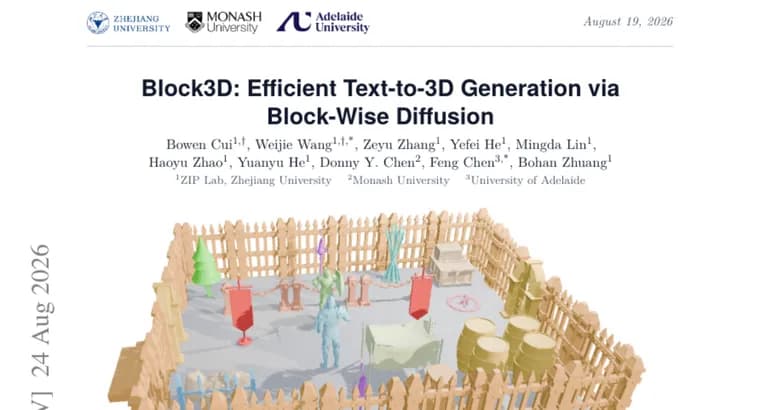
A paper proposes Block3D, a block-wise diffusion framework for text-to-3D generation aimed at cutting inference cost without losing geometric quality. The authors frame the problem as a choice between two existing families of methods, both flawed: autoregressive decoding of discrete shape tokens is sequential and cannot revise a mistake once made, while diffusion and flow-matching models that iteratively refine a global 3D representation have to reprocess the full representation on every step, so high-quality output gets increasingly expensive. Block3D combines the two ideas instead of choosing between them. It partitions the discrete shape-token sequence into contiguous blocks, generates those blocks one after another autoregressively, and within each block jointly denoises all of that block's tokens with diffusion. To keep errors from accumulating across blocks, the method adds confidence-guided intra-block correction: before a block is finalized, tokens the model is least confident about are revised. The authors tested Block3D on a held-out set drawn from TRELLIS-500K. Mean end-to-end generation time fell from 25.71 seconds for a fine-tuned autoregressive baseline to 4.99 seconds for Block3D, a 5.15 times speedup, which the authors state was achieved without sacrificing geometric fidelity. The paper lists Bowen Cui as author but gives no institutional affiliation, publication venue, or code or model release, and it does not compare Block3D against methods other than that one autoregressive baseline.
Key facts
- Block3D partitions a discrete shape-token sequence into contiguous blocks, generating blocks autoregressively while jointly denoising all tokens within the current block.
- Confidence-guided intra-block correction revises low-confidence tokens before a block is finalized, to curb error accumulation from the autoregressive step.
- On a held-out set from TRELLIS-500K, mean end-to-end generation time fell from 25.71 seconds for a fine-tuned autoregressive baseline to 4.99 seconds with Block3D.
- That is a 5.15 times speedup, which the authors say comes without sacrificing geometric fidelity.
- The paper lists Bowen Cui as author but no affiliations, venue, or code release, and compares Block3D against only the one autoregressive baseline.
Why it matters
Text-to-3D generation has been stuck between two unattractive options: autoregressive decoding of shape tokens, which is fast to reason about but sequential and unable to fix a wrong token once it is generated, and diffusion or flow-matching models, which can iteratively improve a shape but have to reprocess the entire representation at every step, making high-fidelity output slow and costly. Block3D targets that tradeoff directly by generating shape tokens in blocks: autoregressive across blocks for structure, diffusion within a block for quality, with a correction step that fixes weak tokens before locking a block in.
Who it affects
The result speaks to researchers and engineers building text-to-3D pipelines, and anyone downstream who depends on fast 3D asset generation, such as game, VFX, and product-design tooling that turns a text prompt into a usable mesh. A roughly five times cut in generation time changes what is practical to offer as an interactive or near-real-time feature rather than an offline batch job.
How to use it
The paper describes a method and reports benchmark numbers; it does not mention a code release, a pretrained model, a license, or a price. There is nothing here to install or call yet based on the text alone.
How solid is it
The reported 5.15 times speedup and the 25.71 to 4.99 second figures come from a single held-out set drawn from TRELLIS-500K, compared against one baseline, a fine-tuned autoregressive model. The paper does not define how geometric fidelity was measured, nor does it compare Block3D to any other method beyond that baseline, so the claim of faster generation without quality loss rests on one benchmark and one comparison point.
Risks and caveats
The only author listed is Bowen Cui, with no institutional affiliation given, so the work cannot be checked against a research group's track record from this source alone. No publication venue or code and model release is mentioned, and the evaluation is limited to a single held-out set and a single baseline, with no stated definition of the fidelity metric used to claim quality was preserved.