Duopra teaches a full-duplex interaction model to call tools
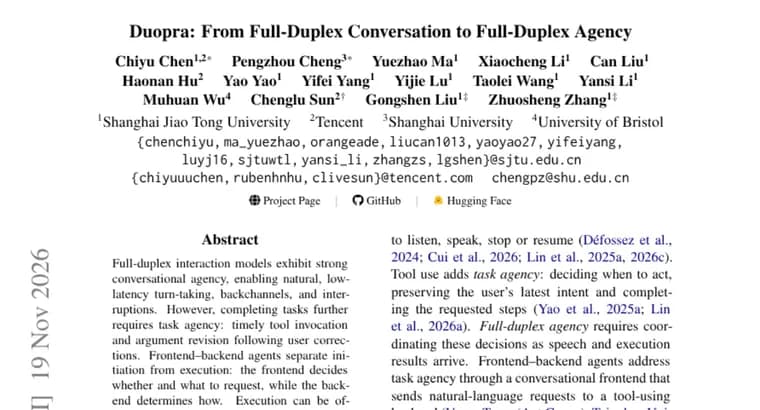
Full-duplex interaction models can hold natural conversation: low-latency turn-taking, backchannels and interruptions. The paper calls this conversational agency. Finishing real tasks needs something more, which it calls task agency: calling a tool at the right moment and revising its arguments after the user corrects something.
The paper starts from frontend-backend agents, where the frontend decides whether and what to request and the backend decides how to carry it out. Execution can be offloaded, the authors say, but a request that was never sent cannot be executed, and an incomplete one can misdirect the backend. On Full-Duplex-Bench v3 (FDB v3), most failures of Realtime-Venus-Audio + Harness in the authors' streaming pipeline occur before a domain tool executes. In other words, the trouble is in starting the action, not in the tool itself.
To address this, the authors introduce Duopra, a full-duplex interaction model that learns task execution alongside conversational control. Duopra treats the backend as a tool and hands it a self-contained natural-language request. Direct tool calls and backend delegation share one action interface, and both require faithful initiation and correct execution.
Training has three stages: protocol SFT; full-duplex RL that rewards timely and complete execution; and projector-only repair of the talker conditioning after the thinker has been updated.
The reported results: with the same backend, Pass@1 rises from 4.7% to 44.7%. Duopra reaches 47.7% when calling tools directly, against 26.0% after SFT alone, and 49.3% with a DeepSeek backend. It also improves three FDB v1.0 takeover rates over the base model. The authors conclude that task agency can coexist with key conversational agency.
Key facts
- Duopra is a full-duplex interaction model trained to execute tasks (tool calls and argument revisions after user corrections) while keeping conversational control.
- With the same backend, Pass@1 rises from 4.7% to 44.7%.
- Duopra scores 47.7% calling tools directly (26.0% after SFT only) and 49.3% with a DeepSeek backend.
- Training has three stages: protocol SFT, full-duplex RL rewarding timely and complete execution, and projector-only repair of talker conditioning after thinker updates.
- It improves three FDB v1.0 takeover rates over the base model.
Why it matters
Voice systems that talk naturally, interrupt and back-channel are one thing; voice systems that also get work done are another. The paper's diagnosis is that on FDB v3 most failures of Realtime-Venus-Audio + Harness in the authors' pipeline happen before a domain tool runs, so the request is never sent properly. Duopra targets that gap by training the interaction model itself to initiate and revise actions, and the reported jump from 4.7% to 44.7% Pass@1 with the same backend is the headline evidence.
Who it affects
Researchers and engineers building full-duplex speech agents that must act on a user's behalf, especially those who split a frontend conversation model from a backend that does the work. The design, which treats the backend as a tool, is also relevant to anyone weighing direct tool calls against delegation, since Duopra uses one shared action interface for both.
How to use it
This is a research result, not a product. The paper's practical idea is a recipe: train the frontend with protocol SFT, then full-duplex RL that rewards timely and complete execution, then repair the talker conditioning with projector-only training after the thinker changes. The backend receives a self-contained natural-language request. One reported configuration uses a DeepSeek backend. No model size, training data, compute, latency figures or release/code availability are given.
How solid is it
The source is a paper abstract on Hugging Face Papers, with the claims made by the authors themselves. The abstract does not name the benchmark for the Pass@1 figures (4.7%, 44.7%, 47.7%, 26.0%, 49.3%) and does not say outright which system is the 4.7% baseline. It also does not say which Duopra variant produces the 4.7% to 44.7% jump, only that the backend is the same. It does not say which three FDB v1.0 takeover rates improved or by how much. No authors or institutions are named in the abstract.
Risks and caveats
The conclusion is scoped: task agency can coexist with key conversational agency, which is not the same as all conversational agency. Only three FDB v1.0 takeover rates are reported as improved. No comparison with other systems is given beyond the base model and Realtime-Venus-Audio + Harness. The failure analysis of Realtime-Venus-Audio + Harness is in the authors' own streaming pipeline. Independent replication is not described.
“These results show that task agency can coexist with key conversational agency.”
— Duopra paper abstract, Hugging Face Papers