Direct3D-V3 drops the VAE to generate 3D shapes in the voxel domain
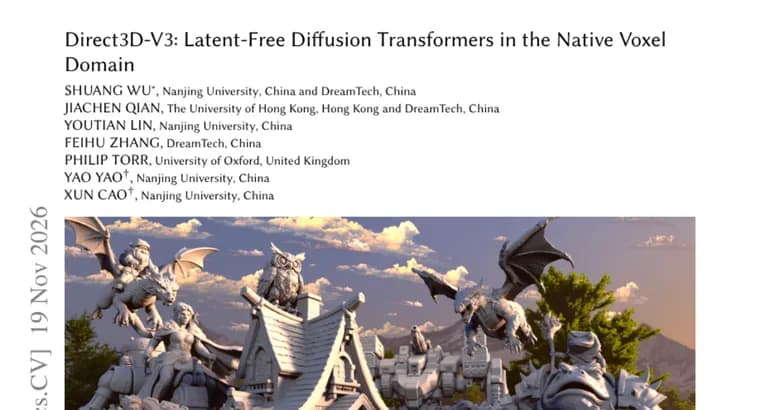
Direct3D-V3 is a framework for native 3D generation described in a paper abstract on Hugging Face. The authors start from an observation about the field: native 3D generation has largely been built around latent diffusion, and recent progress has concentrated on stronger variational autoencoders (VAEs) and increasingly elaborate latent representations, from vecset and triplanes to structured sparse voxels. Despite their differences, the authors say, these methods all share one premise: geometry is first compressed into a latent space and only then modeled by the generator.
Direct3D-V3 takes a different route. It is a latent-free diffusion transformer (DiT) framework that discards the VAE altogether and works in the native voxel domain, directly modeling raw SDF (signed distance field) voxel grids during both training and sampling.
To make this direct voxel formulation geometrically reliable, the authors add two things. The first is an implicit manifold regularization over neighboring voxels, meant to suppress non-watertight surfaces. The second is a step that converts predicted SDF grids into meshes with Marching Cubes, so that rendered normal losses can supervise the model directly from its predicted SDF.
For alignment between the conditioning image and the generated geometry, the model also predicts the camera parameters of the conditioning image as an auxiliary task. The authors say this encourages the DiT to learn the mapping from image observations to 3D shape.
The authors state that the latent-free design removes the reconstruction bottleneck, brings training under an objective in the native voxel domain, and yields meshes with substantially richer local detail. They add that the predicted camera and the native SDF voxel output make Direct3D-V3 extensible to generative reconstruction. In that setup, diffusion is interleaved with normal-guided refinement to improve alignment with the observed view, while the generative prior completes unseen regions. A project page is linked at https://dreamtechai.github.io/Direct3D-V3.
Key facts
- Direct3D-V3 is a latent-free diffusion transformer that discards the VAE and models raw SDF voxel grids directly, in training and in sampling.
- The authors contrast it with latent approaches (vecset, triplanes, structured sparse voxels), which first compress geometry into a latent space.
- An implicit manifold regularization over neighboring voxels suppresses non-watertight surfaces, and Marching Cubes meshes let rendered normal losses supervise the predicted SDF.
- The model predicts the conditioning image's camera parameters as an auxiliary task to improve image-to-shape alignment.
- The authors claim substantially richer local detail and extensibility to generative reconstruction, but the abstract reports no measurements.
Why it matters
Most native 3D generators compress geometry into a latent space before the generator sees it, and much recent work has gone into better VAEs and latent formats. Direct3D-V3 questions that premise. By modeling raw SDF voxel grids directly, the authors say they remove the reconstruction bottleneck that a VAE introduces and train under an objective in the native voxel domain.
Who it affects
The work is aimed at researchers building native 3D generation systems, especially image-conditioned shape generation, and at anyone working on latent representations such as vecset, triplanes or structured sparse voxels. The authors also point to generative reconstruction as an extension.
How to use it
The abstract links a project page at https://dreamtechai.github.io/Direct3D-V3. Beyond that, no code or weights release is stated. For practitioners the design offers a recipe to study: a DiT over raw SDF voxels, a manifold regularizer, Marching Cubes with rendered normal losses, and camera prediction as an auxiliary task.
How solid is it
This is a preprint abstract, and the claims are the authors' own. The claim of substantially richer local detail comes without benchmark results, metrics or comparisons against named methods in the text. Model size, training data, compute and inference speed are not stated either.
Risks and caveats
Without numbers, the case for the latent-free approach over latent diffusion cannot be judged from the abstract. The extra components (regularization, mesh conversion for normal losses, camera prediction) are described as needed to make the direct voxel formulation geometrically reliable, which suggests the approach depends on them. Independent evaluation and the full paper would be needed to confirm the detail gains.