BVSR framework gives AI scientists less task information to spark more original ideas
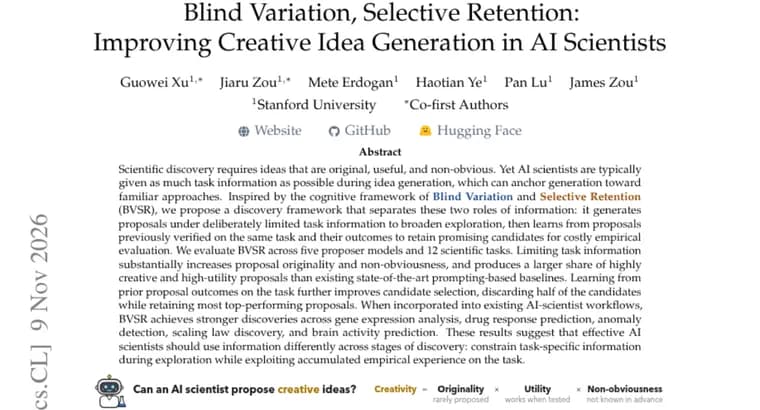
A paper on Hugging Face proposes BVSR, short for Blind Variation and Selective Retention, a discovery framework for AI scientists. It starts from a complaint about current practice: scientific discovery needs ideas that are original, useful and non-obvious, yet AI scientists are typically given as much task information as possible while generating ideas, which can anchor them toward familiar approaches.
The framework is inspired by the cognitive framework of the same name and splits the two roles that information plays. First, it generates proposals under deliberately limited task information, to broaden exploration. Second, it learns from proposals previously verified on the same task, and from their outcomes, to retain promising candidates for costly empirical evaluation.
The authors evaluate BVSR across five proposer models and 12 scientific tasks. They report that limiting task information substantially increases proposal originality and non-obviousness, and produces a larger share of highly creative and high-utility proposals than existing state-of-the-art prompting-based baselines. They also report that learning from prior proposal outcomes on the task further improves candidate selection: it discards half of the candidates while retaining most of the top-performing proposals.
When BVSR is incorporated into existing AI-scientist workflows, the authors say it achieves stronger discoveries across gene expression analysis, drug response prediction, anomaly detection, scaling law discovery and brain activity prediction. Their conclusion is that effective AI scientists should use information differently across stages of discovery: constrain task-specific information during exploration, while exploiting accumulated empirical experience on the task.
Key facts
- BVSR separates two roles of information: limited task information when generating proposals, accumulated outcomes of verified proposals when choosing which to test.
- Evaluated across five proposer models and 12 scientific tasks.
- Limiting task information increases originality and non-obviousness and yields a larger share of highly creative, high-utility proposals than state-of-the-art prompting-based baselines, per the authors.
- Learning from prior outcomes on the task discards half of the candidates while retaining most top-performing proposals.
- Reported stronger discoveries in gene expression analysis, drug response prediction, anomaly detection, scaling law discovery and brain activity prediction.
Why it matters
Empirical evaluation of scientific ideas is costly, so which ideas an AI scientist proposes and which it chooses to test both count. The paper challenges the habit of feeding an AI scientist as much task information as possible, arguing that this can anchor generation toward familiar approaches. Its alternative is to hold information back while brainstorming and use accumulated experience only when selecting candidates. Discarding half of the candidates while keeping most of the best ones points to a possible saving on costly evaluation.
Who it affects
Mainly people building AI-scientist workflows and agents for research. The reported application areas are gene expression analysis, drug response prediction, anomaly detection, scaling law discovery and brain activity prediction, so groups working in those areas are the ones the results speak to most directly.
How to use it
The abstract describes BVSR as something that can be incorporated into existing AI-scientist workflows. The practical pattern it suggests is two-stage: propose under deliberately limited task information, then use the outcomes of proposals already verified on the same task to decide which candidates are worth costly empirical evaluation. No code, dataset release or compute cost is mentioned.
How solid is it
This is a preprint abstract, and the claims are the authors' own evaluation results. The evidence base is five proposer models and 12 scientific tasks, with comparison against existing state-of-the-art prompting-based baselines. No numeric effect sizes are given for originality, non-obviousness, share of creative proposals, or the strength of discoveries. The proposer models and baselines are not named, and the 12 tasks are not listed individually. "Half of the candidates" is not given as a measured percentage, and "most top-performing proposals" is not quantified.
Risks and caveats
The abstract does not say whether any discovery was validated outside the paper's own tasks. The authors frame their closing point as a suggestion ("these results suggest"), not a proven rule. Because the abstract names no baselines or effect sizes, the size of the gains over prompting-based methods cannot be judged from it.
“These results suggest that effective AI scientists should use information differently across stages of discovery: constrain task-specific information during exploration while exploiting accumulated empirical experience on the task.”
— Abstract of the BVSR paper