BirdDreams driving world model generates perspective and BEV video together
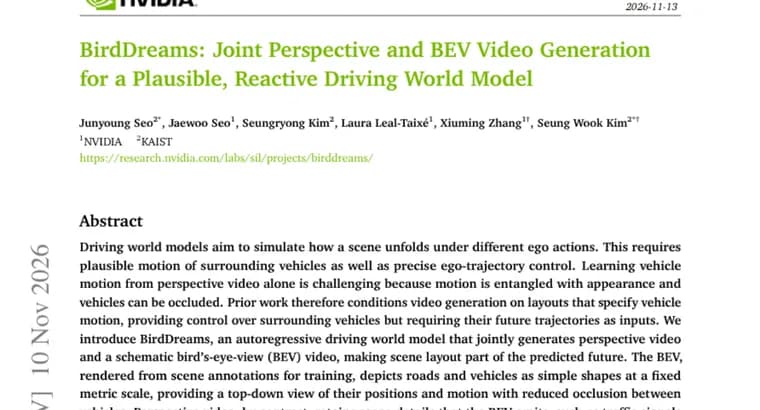
Driving world models try to simulate how a road scene unfolds under different ego actions. That takes two things: plausible motion of the surrounding vehicles and precise control over the ego vehicle's trajectory. The paper behind BirdDreams starts from a known difficulty. Learning vehicle motion from perspective (camera-view) video alone is hard, because motion is entangled with appearance and vehicles can be occluded. Earlier work got around this by conditioning video generation on layouts that specify vehicle motion. That gives control over surrounding vehicles, but it requires their future trajectories as inputs.
BirdDreams is an autoregressive driving world model that generates two videos jointly: a perspective video and a schematic bird's-eye-view (BEV) video. Scene layout thereby becomes part of the predicted future rather than an input. For training, the BEV is rendered from scene annotations. It shows roads and vehicles as simple shapes at a fixed metric scale, giving a top-down view of positions and motion with less occlusion between vehicles. The perspective video covers what the BEV leaves out, such as traffic signals and object appearance.
The two streams are handled by two video diffusion transformers, one per stream. Joint attention between them lets each stream inform the other during generation.
The predicted BEV also serves as a geometric interface for ego control. The model takes its latest BEV frame and translates and rotates it along an input ego trajectory. The resulting frames act as a soft condition that shows how the scene would appear to move if only the ego vehicle moved.
At inference time, BirdDreams generates both videos from a single camera image, with no HD map and no vehicle-state inputs.
The authors report results on two datasets, PhysicalAI-AV and nuScenes. There, BirdDreams follows input ego trajectories more faithfully than prior driving world models and generates more plausible ego motion without ego-action conditioning. A human evaluation shows it outperforming a perspective-only baseline in generating realistic surrounding-vehicle behavior.
Key facts
- BirdDreams is an autoregressive driving world model that jointly generates perspective video and a schematic bird's-eye-view (BEV) video, making scene layout part of the predicted future.
- Two video diffusion transformers, one per stream, are linked by joint attention so each stream informs the other during generation.
- For ego control, the latest predicted BEV frame is translated and rotated along an input ego trajectory and used as a soft condition.
- At inference it needs only a single camera image, with no HD map or vehicle-state inputs.
- On PhysicalAI-AV and nuScenes it follows ego trajectories more faithfully than prior driving world models; human evaluation favors it over a perspective-only baseline for surrounding-vehicle behavior.
Why it matters
A driving simulator is only useful if the other cars behave plausibly and the ego car does what it is told. Earlier approaches that control surrounding vehicles through layouts need those vehicles' future trajectories supplied as inputs. BirdDreams instead predicts the layout itself as a BEV video alongside the camera video, so vehicle motion is generated rather than specified. The top-down view also sidesteps the occlusion problem that makes motion hard to learn from perspective video alone.
Who it affects
The work is aimed at researchers building driving world models and video generators for driving scenes. The setup, with ego trajectories as control and surrounding traffic generated by the model, is relevant to anyone who wants to simulate how a scene unfolds under different ego actions.
How to use it
No code, weights or release plans are mentioned in the source, so there is nothing to download or run yet. Conceptually, the interface is simple: one camera image goes in, and an ego trajectory steers the generation through the translated and rotated BEV frames. No HD map or vehicle-state inputs are needed at inference. Training does require scene annotations, since the BEV is rendered from them.
How solid is it
This is a paper abstract, so the claims are the authors' own. The source reports that BirdDreams follows ego trajectories more faithfully than prior driving world models on PhysicalAI-AV and nuScenes, and that human evaluation favors it over a perspective-only baseline. No numeric metrics are given for either result. The size of the human evaluation and the degree of preference are not stated, and the prior models compared against are not named.
Risks and caveats
Without numbers, the size of the improvement cannot be judged. The human evaluation compares against a perspective-only baseline, not against other BEV-based or layout-conditioned systems. The BEV used in training is rendered from scene annotations, so training depends on annotated data. Model size, training compute, video length, resolution and inference speed are not stated, so practical cost is unknown.
“We introduce BirdDreams, an autoregressive driving world model that jointly generates perspective video and a schematic bird's-eye-view (BEV) video, making scene layout part of the predicted future.”
— BirdDreams paper abstract, Hugging Face Papers