ByteShape ships full ShapeLearn quants for Qwen 3.8 27B
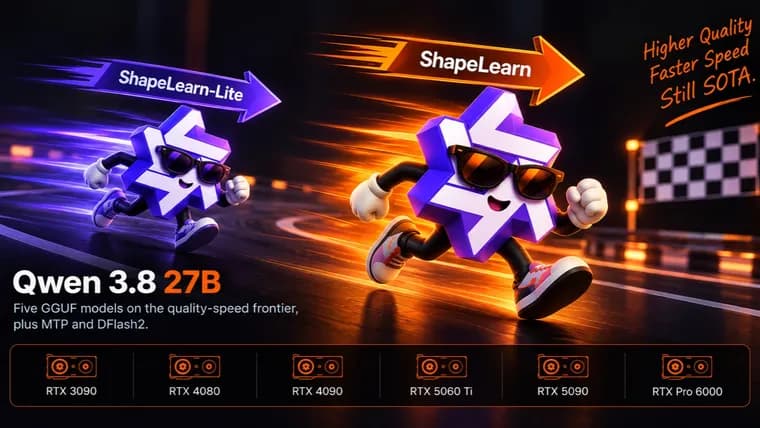
Qwen 3.8 27B came out on August 14, 2026. Four days later, ByteShape published a first set of quantized GGUFs it called ShapeLearn-Lite, built on a smaller optimization budget and fewer checks because the team wanted something usable fast. It has now finished the full ShapeLearn run: five models, benchmarked alongside Lite and against competing quantizations from Unsloth (Dynamic v3), ISTA-DASLab, Bartowski and AtomicChat, across six GPU tiers from 16 GB to 96 GB of VRAM (RTX 5060 Ti, RTX 4080, RTX 3090, RTX 4090, RTX 5090, RTX Pro 6000).
All five full ShapeLearn models sit on what ByteShape calls the measured quality-speed frontier in every one of the six GPU comparisons, meaning no other plotted model in that comparison is both faster and more accurate. GPU-5, ByteShape's default recommendation wherever it fits, reaches 99.63% of the BF16 baseline's aggregate benchmark score at 13.1 GB of VRAM, hitting 90.4 tok/s on the RTX Pro 6000 and 93.7 tok/s on the RTX 5090. GPU-4 trades a little accuracy for size and speed: 98.72% of BF16 at 11.0 GB. On the RTX 3090, moving from GPU-4 to GPU-5 costs about 7.5% in throughput (49.5 versus 45.8 tok/s) for the score to rise from 98.72% to 99.63%; on the RTX 4090 GPU-5 reaches 59.2 tok/s; on the 16 GB tier, GPU-4 leads on both the RTX 4080 (52.4 versus 45.7 tok/s) and the RTX 5060 Ti (33.1 versus 29.1 tok/s).
ByteShape also revisited how Lite held up. Unsloth's Dynamic v3 release had scored better than Lite on KLD, a measure of how much a quantized model's predicted token distribution diverges from the BF16 reference. Unsloth's UD-IQ3_S showed about 20% lower KLD than the similarly sized Lite-1 model (0.028759 versus 0.035875), which looked like a win for Unsloth. But UD-IQ3_S's actual aggregate benchmark score came in lower: 95.55% of BF16 versus Lite-1's 97.33%. ByteShape takes this as confirmation that KLD, however useful for spotting large fidelity changes, is not a reliable proxy for task performance; a related paper of theirs on this exact question was accepted to the EMNLP Industry Track. Looked at against the full field rather than Lite alone, three of Lite's six models still sit on the Lite-versus-Unsloth frontier, alongside three of Unsloth's twelve; once the five full ShapeLearn models are added back in, they take over the entire frontier.
Both GGUF releases bundle Multi-Token Prediction (MTP) speculative decoding, and a separate DFlash2 draft model is available for llama.cpp b10658 or newer. Tested with 3 draft tokens for MTP and 7 for DFlash2, both lifted throughput on every ShapeLearn model on every GPU: DFlash2 reached 1.34 to 2.10 times baseline next-token throughput, MTP 1.28 to 1.66 times. DFlash2 is usually the faster of the two but needs roughly 1.1 GB of extra GPU memory for its separate 4-bit draft model and does not support image inputs in llama.cpp; MTP's weights add only about 250 MB and are not loaded at all if MTP is unused. Benchmarks (GSM8K, IFEval, MMLU, LiveCodeBench V6, Multi-IF, ACEBench, HumanEval, BFCL V4) were run on llama.cpp b10430 with Qwen's own recommended sampling settings, and each quantized model's score is normalized against its own BF16 baseline. No pricing or licensing terms for the GGUFs are given in the post.
Key facts
- ByteShape released the full ShapeLearn quantization set for Qwen 3.8 27B, five models benchmarked across six GPU tiers from 16 GB to 96 GB, as a follow-up to its faster, smaller-budget ShapeLearn-Lite release from four days after Qwen 3.8 27B's August 14, 2026 launch.
- All five full ShapeLearn models sit on the measured quality-speed frontier on every one of the six tested GPUs; the default GPU-5 model reaches 99.63% of the BF16 baseline's aggregate score at 13.1 GB VRAM, and GPU-4 reaches 98.72% at 11.0 GB.
- Unsloth's UD-IQ3_S had about 20% lower KLD than ShapeLearn-Lite's Lite-1 (0.028759 versus 0.035875), yet scored lower on ByteShape's actual benchmarks (95.55% versus 97.33% of BF16), which ByteShape cites as evidence that KLD does not reliably predict task performance.
- Both MTP and DFlash2 speculative decoding raised throughput on every ShapeLearn model on every GPU tested: DFlash2 reached 1.34 to 2.10x baseline next-token throughput versus MTP's 1.28 to 1.66x, but DFlash2 needs about 1.1 GB more GPU memory and does not support image inputs in llama.cpp.
- The benchmark comparison also includes quantizations from Unsloth, ISTA-DASLab, Bartowski and AtomicChat; Bartowski's newest models were released after ByteShape's testing and were not included.
Why it matters
ByteShape's first pass at quantizing Qwen 3.8 27B, ShapeLearn-Lite, was deliberately rushed: a smaller optimization budget and fewer checks so users could run the model on 12 to 24 GB GPUs within days of its release. The full ShapeLearn run, finished afterward, measurably improves on that: all five new models land on the quality-speed frontier across all six GPU tiers ByteShape tested, with the default GPU-5 model reaching 99.63% of the uncompressed BF16 model's aggregate benchmark score.
Who it affects
Anyone running Qwen 3.8 27B locally with llama.cpp, from 16 GB cards (RTX 4080, RTX 5060 Ti) up to a 96 GB RTX Pro 6000. It also matters to other quantization teams and their users: the post benchmarks ByteShape's models directly against Unsloth's Dynamic v3, ISTA-DASLab, Bartowski and AtomicChat releases of the same base model.
How to use it
ByteShape gives ready llama-server commands: pull the GGUF tagged for a given GPU (for example Qwen3.8-27B-IQ4_XS-3.84bpw for GPU-5) with either the bundled MTP draft head (--spec-type draft-mtp --spec-draft-n-max 3) or the separate DFlash2 draft model (--spec-type draft-dflash --spec-draft-n-max 7, requiring llama.cpp b10658 or newer). GPU-5 is ByteShape's default pick wherever it fits; GPU-4 is the fallback when VRAM is tight, at a small accuracy cost. No pricing or licensing terms for the GGUFs are stated in the post.
How solid is it
The numbers come entirely from ByteShape's own benchmarking: GSM8K, IFEval, MMLU, LiveCodeBench V6, Multi-IF, ACEBench, HumanEval and BFCL V4, run on llama.cpp b10430 with Qwen's recommended sampling parameters and each score normalized against that model's own BF16 baseline. ByteShape's broader argument, that its revised KLD metric does not track task performance well on its own, has independent backing: a related paper was accepted to the EMNLP Industry Track. The frontier comparisons against Unsloth, ISTA-DASLab and AtomicChat are ByteShape's own plots, not a third-party evaluation.
Risks and caveats
The whole comparison is self-published and self-benchmarked; there is no independent replication of the frontier claims in the post. Bartowski's latest models came out after ByteShape's testing window and are missing from the comparison entirely, so the frontier picture is incomplete for that competitor. DFlash2 buys more throughput than MTP but costs roughly 1.1 GB of extra GPU memory and drops image-input support in llama.cpp, so the right choice depends on whether VRAM or multimodal input matters more for a given setup.
“If lower KLD were sufficient to rank these models by task performance, the benchmark ordering should have followed it. It did not.”
— ByteShape