Capability-driven data infrastructure trains 3B and 6B image generation models
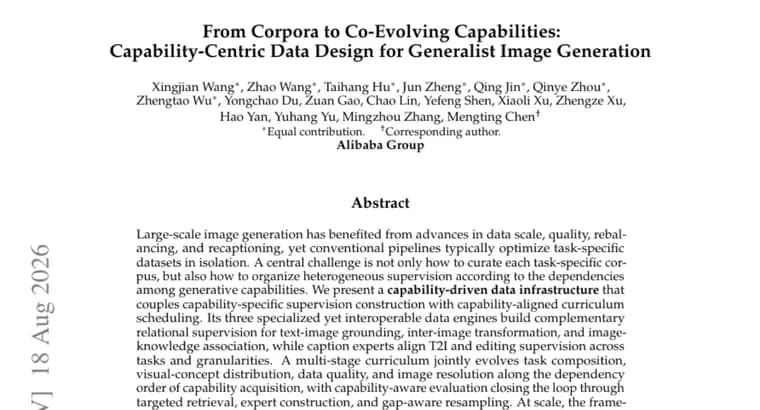
Large-scale image generation has benefited from advances in data scale, quality, rebalancing, and recaptioning, but conventional pipelines typically optimize task-specific datasets in isolation. The researchers frame the central challenge as twofold: not only how to curate each task-specific corpus, but also how to organize heterogeneous supervision according to the dependencies among generative capabilities.
To address this, they present a capability-driven data infrastructure that couples capability-specific supervision construction with capability-aligned curriculum scheduling. The system runs on three specialized, interoperable data engines that build complementary relational supervision: one for text-image grounding, one for inter-image transformation, and one for image-knowledge association. Caption experts then align text-to-image and editing supervision across tasks and levels of detail.
A multi-stage curriculum jointly evolves task composition, the distribution of visual concepts, data quality, and image resolution, following the dependency order in which capabilities are acquired. Capability-aware evaluation closes the loop through targeted retrieval, expert construction, and gap-aware resampling.
At scale, the framework curates a 440M-image text-to-image corpus, 120M editing pairs, and over 27M image-entity pairs. Using this infrastructure, the researchers train multimodal diffusion models at two sizes from scratch, 3B and 6B parameters. They evaluate the models quantitatively on a benchmark called CPI-Bench, alongside qualitative evaluations across a range of text-to-image and editing scenarios, reporting broad visual coverage, versatile rendering, and effective transfer across generative capabilities. The abstract does not give specific numeric scores for either evaluation or compare the models to any named competing system.
Key facts
- The framework curates a 440M-image text-to-image corpus, 120M editing pairs, and over 27M image-entity pairs.
- Two multimodal diffusion models are trained from scratch using this infrastructure, at 3B and 6B parameters.
- Three specialized data engines build relational supervision for text-image grounding, inter-image transformation, and image-knowledge association.
- A multi-stage curriculum jointly evolves task composition, visual-concept distribution, data quality, and image resolution along the dependency order of capability acquisition.
- Quantitative evaluation runs on a benchmark called CPI-Bench, plus qualitative evaluation across text-to-image and editing scenarios, but the abstract gives no specific numeric scores.
Why it matters
Most large-scale image generation pipelines build separate datasets for separate tasks, such as text-to-image generation, editing, and knowledge-grounded generation, then train on them with little regard for how those capabilities depend on one another. This work treats data curation itself as the bottleneck: it organizes supervision by capability dependency and evolves the training curriculum stage by stage, across task mix, visual concepts, data quality, and image resolution, rather than optimizing each task-specific corpus on its own. That reframes generalist image generation as a data-engineering and scheduling problem as much as a modeling one.
Who it affects
This is aimed at teams building or training generalist image and multimodal diffusion models, not end users of image tools. It matters most to researchers and engineers who curate large multimodal training corpora and design curriculum schedules, and to anyone tracking how text-to-image, image-editing, and image-knowledge capabilities can be trained together instead of as separate pipelines. The abstract names no individual authors or institutions, so it is not possible to say which lab or company is behind the work from this source alone.
How to use it
The paper describes an infrastructure and training methodology, not a released product. The abstract does not state whether the code, the trained 3B and 6B model weights, or the curated datasets, the 440M-image corpus, 120M editing pairs, and 27M image-entity pairs, are released or open-sourced, so at this point the practical use is reading the methodology rather than running the models.
How solid is it
The claims rest on both quantitative and qualitative evaluation: the models are scored on a benchmark called CPI-Bench and assessed qualitatively across a range of text-to-image and editing scenarios, with reported results described as broad visual coverage, versatile rendering, and effective transfer across generative capabilities. The abstract does not give specific numeric scores for either evaluation, does not define what CPI-Bench measures beyond naming it as the quantitative benchmark, and does not compare the models against any named competing system, so the strength of the results cannot be checked from this source alone.
Risks and caveats
Beyond the evaluation gaps noted above, the abstract gives no detail on training compute, hardware, or cost, and no publication or release date. It also does not name individual authors or institutions, and does not say whether the code, model weights, or curated datasets are released. Until those details surface, the work is verifiable only as a methodology description, not as a reproducible or independently checked result.