CarryOn harness cuts a robot VLA's violation rate from 52.6% to 6.1%
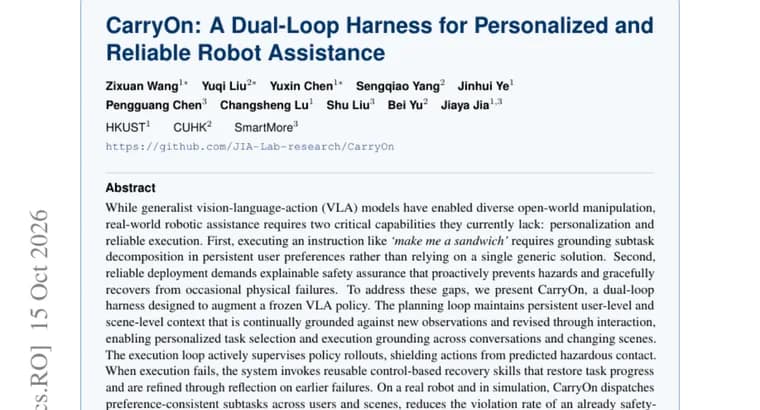
A new paper presents CarryOn, a harness built around a frozen vision-language-action (VLA) policy, the kind of generalist model that has made open-world robot manipulation possible. The authors argue that such models still lack two things that real-world robotic assistance requires: personalization and reliable execution.
On personalization, the paper's example is an instruction like "make me a sandwich". Doing it well means breaking the task into subtasks according to persistent user preferences, not following one generic recipe. On reliability, the authors say deployment demands explainable safety assurance that prevents hazards in advance and recovers gracefully from occasional physical failures.
CarryOn answers with two loops. The planning loop keeps persistent user-level and scene-level context. That context is continually grounded against new observations and revised through interaction, which lets the system choose tasks in a personalized way and ground execution across conversations and changing scenes. The execution loop actively supervises the policy's rollouts and shields actions from predicted hazardous contact. When execution still fails, the system calls reusable control-based recovery skills that restore task progress. These skills are refined through reflection on earlier failures.
The authors report results on a real robot and in simulation. CarryOn dispatches preference-consistent subtasks across users and scenes. It reduces the violation rate of an already safety-finetuned VLA from 52.6% to 6.1%. And it raises recovery success from 13% to 80% when the refined skills are reused.
Key facts
- CarryOn is a dual-loop harness that augments a frozen VLA policy, so the underlying policy itself is not changed.
- The planning loop keeps persistent user-level and scene-level context, grounded against new observations and revised through interaction, to pick personalized tasks.
- The execution loop supervises policy rollouts and shields actions from predicted hazardous contact; failures trigger reusable control-based recovery skills refined by reflecting on earlier failures.
- Reported on a real robot and in simulation: the violation rate of an already safety-finetuned VLA drops from 52.6% to 6.1%.
- Recovery success rises from 13% to 80% when refined skills are reused.
Why it matters
The paper targets a gap the authors see in generalist VLA models: they handle diverse manipulation but do not adapt to individual users and cannot guarantee safe, recoverable execution. CarryOn tries to close that gap without touching the policy, by adding structure around it. The headline number is aimed at a hard baseline: the 52.6% to 6.1% drop in violation rate is measured on a VLA that was already safety-finetuned.
Who it affects
Robotics researchers working on VLA policies and on assistive or home robots are the direct audience. The personalization side concerns people who would give a robot repeated instructions across conversations and changing scenes, where the same request such as "make me a sandwich" should resolve differently for different users.
How to use it
The design is a wrapper: a planning loop that holds user and scene context, and an execution loop that supervises rollouts and calls recovery skills, both placed around a frozen VLA policy. Because the policy stays frozen, the approach is described as an add-on to an existing model rather than a replacement. No code release, dataset, or submission date is mentioned in the source.
How solid is it
The results are the authors' own claims, reported on a real robot and in simulation. The source does not say whether the 52.6% to 6.1% and 13% to 80% figures come from the real robot, the simulation, or both. It also does not define a "violation" or "recovery success", and gives no number of users, scenes, tasks or trials. No comparison against other personalization or safety methods is given.
Risks and caveats
The headline figures cannot be interpreted fully without the missing details: what counts as a violation, how many trials were run, and which setting produced each number. No authors or institutions are named in the source, and no robot hardware, VLA model name, or simulator is named. The recovery gain of 13% to 80% applies when refined skills are reused, so it depends on the system having reflected on earlier failures first.