CoDA trains robot policy and simulation data engine together, lifting OOD success to 27.6%
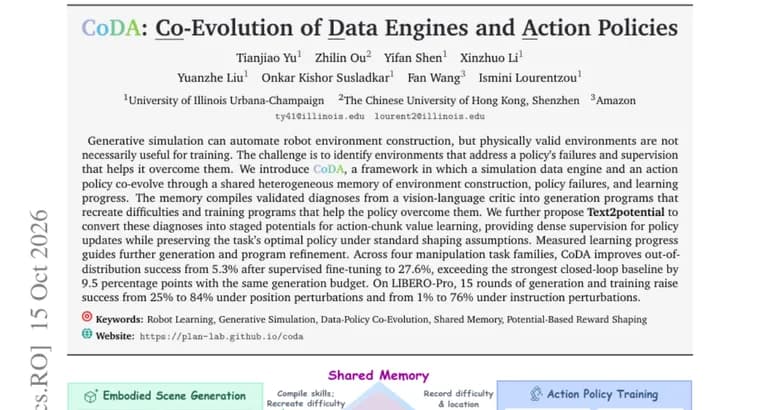
CoDA is a framework from a new preprint on generative simulation for robot learning. The starting point is a problem the authors name directly: generative simulation can automate the building of robot training environments, but physically valid environments are not necessarily useful for training. The hard part is to find environments that target a policy's actual failures, and supervision that helps the policy get past them.
CoDA's answer is to let a simulation data engine and an action policy co-evolve through a shared heterogeneous memory. The memory holds three kinds of information: how environments were constructed, where the policy failed, and how much learning progress has been made. A vision-language critic produces diagnoses of the policy's failures. Once validated, those diagnoses are compiled by the memory into two kinds of program: generation programs that recreate the difficulties the policy ran into, and training programs that help the policy overcome them. Measured learning progress then steers further generation and refinement of the programs, which closes the loop.
The paper also proposes Text2potential. It converts the critic's diagnoses into staged potentials for action-chunk value learning. This gives dense supervision for policy updates while preserving the task's optimal policy, under standard shaping assumptions.
The reported results come from two settings. Across four manipulation task families, CoDA raises out-of-distribution success from 5.3% after supervised fine-tuning to 27.6%. That is 9.5 percentage points above the strongest closed-loop baseline given the same generation budget. On LIBERO-Pro, 15 rounds of generation and training lift success from 25% to 84% under position perturbations, and from 1% to 76% under instruction perturbations.
Key facts
- CoDA lets a simulation data engine and a robot action policy co-evolve through a shared memory of environment construction, policy failures and learning progress.
- A vision-language critic's validated diagnoses are compiled into generation programs that recreate difficulties and training programs that help the policy overcome them.
- Across four manipulation task families, out-of-distribution success goes from 5.3% after supervised fine-tuning to 27.6%, 9.5 percentage points above the strongest closed-loop baseline at the same generation budget.
- On LIBERO-Pro, 15 rounds of generation and training raise success from 25% to 84% under position perturbations and from 1% to 76% under instruction perturbations.
- Text2potential turns the diagnoses into staged potentials for action-chunk value learning, preserving the task's optimal policy under standard shaping assumptions.
Why it matters
Automated environment generation is only useful if the environments teach the policy something it does not already know. CoDA treats this as a feedback problem: instead of generating scenes that are merely physically valid, it ties generation to the policy's diagnosed failures and to measured learning progress. The headline gain is out-of-distribution success rising from 5.3% to 27.6% across four manipulation task families, and the LIBERO-Pro jump under instruction perturbations, from 1% to 76%, is the largest single move reported.
Who it affects
Researchers working on robot manipulation, simulation-based data generation and policy training are the direct audience. The method is aimed at teams that already use generative simulation to build training environments and want those environments to follow what the policy gets wrong.
How to use it
The source is a paper abstract, and it describes a method rather than a product. No code or data release is mentioned. Practitioners can take the design pattern: diagnose failures with a vision-language critic, compile the diagnoses into generation and training programs, and let measured learning progress decide what to generate next.
How solid is it
The numbers are reported by the authors of the preprint itself. The comparison with the strongest closed-loop baseline uses the same generation budget, which makes the 9.5 percentage point margin a like-for-like claim on the authors' terms. The 5.3% and 27.6% figures are single aggregate numbers; no per-task-family breakdown is given. The names of the baselines and of the four task families are not given either. The LIBERO-Pro results are reported after 15 rounds of generation and training.
Risks and caveats
The abstract does not state the baseline's own out-of-distribution success rate, only the 9.5 percentage point gap. It does not say which policy model or vision-language critic is used, and the size of the generation budget is not given. No real-robot results are mentioned, and it does not say whether the evaluation is simulated or on physical hardware. The preserved-optimal-policy property of Text2potential holds under standard shaping assumptions, so it is conditional. Absolute out-of-distribution success of 27.6% also leaves most trials unsolved.
“physically valid environments are not necessarily useful for training”
— From the CoDA paper abstract