Data World synthesizes training environments for data agents
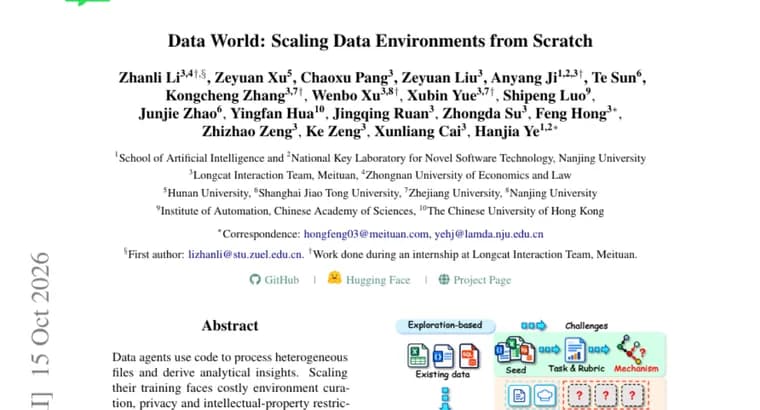
Data agents write code to process heterogeneous files and derive analytical insights. The authors say that scaling their training faces three obstacles: environment curation is costly, privacy and intellectual-property restrictions limit real data, and open-ended findings are hard to verify when there is no known generative truth.
Their answer is Data World, a multi-agent engine that synthesizes environments, tasks and rubrics from explicit mechanisms. The core insight, in the authors' words, is to specify the world behind the files before generating the files themselves. Independent audits then check that the target is recoverable from the observed files, and the rubrics serve both for evaluation and as RL rewards.
The engine produces two sets of material. For evaluation, human preference-based curation for question realism selects 100 tasks across 50 held-out worlds and 16 domains; this is DataWorld-Bench. For training, the engine yields 2,135 tasks from 1,037 disjoint worlds.
The authors evaluated ten frontier models on the benchmark and report that it remains challenging, particularly for insight discovery, with a consistent computation-insight gap.
They then ran RL-zero training on the synthesized tasks, without trajectory distillation, starting from Qwen3.6-35B-A3B. The result is DataWorld-35B-A3B. Under matched evaluation, it improves over its base by 7.06 points on DataWorld-Bench, 14.28 on DAComp, 20.90 on DABstep-Hard and 12.13 on JobBench, which the source describes as a broader occupational benchmark.
Key facts
- Data World is a multi-agent engine that synthesizes environments, tasks and rubrics for training and evaluating data agents, starting from the world behind the files rather than the files themselves.
- DataWorld-Bench holds 100 tasks across 50 held-out worlds and 16 domains, chosen by human preference-based curation for question realism; the engine also yields 2,135 training tasks from 1,037 disjoint worlds.
- Ten frontier models were evaluated; the authors say the benchmark remains challenging, especially for insight discovery, with a consistent computation-insight gap.
- RL-zero training without trajectory distillation turns Qwen3.6-35B-A3B into DataWorld-35B-A3B.
- Under matched evaluation the model gains 7.06 points on DataWorld-Bench, plus 14.28 on DAComp, 20.90 on DABstep-Hard and 12.13 on JobBench.
Why it matters
Training data agents needs environments where an analytical finding can be checked. Real datasets are costly to curate, often restricted by privacy and intellectual property, and rarely come with a known truth behind an open-ended insight. Data World tries to get around this by fixing the underlying world first and generating the files from it, so the answer is known by construction. If that holds up, it offers a way to scale training tasks without relying on private data.
Who it affects
Researchers building and evaluating data agents, meaning systems that use code to work through heterogeneous files and produce analytical insights. Teams that train such agents with reinforcement learning are the most direct audience, since the engine supplies both tasks and rubric-based rewards.
How to use it
The abstract describes a pipeline: synthesize worlds, tasks and rubrics, audit that targets are recoverable, then use the rubrics for evaluation or as RL rewards. No release date, code, dataset or model-weights availability is stated, so there is nothing to download or run based on the source alone.
How solid is it
This is a preprint listed on Hugging Face Papers, and the account here rests on its abstract. The claims are the authors' own. The improvements are reported as gains over the base model under matched evaluation. The source says 'points' only for DataWorld-Bench; for DAComp, DABstep-Hard and JobBench it gives bare numbers, and does not say whether they are relative percentages. Absolute scores of the base model and of DataWorld-35B-A3B are not given, only the improvements.
Risks and caveats
The abstract does not state whether the model beats any frontier model, only that it improves over its base. The names of the ten frontier models and their individual scores are not given, and the size of the computation-insight gap is not quantified. The abstract also does not list the 16 domains or describe the number or roles of the agents in the engine. The abstract names no authors or institutions.
“Our core insight is to specify the world behind the files before generating the files themselves.”
— From the Data World abstract