Cliff beats on-policy distillation by 15% at teaching LLMs to reason
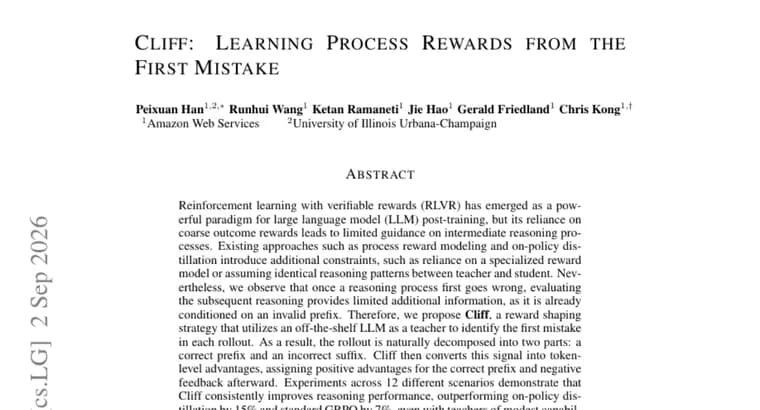
Reinforcement learning with verifiable rewards, or RLVR, has become a common way to train large language models to reason, but it typically scores only the final answer as right or wrong. That leaves the model with little guidance about which of its intermediate reasoning steps were actually sound. Two existing fixes each add a cost of their own. Process reward modeling needs a separate, specially trained reward model to judge each step. On-policy distillation assumes the teacher model doing the judging reasons the same way as the student model being trained, which is not always true.
A new paper, Cliff: Learning Process Rewards from the First Mistake, starts from a different observation: once a chain of reasoning goes wrong at some point, grading the steps that follow adds little extra information, because they are already built on a broken premise. Cliff turns that observation into a training method. It uses an off-the-shelf LLM as a teacher whose only job is to find the first mistake in a given reasoning rollout. That single point splits the rollout into two parts, a correct prefix up to the mistake and an incorrect suffix after it. Cliff then converts this split into token-level advantages: positive for every token in the correct prefix, negative for every token in the incorrect suffix.
Tested across 12 different scenarios, Cliff consistently improved reasoning performance, outperforming on-policy distillation by 15% and standard GRPO by 7%. The improvement held up even when the teacher LLM used to spot the first mistake was itself only modestly capable, so Cliff does not need an especially strong or specialized judge to work. The authors say they also analyzed the role of ground truth in Cliff and studied its training dynamics, though they do not state what that analysis found. They do not name the specific benchmarks, task domains, or the teacher and student models behind the 12 scenarios, and they give no absolute accuracy or reward numbers for Cliff or either baseline, only the relative 15% and 7% gains; nor do they mention any code or data release.
Key facts
- Cliff is a reward-shaping method for RLVR that uses an off-the-shelf LLM as a teacher to find the first mistake in each reasoning rollout, rather than training a dedicated reward model.
- It splits every rollout into a correct prefix, up to that first mistake, and an incorrect suffix after it, then assigns positive token-level advantages before the mistake and negative ones after.
- Across 12 different scenarios, Cliff outperformed on-policy distillation by 15% and standard GRPO by 7%.
- The improvement held even when the teacher LLM spotting the mistakes was only modestly capable.
- The authors also studied the role of ground truth in Cliff and its training dynamics, but the abstract does not say what they found.
Why it matters
Reinforcement learning with verifiable rewards, RLVR for short, is now a common way to make large language models better at multi-step reasoning, but it typically scores only the final answer, right or wrong. That leaves the model with little signal about which of its intermediate steps were actually sound. Two existing fixes each add a cost: process reward modeling needs a separate, specially trained reward model, and on-policy distillation assumes the teacher model reasons the same way the student does. Cliff sidesteps both constraints with a simpler idea: once a reasoning chain goes wrong at some step, everything after that point is already built on a broken premise, so scoring it in detail adds little. Finding just the first mistake, with an ordinary off-the-shelf LLM as judge, turns out to be enough to shape useful rewards.
Who it affects
This is a research method for teams that train reasoning models with RLVR-style pipelines, not a consumer product. It matters most to researchers and engineers building or fine-tuning reasoning-focused LLMs who currently rely on outcome-only rewards, a dedicated process reward model, or on-policy distillation, and who are looking for a cheaper source of step-level supervision.
How to use it
Cliff is meant to work as a reward-shaping layer inside an existing RLVR training loop. Instead of training a specialized reward model, a team points an off-the-shelf LLM at each rollout and asks it to find the first mistake; the rollout then splits into a correct prefix and an incorrect suffix, and the token-level advantage is set positive before the mistake and negative after it. The abstract does not mention any code or data release, so there is no public implementation to point to yet.
How solid is it
The evidence is the authors' own experiments across 12 different scenarios, where Cliff consistently beat on-policy distillation by 15% and standard GRPO by 7%, including when the teacher LLM doing the mistake-spotting was itself only modestly capable. The abstract does not name the specific benchmarks, task domains, or the teacher and student models behind those 12 scenarios, and it gives no absolute accuracy or reward numbers, only the relative gains. It also names no individual authors or institutional affiliation; a submitter name accompanies the paper's listing, but that is platform metadata, not a statement inside the abstract itself. These are the authors' own reported results, with no independent replication mentioned.
Risks and caveats
Because the first mistake is identified by an LLM judge rather than a fixed rule, any blind spot or bias in that judge's own reasoning would feed directly into the reward signal, and the abstract gives no detail on how reliable that judgment is. The authors say they analyzed the role of ground truth in Cliff and studied its training dynamics, but they do not say what that analysis found, so it is unclear how the method behaves over longer training runs or on reasoning domains outside the 12 tested scenarios.
“We observe that once a reasoning process first goes wrong, evaluating the subsequent reasoning provides limited additional information, as it is already conditioned on an invalid prefix.”
— the authors, in the paper's abstract