CORE distills reranker judgments into MLLM embeddings, beats Jina-Reranker by 10.7 points
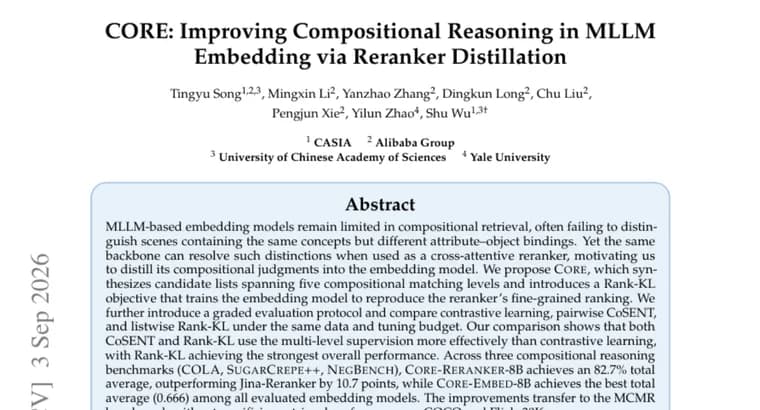
MLLM-based embedding models remain limited in compositional retrieval: they often fail to distinguish scenes that contain the same concepts but bind attributes to objects differently. The same backbone model can resolve those distinctions when it is used instead as a cross-attentive reranker. That gap, between what the backbone can do as a reranker and what it can do as an embedding model, motivated a new method called CORE, which distills the reranker's compositional judgments into the embedding model.
CORE synthesizes candidate lists spanning five compositional matching levels, then trains the embedding model with a new objective, Rank-KL, designed to make it reproduce the reranker's fine-grained ranking. The authors also introduce a graded evaluation protocol and use it to compare this listwise Rank-KL objective against pairwise CoSENT and standard contrastive learning, all under the same training data and tuning budget. Both CoSENT and Rank-KL make better use of the multi-level supervision than contrastive learning does, and Rank-KL performs best overall.
Across three compositional reasoning benchmarks, COLA, SUGARCREPE++ and NEGBENCH, CORE-RERANKER-8B reaches an 82.7% total average, 10.7 points ahead of Jina-Reranker on the same benchmarks. CORE-EMBED-8B, the embedding-model counterpart, posts the best total average (0.666) among all the embedding models evaluated in the study.
The improvements also transfer to a further benchmark, MCMR, without sacrificing standard retrieval performance on COCO and Flickr30K.
Key facts
- CORE distills a cross-attentive reranker's compositional judgments into MLLM-based embedding models, using a new listwise objective called Rank-KL.
- Candidate lists are synthesized across five compositional matching levels; under the same data and tuning budget, both Rank-KL and pairwise CoSENT beat standard contrastive learning, with Rank-KL performing best overall.
- On three compositional reasoning benchmarks, COLA, SUGARCREPE++ and NEGBENCH, CORE-RERANKER-8B posts an 82.7% total average, 10.7 points ahead of Jina-Reranker.
- CORE-EMBED-8B reaches the best total average (0.666) among all evaluated embedding models on the same benchmarks.
- The gains transfer to the MCMR benchmark without sacrificing standard retrieval performance on COCO and Flickr30K.
Why it matters
Embedding models retrieve items with a single vector-similarity comparison, while cross-attentive rerankers score each query-candidate pair jointly and so only scale to reranking a short list, not to searching a full collection. The paper's central observation is that the same backbone model resolves compositional attribute-object distinctions correctly as a reranker but not as an embedding model. CORE targets that specific gap: it trains the embedding model, through the Rank-KL objective, to reproduce the reranker's compositional judgments.
Who it affects
Teams building multimodal search or retrieval on MLLM embeddings, such as image-text search, RAG-style retrieval over mixed media, or dataset curation, are the direct audience: getting the attribute-object pairing wrong is a real failure mode for exactly these systems. It also concerns anyone using Jina-Reranker as a compositional-accuracy baseline, since CORE-RERANKER-8B is reported 10.7 points ahead of it. And it concerns researchers who track the COLA, SUGARCREPE++, NEGBENCH and MCMR benchmarks the paper uses.
How to use it
The text gives no code, weights or license, so there is nothing here to run or reproduce yet. Mechanically, the recipe is to use the same MLLM backbone as a cross-attentive reranker to synthesize candidate lists spanning five compositional matching levels, then fine-tune it as an embedding model against those rankings with the Rank-KL objective. The model names, CORE-RERANKER-8B and CORE-EMBED-8B, carry an '8B' suffix that the text does not explain, so their scale is not confirmed by this material.
How solid is it
The three-way training comparison is controlled: contrastive learning, pairwise CoSENT and listwise Rank-KL are all trained on the same data with the same tuning budget. Results are also checked well beyond the three benchmarks used for the headline numbers, extending to a further benchmark, MCMR, and to two standard retrieval benchmarks, COCO and Flickr30K, to confirm nothing regresses. Some gaps limit how far the headline numbers can be read, though. The text gives only a total average per benchmark group, not a per-benchmark breakdown, and does not say how that total average is computed, nor does it give absolute scores for the contrastive-learning and CoSENT baselines, only their ranking behind Rank-KL. And for CORE-EMBED-8B's leading score of 0.666, the text does not name which other embedding models were evaluated, so 'best among all evaluated embedding models' cannot be checked against a named field the way the Jina-Reranker comparison can.
Risks and caveats
No publication venue or date is given, so whether these results have been externally reviewed is not stated here. The two headline scores also sit on different scales and should not be treated as comparable: CORE-RERANKER-8B's 82.7% total average is a percentage, while CORE-EMBED-8B's leading 0.666 total average among embedding models is reported as a bare decimal rather than a percentage.