Code-as-World turns physical scenes into executable code for reasoning
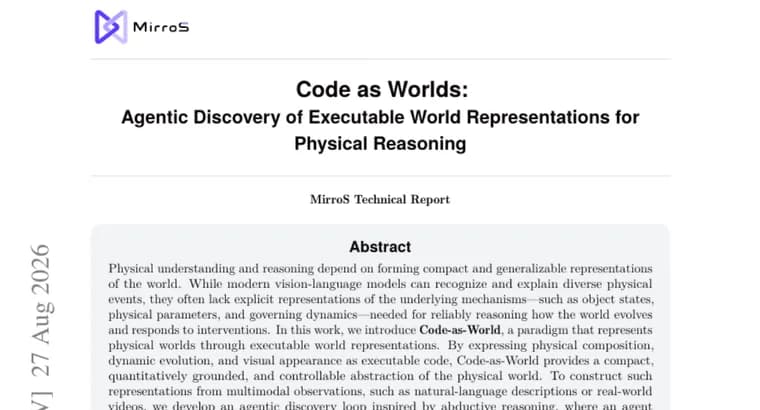
Researchers have introduced Code-as-World, a paradigm for representing physical worlds as executable code rather than as natural-language descriptions or pixels. The authors argue that today's vision-language models can recognize and explain physical events but often lack explicit representations of the underlying mechanisms, such as object states, physical parameters, and governing dynamics, that are needed to reliably reason about how a scene will evolve or respond to an intervention. Code-as-World addresses this by expressing physical composition, dynamic evolution, and visual appearance as code that can be run, which the authors say yields a compact, quantitatively grounded, and controllable abstraction of a physical scene.
To build these executable representations from real inputs such as natural-language descriptions or real-world videos, the team built an agentic discovery loop modeled on abductive reasoning: an agent proposes a candidate world hypothesis expressed as code, executes it, renders the result, verifies it against the observation, and iteratively refines the hypothesis until it holds up. As an application of this method, the authors used the verified executable worlds it produces as a source of scalable physical supervision to train a vision-language model, Code-as-World-VL, for quantitative physical reasoning. In experiments, Code-as-World-VL reaches state-of-the-art performance on the QuantiPhy benchmark and surpasses leading proprietary models, which the authors present as evidence that executable world representations can serve as a scalable foundation for physical intelligence. The abstract does not give the specific numeric scores or margins behind that result, name the authors' institutions, or state a publication venue or release plans for code, model, or data.
Key facts
- Code-as-World represents physical worlds as executable code, capturing physical composition, dynamic evolution, and visual appearance so scenes can be simulated and checked rather than just described.
- An agentic discovery loop, inspired by abductive reasoning, has an agent propose, execute, render, verify, and iteratively refine executable world hypotheses from inputs like natural-language descriptions or real-world videos.
- The verified executable worlds are used as scalable physical supervision to train a vision-language model called Code-as-World-VL for quantitative physical reasoning.
- Code-as-World-VL achieves state-of-the-art performance on the QuantiPhy benchmark and surpasses leading proprietary models, according to the authors.
- The published abstract does not include numeric scores, author affiliations, a publication venue, or any statement on code or data release.
Why it matters
Vision-language models are generally good at describing what is happening in a physical scene but weak at predicting how it will change, because they have no explicit model of the physics involved. Code-as-World tries to close that gap by making the world representation itself executable code: something that can be run, rendered, and checked against reality, rather than a fuzzy internal representation. That reframes physical reasoning as a discovery problem an agent can iterate on, rather than something a model has to get right in one shot from a prompt.
Who it affects
This is research aimed at people building or studying vision-language models for physical and quantitative reasoning: robotics, simulation, and embodied-AI researchers who need models to predict physical outcomes, not just recognize them. It is not a consumer-facing release.
How to use it
The abstract does not state that code, model weights, or data have been released, and gives no publication venue or date, so there is nothing here yet for practitioners to run. The work is presented as a paradigm plus a proof-of-concept model, Code-as-World-VL, trained using this method.
How solid is it
The central evidence offered is a benchmark result: Code-as-World-VL reaches state-of-the-art performance on QuantiPhy and beats leading proprietary models, according to the authors. The abstract does not provide the actual scores, margins, or details of QuantiPhy itself, such as what it measures or how large it is, so the size of the improvement cannot be assessed from what is available.
Risks and caveats
The claims here come from the authors' own abstract, with no independent verification, no reported numbers to check, and no stated author affiliations or publication venue. Benchmark superiority against proprietary models is a self-reported comparison, and without access to QuantiPhy's design or the underlying scores, readers cannot judge how meaningful or generalizable the result is.
“Code-as-World provides a compact, quantitatively grounded, and controllable abstraction of the physical world.”
— the authors