CoinVE-200K dataset debuts for compositional video editing
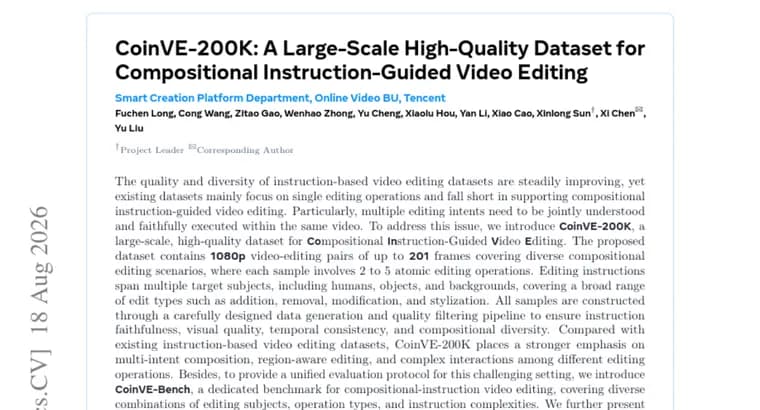
Video-editing datasets built around natural-language instructions have been steadily improving, but most cover single editing operations only: one instruction, one change to the clip. A new paper argues that leaves a real gap, because multiple editing intents must be jointly understood and faithfully executed within the same video, and existing datasets fall short of supporting that. To close the gap, the authors introduce CoinVE-200K, a large-scale dataset built specifically for compositional instruction-guided video editing.
CoinVE-200K consists of 1080p video-editing pairs, each up to 201 frames long. Every sample is built around a compositional scenario made of 2 to 5 atomic editing operations applied to the same clip, touching people, objects and backgrounds, and drawing on edit types such as addition, removal, modification and stylization. The name points to a dataset on the order of 200,000 pairs, though the paper's own text does not restate an exact sample count as a numeral anywhere. Every sample passes through what the authors call a carefully designed generation and filtering pipeline, meant to keep the instructions faithfully followed, the visual quality high, the video temporally consistent, and the samples compositionally diverse.
Alongside the dataset, the paper introduces CoinVE-Bench, a benchmark built to test compositional-instruction video editing across a range of subjects, operation types and levels of instruction complexity.
The authors also present CoinVE-Edit, a 22B compositional video editing model built on top of two existing models, Wan2.1-T2V-14B and Qwen3-VL-8B-Instruct. Its central design choice is disentangled, region-aware attention: the model handles the instructions for different regions of a frame separately, which lets it make precise edits across several parts of a video at once while leaving unrelated content, and the video's temporal coherence, intact.
On CoinVE-Bench, the authors report that CoinVE-Edit performs strongly on instruction following, compositional editing accuracy, visual quality and temporal consistency. The paper does not attach specific numbers to that performance claim, nor does it name a specific prior dataset or model it was compared against. It also gives no release date, code availability or dataset download link for CoinVE-200K, CoinVE-Bench or CoinVE-Edit.
Key facts
- CoinVE-200K is a new dataset of 1080p video-editing pairs, each up to 201 frames long, built for edits that combine 2 to 5 atomic operations in the same clip.
- Its edits touch people, objects and backgrounds, using operations such as addition, removal, modification and stylization, all produced through a generation and filtering pipeline rather than collected from real editors.
- The accompanying CoinVE-Bench benchmark tests compositional-instruction video editing across different subjects, operation types and instruction complexities.
- CoinVE-Edit, a 22B video editing model built on Wan2.1-T2V-14B and Qwen3-VL-8B-Instruct, uses region-aware attention to edit several parts of a frame at once without disturbing the rest.
- The paper reports CoinVE-Edit performs strongly on CoinVE-Bench across instruction following, editing accuracy, visual quality and temporal consistency, but gives no specific scores or baseline comparison.
Why it matters
Instruction-guided video editing has mostly meant one instruction, one change: swap a background, remove an object, restyle a clip. Real edit requests are rarely that narrow. The paper's own framing is direct about the gap: multiple editing intents must be jointly understood and faithfully executed within the same video, and existing datasets fall short of supporting that. CoinVE-200K is built around exactly that case, pairing videos with instructions that call for 2 to 5 edits at once, layered onto the same clip and touching people, objects and backgrounds together. The real news is less the dataset on its own and more the trio it arrives as: a dataset to train on, CoinVE-Bench to measure against, and CoinVE-Edit as a working model aimed at the same compositional problem end to end.
Who it affects
This is aimed at researchers and engineers building instruction-guided video editing systems, especially anyone working with Wan2.1-T2V-14B or Qwen3-VL-8B-Instruct, since CoinVE-Edit is built directly on top of both. It also matters to teams building AI video editing products: a dataset and benchmark aimed at compositional edits give them a concrete way to check whether a model can handle a request that bundles several changes, rather than the single-operation case most existing datasets cover. For people who eventually use such editing tools, the payoff this is working toward is software that takes one instruction covering several changes and gets all of them right in one pass, instead of forcing one edit at a time.
How to use it
The paper gives no release date for CoinVE-200K, CoinVE-Bench or the CoinVE-Edit model weights, and no code repository or dataset download link. There is no pricing or licence to speak of because there is nothing yet published to license: everything here is a description in the paper itself, not an artifact someone can pick up and run today.
How solid is it
The performance claims come entirely from the authors' own experiments on their own benchmark, CoinVE-Bench, the normal starting point for a new paper but not independent verification. The text states that CoinVE-Edit achieves strong performance in instruction following, compositional editing accuracy, visual quality and temporal consistency, but it attaches no number to any of those claims and names no specific prior dataset or model that CoinVE-Edit was measured against. The name CoinVE-200K points to a dataset on the order of 200,000 pairs, but the paper's own text never restates an exact sample count as a numeral.
Risks and caveats
Every sample in CoinVE-200K is built, not collected, through what the paper calls a carefully designed generation and filtering pipeline, so this is engineered data aimed at hitting specific quality and diversity targets rather than a record of how real editors actually phrase multi-part requests. Because the strong performance claimed for CoinVE-Edit is not backed by published numbers or an outside baseline, there is no way to judge from the paper alone how large an improvement it represents, or whether it holds up once the dataset, benchmark and model are examined outside the authors' own testing.