Context-Matched Distillation fixes a teacher-student mismatch in video generation
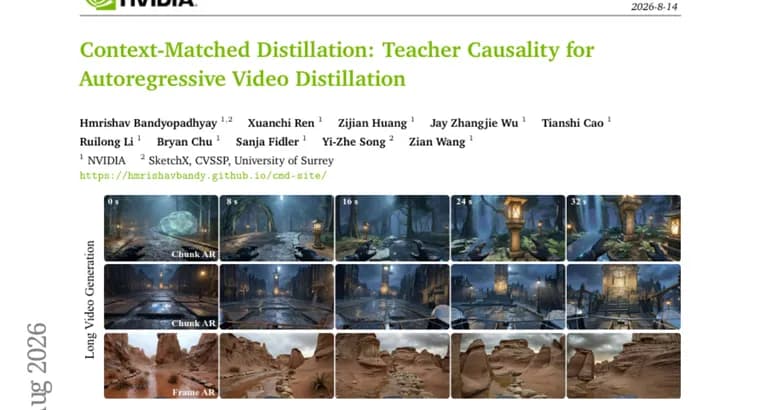
Interactive autoregressive video generation needs both low-latency rollouts and precise online control, the authors write. Few-step distillation, which speeds up generation by cutting the number of denoising steps, addresses the latency side. But online control imposes a causal constraint: each frame or block should depend only on the history and controls actually available at the moment it is generated. The authors argue that existing video distribution matching distillation (DMD) pipelines routinely break that constraint: they supervise a causal few-step student using a bidirectional teacher that scores a complete clip at once. Because that teacher can see the whole clip, its score for a given target can depend on future frames and controls the student did not have when it generated that target, misaligning the teacher's supervision with the student's own causal information.
The paper's proposed fix, Context-Matched Distillation (CMD), is a causal version of DMD that keeps the teacher's information matched to what the student actually had available at each step. Instead of a bidirectional teacher scoring the whole clip, CMD uses a causal teacher that evaluates each target frame without access to future frames or controls. That same causal teacher also initializes the few-step student, so teacher training, student distillation and inference all share one consistent causal formulation.
Two further mechanisms refine that alignment. Prefix Scoring matches supervision to the context the student actually experienced during generation, by evaluating each target under the specific prefix, cached from the student's own rollout, that produced it. Prefix Corruption then stabilizes training by perturbing the unreliable prefixes the student produces early in training, while still preserving the target-context alignment Prefix Scoring is built to protect.
Because the underlying formulation is simple and causal, the authors say CMD extends naturally to frame-wise and chunk-wise generation, long-video distillation, and camera-conditioned distillation. In experiments, the authors report state-of-the-art aggregate performance among autoregressive methods on both short- and long-video benchmarks, together with substantially improved adherence to time-varying camera controls. The paper does not name the specific benchmarks, does not give numeric scores behind the state-of-the-art claim, and does not name the prior methods it compares against beyond describing them generically as bidirectional teachers.
Key facts
- Existing few-step distillation pipelines for autoregressive video generation supervise a causal student using a bidirectional teacher that scores whole clips, so the teacher's score for a target can depend on future frames and controls the student never had access to.
- Context-Matched Distillation (CMD) replaces that bidirectional teacher with a causal one that evaluates each target frame without access to future frames or controls, and the same causal teacher initializes the few-step student.
- Prefix Scoring evaluates each target under the specific prefix the student itself generated on the way to producing it, rather than an idealized history, and Prefix Corruption perturbs unreliable early-training prefixes to stabilize training while preserving that alignment.
- The authors say CMD's simple causal formulation extends naturally to frame-wise and chunk-wise generation, long-video distillation, and camera-conditioned distillation.
- The authors report state-of-the-art aggregate performance among autoregressive methods on short- and long-video benchmarks and substantially improved adherence to time-varying camera controls, but the paper names no specific benchmark, baseline, or numeric score behind either claim.
Why it matters
Fast, interactive video generation and precise control over that generation are usually in tension: cutting denoising steps for low latency only helps if the resulting few-step model still obeys the controls it is given while running. The paper locates a specific cause of that tension in how these models are trained: the standard few-step distillation setup supervises a causal student with a teacher that is allowed to see an entire finished clip, including frames the student had not yet generated and controls it did not yet have access to. CMD's fix is to match the teacher's information exactly to what the student had at generation time, both by cutting off the future and, through Prefix Scoring, by using the student's own generated past rather than an idealized one. The authors say the resulting formulation is simple enough to extend to frame-wise and chunk-wise generation, long-video distillation, and camera-conditioned distillation without further redesign.
Who it affects
This is a method for researchers and engineers building or training autoregressive, few-step video generation models, especially ones meant to run under online control, including the time-varying camera controls the paper specifically tests. It is aimed at the video-distillation research community more broadly, since CMD is presented as a general causal replacement for bidirectional DMD-style teacher supervision rather than a fix built for one specific model or product.
How to use it
Context-Matched Distillation is presented as a training method for existing distillation pipelines, not as a released product. No code, model, or dataset release is mentioned in the text.
How solid is it
The headline results, state-of-the-art aggregate performance among autoregressive methods and substantially improved adherence to time-varying camera controls, both come from the authors' own experiments and are both stated only qualitatively: no percentage, score or margin is attached to either claim. The paper also does not name the specific short- or long-video benchmarks used, or the prior bidirectional-teacher methods it is compared against beyond that generic description, which limits how directly the comparison can be checked from the text alone.
Risks and caveats
The text gives no authors, institutions or publication venue, so there is no way to check the team's track record from this document alone. Prefix Corruption exists specifically because the student's own generated prefixes are unreliable early in training, which is the authors' own account of a stability problem their causal training approach has to work around. Until benchmark names, numbers or a release appear, the headline results should be read as the authors' own account of their own experiments.
“CMD replaces bidirectional full-clip scoring with a causal teacher that evaluates each target without access to future frames or controls.”
— the paper