CoolIT: past 250 kW per rack, AI servers need near-total liquid cooling
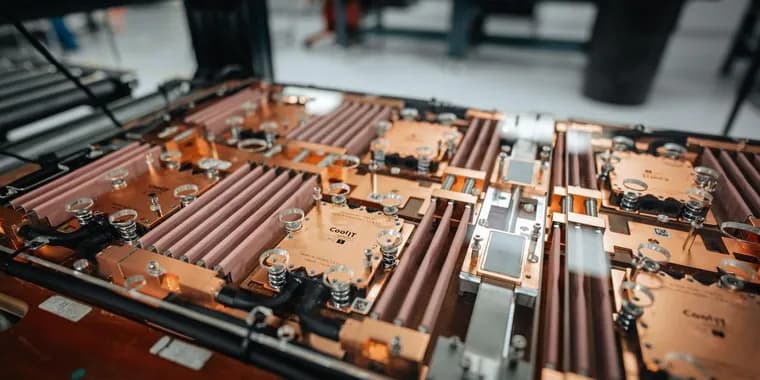
CoolIT, an Ecolab company that builds liquid-cooling hardware for AI and high-performance computing, lays out its case for fanless server design in sponsored content published via IEEE Spectrum. The core claim: beyond 250 kW per rack, a hybrid approach that splits cooling between liquid and air stops working. At that density, a 70/30 liquid-air split still leaves 75 kW of heat for air to remove from a single rack, and the parallel air-cooling system needed to move that much heat brings cost and complexity CoolIT says few operators will accept. Its proposed fix is near-total heat capture: liquid takes effectively all the heat load, air's share falls below 1 percent, and the server can run without fans.
The article frames this as a response to a broader shift. For years, cooling AI servers meant cooling the processor and letting air handle everything else. As chip thermal design power (TDP) keeps rising generation over generation, heat now cascades outward into memory, networking, storage, and power components that used to run fine on air. Because these peripherals come in varied shapes and thermal limits, CoolIT says they need purpose-built solutions rather than a design tuned only for CPUs and GPUs, drawing on conductive plates, vapor chambers, heat pipes, thermal transfer plates, and pluggable riding coldplates. The harder engineering problem, per the article, is not cooling each part individually but folding all of these solutions into one server loop with reliable connections, efficient coolant routing, and fast rack-integration assembly.
CoolIT says it already builds these loops from modular coldplate blocks that have been proven across six generations of fanless server designs. As overall rack power keeps climbing toward 1 MW, the company's modeling places full (near-total) heat capture as the standard design for flagship rack-scale products through 2028. The article does concede a technical nuance: true 100 percent heat capture is almost impossible to reach in the strictest sense, so the realistic and stated target is near-total capture, with air's share pushed under 1 percent.
The piece closes with CoolIT's own credentials as a sponsor: it describes itself as a global leader in liquid cooling for AI and HPC, says its direct liquid-cooling (DLC) systems are used in seven of the world's top 10 supercomputers and at many hyperscale cloud sites, and notes that in 2026 Data Center Magazine ranked it the number one direct-to-chip cooling company and among the top three cooling companies worldwide.
Key facts
- CoolIT says a hybrid liquid-air cooling approach stops working beyond 250 kW per rack, since a 70/30 liquid-air split at that density still leaves 75 kW of heat for air to remove.
- Its proposed alternative, near-total liquid heat capture, drops air's share of the load below 1 percent, letting AI servers run fanless.
- CoolIT says its modular coldplate blocks have been proven across six generations of fanless server designs, and its modeling puts full heat capture as the standard design for flagship rack-scale products through 2028.
- As chip TDP rises, the article says heat now cascades into memory, networking, storage and power components that previously ran on air, requiring purpose-built cooling (vapor chambers, heat pipes, thermal transfer plates) rather than a CPU/GPU-only design.
- As sponsor credentials, CoolIT states its DLC systems run in seven of the world's top 10 supercomputers, and that Data Center Magazine named it the number one direct-to-chip cooling company in 2026.
Why it matters
Rack power in AI data centers keeps climbing, and the article's central argument is that this trend has a hard physical breakpoint: past roughly 250 kW per rack, splitting cooling between liquid and air no longer works, because the air side alone would have to move 75 kW of heat. As racks push toward 1 MW, that makes near-total liquid heat capture, and fanless server design, a shift the article frames as moving from a premium option toward a mainstream engineering requirement.
Who it affects
The article targets engineers and operators building or specifying next-generation, high-density AI server racks: hyperscale cloud providers, supercomputer sites, and the server and component makers who now have to design memory, networking, storage and power parts to run under liquid rather than air, since rising chip thermal design power pushes heat into those components too.
How to use it
As described, CoolIT's approach is to build a single server cooling loop from modular coldplate building blocks, combined with vapor chambers, heat pipes, conductive and thermal transfer plates matched to each component's shape and thermal limits, rather than a single mount tuned only for CPUs and GPUs. The article positions this as an existing, deployable product line, proven across six generations of fanless designs, that operators can adopt for rack-scale systems; no pricing or licensing terms are given, and the piece ends by inviting readers to contact CoolIT directly.
How solid is it
This is sponsored content commissioned by CoolIT, an Ecolab company, and published through IEEE Spectrum, not independent reporting; the technical explanation of the 250 kW threshold and the liquid/air split doubles as a pitch for CoolIT's own cooling hardware. Figures about the vendor itself, such as its ranking in supercomputers and industry awards, are self-reported claims from the company rather than independently verified facts, and the piece names no individual engineer or executive as a source.
Risks and caveats
The article does not specify which server or chip models the 250 kW threshold applies to, nor any cost figures for the cooling systems it describes. It also acknowledges its own central promise has a technical limit: true 100 percent heat capture is, in its own words, almost impossible to reach in the strictest sense, so the actual achievable target is near-total capture with air kept under 1 percent of the load, not literal zero-air cooling.
“Beyond 250 kW per rack, air cooling becomes the bottleneck.”
— CoolIT, in sponsored content on IEEE Spectrum