CoVeR cuts visual tokens to about 8%, keeps 93.5% of full-token performance
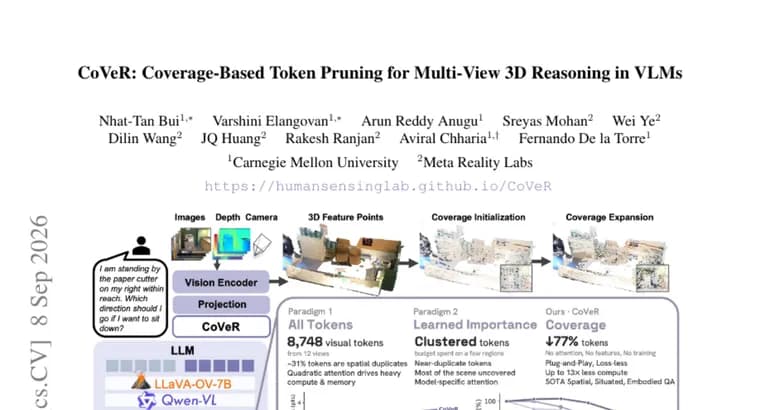
Representing a 3D scene as a set of multi-view 2D images lets vision-language models (VLMs) reason about it by reusing the visual priors they picked up during 2D pretraining, sidestepping the scarcity of annotated 3D data. The tradeoff is token count: this approach produces thousands of redundant visual tokens, and the cost grows with every additional view fed into the model.
Existing visual token pruners fall into two families, and the paper argues both are limited in this multi-view 3D setting. Learned-importance methods rank tokens by attention scores or encoder features; because the redundancy in multi-view data is fundamentally spatial, these methods end up keeping near-duplicate tokens from a few prominent regions while leaving most of the scene unrepresented. Voxelization methods improve spatial coverage, but they cannot enforce an exact token budget, and they saturate as multi-view observations increasingly overlap in 3D, which caps how many tokens they retain well below the intended target.
The authors report that spatial coverage of a scene is associated with 3D reasoning performance, and introduce CoVeR, short for coverage-based token pruning, a deterministic, training-free selector that relies only on token coordinates, with no learned signals at all. CoVeR picks the set of tokens that collectively covers every region of the scene. That design is meant to resolve both prior failure modes at once: it enforces an exact per-scene token budget, breaks through the saturation plateau that limits voxelization methods, and avoids the near-duplicate selections that learned-importance methods produce.
In the reported experiments, CoVeR outperforms prior state-of-the-art pruning methods on all three 3D reasoning benchmarks tested and generalizes as a plug-and-play module across four different VLMs, meaning it was not built around one specific model architecture. Keeping only about 8% of the original visual tokens, CoVeR preserves 93.5% of the performance reached with the full, unpruned token set, and it surpasses the prior state of the art by 3.9 percentage points on average across the benchmarks. The text does not name the specific benchmarks, VLMs, or prior methods involved, and gives no absolute performance scores beyond those two figures.
Key facts
- CoVeR is a deterministic, training-free token pruner that uses only token coordinates, with no learned signals, to select the set of tokens that collectively covers every region of a 3D scene built from multi-view images.
- It targets two known failure modes: learned-importance pruners cluster on near-duplicate tokens from a few prominent regions, while voxelization pruners cannot hit an exact token budget and saturate as multi-view observations overlap in 3D.
- Keeping only about 8% of the original visual tokens, CoVeR preserves 93.5% of full-token performance.
- CoVeR surpasses prior state-of-the-art pruning methods by 3.9 percentage points on average across benchmarks.
- It was tested as a plug-and-play module across four different VLMs and on all three of the paper's 3D reasoning benchmarks.
Why it matters
Feeding a VLM multi-view images of a 3D scene lets it reason in 3D while reusing priors from 2D pretraining, sidestepping the scarcity of annotated 3D data. The tradeoff is cost: representing a scene this way produces thousands of redundant visual tokens, and that cost grows with every additional view. Prior pruning methods traded spatial coverage against a hard token budget: importance-based methods hit the budget exactly but cluster on a few regions, while voxelization methods spread out spatially without being able to guarantee the budget. CoVeR targets spatial coverage itself as the selection rule, which the authors say resolves both limitations at once rather than trading one against the other.
Who it affects
The direct audience is teams building or researching vision-language models that reason over 3D scenes from multi-view image input, since inference cost for these systems scales with the number of views and the tokens each one adds. Because CoVeR is described as a plug-and-play module tested across four different VLMs rather than built around one architecture, it is framed as something that could be dropped into existing systems rather than requiring a bespoke redesign.
How to use it
CoVeR is deterministic and training-free: it needs no learned model or extra training pass, only the coordinates of the visual tokens a VLM's encoder already produces, which it uses to select a subset that collectively covers every region of the scene under an exact, chosen token budget. That positions it as a preprocessing step ahead of a VLM's reasoning stage rather than a change to the model itself. The source does not mention a code or model-weight release.
How solid is it
The paper reports extensive experiments showing CoVeR beats prior state-of-the-art methods on all three of its 3D reasoning benchmarks and generalizes across four VLMs. The names of those three benchmarks and four VLMs are not given, only their counts, and the prior state-of-the-art methods it surpasses by 3.9 percentage points are not identified. No absolute performance scores are given either, only the 93.5% of full-token performance ratio and the 3.9-percentage-point margin; the source marks that margin, but not the 93.5% figure, as an average across benchmarks.
Risks and caveats
The text does not explain how CoVeR computes or defines spatial coverage from token coordinates, beyond stating that it selects tokens that collectively cover every region of the scene, so the underlying algorithm cannot be checked from this material alone. No individual author names or research institutions appear in the text, and no publication or submission date is given either. Every reported figure, including the 93.5% performance-retention ratio and the 3.9-percentage-point margin over prior methods, comes from the authors' own experiments as described in the paper.