DeepSeek ships V4.1-Flash with native visual understanding
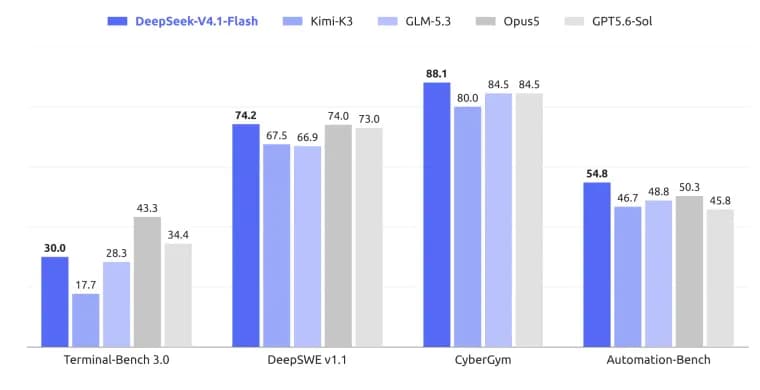
DeepSeek has introduced DeepSeek-V4.1-Flash, describing it as the smallest model in a new architecture family, with native visual understanding built in. The model is now live on the DeepSeek API: developers select it by setting the model field to deepseek-flash. Two earlier models, V4-Flash and V4-Flash-Vision-Exp, are retired as a result; for compatibility, calls that still use the old names deepseek-v4-flash and deepseek-v4-flash-vision-exp are temporarily routed to V4.1-Flash.
Architecturally, V4.1-Flash is a 552B-parameter Mixture-of-Experts (MoE) model built on what DeepSeek calls a new Causal Encoder-Decoder design: only 8B of those parameters activate for input and 16B for output, far fewer than the total would suggest. DeepSeek says new pre-training methods combined with larger-scale reinforcement-learning post-training give the model benchmark results ahead of its own flagship models, including DeepSeek-V4-Pro, and that tests run by multiple, unnamed parties put V4.1-Flash ahead of V4-Pro on performance, cost, speed and total runtime. The announcement names no specific benchmark or score behind either claim.
The model's key-value cache is smaller too: DeepSeek says it needs just a quarter of the HBM memory and an eighth of the SSD storage that the previous generation's cache required. Because cache-hit charges often make up a large share of the cost of running agents, the company says compressing the cache cuts those costs significantly.
New, lower API pricing took effect at 04:00 UTC on September 10, 2026, the same day as the announcement. Off-peak rates continue to run at 50% of peak rates, as before, and DeepSeek recommends scheduling flexible workloads off-peak to save money; the announcement gives no absolute per-token figures. A bigger change follows on September 14: starting at 04:00 UTC that day, every deepseek-v4-pro API request will be routed to V4.1-Flash and billed at V4.1-Flash's rates, as DeepSeek phases V4-Pro out. DeepSeek says this routing continues until V4.1-Pro launches, but gives no date for that launch.
Two official partners, WorkBuddy_AI, including its Codebuddy product, and opencode, already fully support V4.1-Flash. DeepSeek also says it will work closely with the open-source community on inference support for the model and is exploring further deployment options, and it is asking teams planning large-scale self-hosted deployments to get in touch, citing a setup of 2,000 GPUs plus a storage cluster as an example scale. The announcement links to a V4.1-Flash model page and a technical report on Hugging Face.
Key facts
- V4.1-Flash is a 552B-parameter Mixture-of-Experts model on a new Causal Encoder-Decoder architecture that activates only 8B parameters for input and 16B for output.
- It is the smallest model in DeepSeek's new architecture family and has native visual understanding built in.
- DeepSeek says the model's key-value cache needs just a quarter of the HBM and an eighth of the SSD storage of the previous generation, cutting cache-related agent costs.
- V4-Flash and V4-Flash-Vision-Exp are now retired, and new, lower API pricing (off-peak rates still at 50% of peak) took effect on September 10, 2026.
- From September 14, 2026, all deepseek-v4-pro API traffic routes to V4.1-Flash at V4.1-Flash's rates, as DeepSeek phases V4-Pro out until V4.1-Pro launches.
Why it matters
DeepSeek is putting native visual understanding into its cheapest, fastest model tier instead of reserving it for a flagship, and pairing that with a new Causal Encoder-Decoder architecture built for efficiency: only 8B of the 552B total parameters activate for input and 16B for output. That efficiency focus, not just scale, is the point. DeepSeek says new pre-training methods and larger-scale reinforcement-learning post-training let this smaller model post benchmark results ahead of its own flagship models, V4-Pro included, and starting September 14 the company is routing V4-Pro's own API traffic into V4.1-Flash, phasing out the Pro tier until a V4.1-Pro arrives.
Who it affects
Developers already calling the DeepSeek API feel this first: requests to deepseek-v4-flash and deepseek-v4-flash-vision-exp are temporarily rerouted to V4.1-Flash now that those two models are retired, and from September 14 the same happens to deepseek-v4-pro calls, which then bill at V4.1-Flash's rates. DeepSeek's official partners WorkBuddy_AI, including its Codebuddy product, and opencode already support V4.1-Flash. Teams planning a large, self-hosted deployment are a target too: DeepSeek is asking them to get in touch, citing a 2,000-GPU cluster plus storage as an example scale, and says it will work with the open-source community on inference support for the model.
How to use it
On the DeepSeek API, set the model field to deepseek-flash to call V4.1-Flash directly. The retired names deepseek-v4-flash and deepseek-v4-flash-vision-exp still work for now through temporary routing, but should be migrated since the underlying models are gone. New, lower API pricing took effect at 04:00 UTC on September 10, 2026; off-peak rates remain at 50% of peak rates, so workloads that can be scheduled off-peak cost less, though DeepSeek gives no absolute per-token figures or context-window size in this announcement. From 04:00 UTC on September 14, deepseek-v4-pro calls route automatically to V4.1-Flash and bill at V4.1-Flash's rates, a change DeepSeek says lasts until V4.1-Pro launches. The announcement links to a V4.1-Flash model page and a technical report on Hugging Face, at huggingface.co/deepseek-ai/DeepSeek-V4.1-Flash.
How solid is it
This is DeepSeek's own announcement thread on its official account, not independent reporting. The architecture and efficiency figures it discloses are DeepSeek's own specifications for its own model: the 552B-parameter MoE design, the 8B/16B input/output active-parameter split, and the 1/4 and 1/8 reductions in key-value cache HBM and SSD needs. The comparative performance claims are harder to check: DeepSeek says benchmark results put V4.1-Flash ahead of flagship models including V4-Pro, and that tests by multiple parties put it ahead of V4-Pro on performance, cost, speed and total runtime, but the thread names no benchmark, no score and none of those parties. No independent evaluation is cited.
Risks and caveats
Treat the comparisons with V4-Pro as DeepSeek's own characterization until an independent benchmark confirms them; none is named in the thread. The routing of V4-Pro traffic into V4.1-Flash is described as temporary, lasting only until V4.1-Pro launches, but DeepSeek gives no date for that launch, so there is no way to know how long the Pro tier stays sidelined. Pricing is stated only in relative terms, off-peak at 50% of peak, with no absolute per-token figures or context-window size in the thread, so budgeting means checking DeepSeek's pricing page directly. And while DeepSeek says it will work closely with the open-source community on inference support for V4.1-Flash, the thread stops short of saying the model's weights are already released as open source.
“Cache-hit charges often account for a large share of agent costs. Compressing the cache cuts those costs significantly.”
— DeepSeek (@deepseek_ai)