CoworkEnv builds training environments for AI coworker agents, lifting Qwen3-VL-8B on Claw-Eval
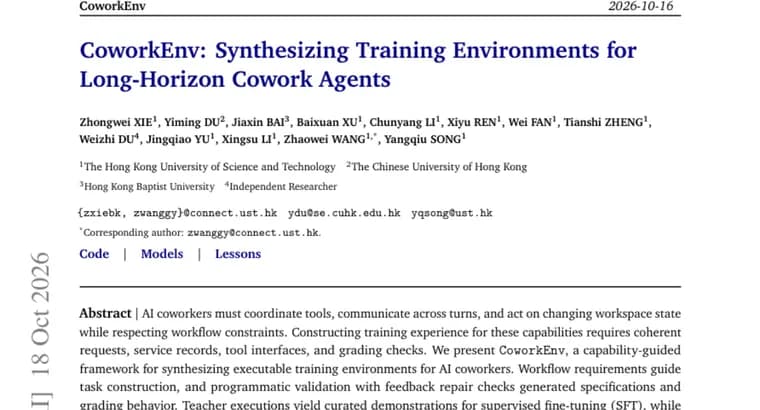
A paper on Hugging Face presents CoworkEnv, a capability-guided framework for synthesizing executable training environments for AI coworkers, meaning agents that work alongside people on workflow tasks. The authors start from what such agents must do: coordinate tools, communicate across turns, and act on changing workspace state while respecting workflow constraints. Training experience for those skills needs coherent requests, service records, tool interfaces and grading checks, and CoworkEnv is meant to generate all of them.
The pipeline works in two steps. Workflow requirements guide how tasks are constructed. Programmatic validation with feedback repair then checks the generated specifications and the grading behavior. Once environments exist, teacher executions yield curated demonstrations for supervised fine-tuning (SFT), while student interactions provide rollouts and rewards for reinforcement learning (RL).
Using these resources, the authors train compact models they call PocketWorker. The headline result is for Qwen3-VL-8B-Instruct: SFT raises the mean score on Claw-Eval from 46.6 to 64.1, including a 31.9-point gain on the Multi-turn tasks subset. The authors also report an SFT-only extension to ClawMark, which they say demonstrates applicability across coworker benchmarks.
For RL, the paper compares training dynamics across configurations that vary reward processing and credit assignment. The evidence here is modest: improving training rewards are described as preliminary evidence that the constructed environments support policy optimization. No RL scores are given as numbers.
Key facts
- CoworkEnv is a capability-guided framework for synthesizing executable training environments for AI coworkers.
- Task construction is guided by workflow requirements; programmatic validation with feedback repair checks the generated specifications and grading behavior.
- Teacher executions supply demonstrations for SFT; student interactions supply rollouts and rewards for RL.
- For Qwen3-VL-8B-Instruct, SFT raises the mean Claw-Eval score from 46.6 to 64.1, with a 31.9-point gain on Multi-turn tasks.
- RL evidence is preliminary: improving training rewards suggest the environments support policy optimization.
Why it matters
Agents that act as coworkers need practice in settings with tools, multi-turn conversation and workspace state that changes under them. The paper's argument is that such training experience needs coherent requests, service records, tool interfaces and grading checks, and that these can be synthesized rather than assembled by hand. CoworkEnv is an attempt at that synthesis, with checks built in to validate the generated tasks and their grading.
Who it affects
Mainly researchers and teams training agents for workplace-style tasks, who need executable environments plus demonstrations and rewards. The reported results concern a compact model setup built on Qwen3-VL-8B-Instruct, so the findings speak first to small-model training.
How to use it
The abstract describes a workflow rather than a product: build environments from workflow requirements, validate them programmatically, collect teacher demonstrations for SFT, and collect student rollouts and rewards for RL. No code, dataset or model release is mentioned in the source.
How solid is it
This is a preprint abstract, and the numbers are the authors' own. The one concrete result is the SFT gain on Claw-Eval for Qwen3-VL-8B-Instruct, from 46.6 to 64.1 mean score, including a 31.9-point gain on the Multi-turn tasks subset. The source does not say what the scale of the score is or how many tasks Claw-Eval contains. The ClawMark result is described only as demonstrating applicability, with no scores. The RL claim is explicitly labelled preliminary.
Risks and caveats
No RL results are given as numbers; only improving training rewards are described, as preliminary evidence. No ClawMark scores are given, and the abstract gives no comparison against other methods or other base models. Sizes of the PocketWorker models are not stated beyond 'compact'. Gains measured on a benchmark do not by themselves show how the trained models would behave in real workplaces.
“Improving training rewards provide preliminary evidence that the constructed environments support policy optimization.”
— CoworkEnv paper abstract