MTEdit: 500K-trajectory dataset for multi-turn image editing
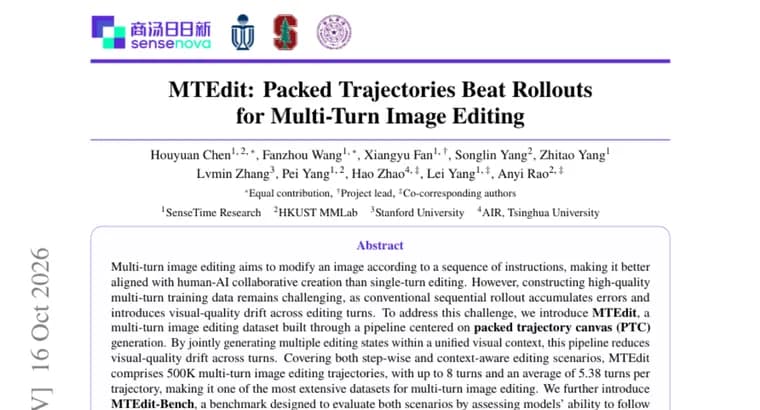
Multi-turn image editing means changing an image through a sequence of instructions, which fits human-AI collaborative creation better than a single edit does. The authors say the hard part is training data: the conventional way to build it, sequential rollout, accumulates errors and introduces visual-quality drift across editing turns.
To address this, the paper introduces MTEdit, a multi-turn image editing dataset built through a pipeline centered on packed trajectory canvas (PTC) generation. Instead of editing step by step, the pipeline jointly generates multiple editing states within a unified visual context. The authors state that this reduces visual-quality drift across turns.
MTEdit covers both step-wise and context-aware editing scenarios. It holds 500K multi-turn image editing trajectories, with up to 8 turns and an average of 5.38 turns per trajectory. The authors describe it as one of the most extensive datasets for multi-turn image editing.
The paper also introduces MTEdit-Bench, a benchmark for both scenarios. It assesses whether models follow editing instructions, maintain content consistency, resist visual-quality drift, and effectively use historical context across turns.
Using MTEdit, the authors fine-tune Qwen-Image-Edit-Causal to obtain Qwen-Image-MTEdit. On MTEdit-Bench they evaluate a broad range of closed-source and open-source image editing models, including Qwen-Image-MTEdit. According to the experimental results, Qwen-Image-MTEdit achieves the best performance among the evaluated open-source models, which the authors take as a sign that MTEdit improves models' multi-turn image editing capabilities.
Key facts
- MTEdit is a multi-turn image editing dataset of 500K trajectories, with up to 8 turns and an average of 5.38 turns per trajectory.
- Its packed trajectory canvas (PTC) pipeline jointly generates multiple editing states in one visual context, which the authors say reduces visual-quality drift compared with sequential rollout.
- MTEdit-Bench evaluates instruction following, content consistency, resistance to visual-quality drift and use of historical context across turns.
- Fine-tuning Qwen-Image-Edit-Causal on MTEdit gives Qwen-Image-MTEdit, reported as the best among the evaluated open-source models on the benchmark.
Why it matters
Editing an image over several rounds is closer to how people actually work with AI tools than one-shot edits. The authors argue the bottleneck is training data, because sequential rollout piles up errors and lets visual quality slip with each turn. MTEdit tackles this by generating several editing states together on a packed trajectory canvas, and it pairs the data with a benchmark that measures drift and use of earlier context, not just single-step instruction following.
Who it affects
Researchers and teams training or evaluating image editing models are the direct audience, since the work offers both training data and an evaluation set for multi-turn editing. Anyone building editing tools that take a series of instructions has a stake in whether models keep content consistent across turns.
How to use it
The paper's recipe is to fine-tune an existing editing model on MTEdit, as the authors did with Qwen-Image-Edit-Causal to get Qwen-Image-MTEdit, and to score models on MTEdit-Bench across both step-wise and context-aware scenarios. No release, licence, code or dataset availability is stated.
How solid is it
The claims come from the authors' own abstract. The reported result is limited: Qwen-Image-MTEdit is best among the evaluated open-source models on the authors' own benchmark. No benchmark scores or margins over other models are given. The source does not say how Qwen-Image-MTEdit compares with closed-source models, and it does not name the other models evaluated. The claim that the PTC pipeline reduces drift is stated as a property of the pipeline; the abstract gives no quantitative comparison with sequential rollout.
Risks and caveats
Dataset and benchmark come from the same team, so the best-among-open-source result is a self-reported finding on a self-built test. The source does not say which tools or models generate the packed trajectory canvases. No authors or institutions are named. The phrase "one of the most extensive datasets" is the authors' own description.
“conventional sequential rollout accumulates errors and introduces visual-quality drift across editing turns”
— MTEdit paper abstract