Fréchet Forcing keeps MiniWorld-1B stable beyond 4,000 frames
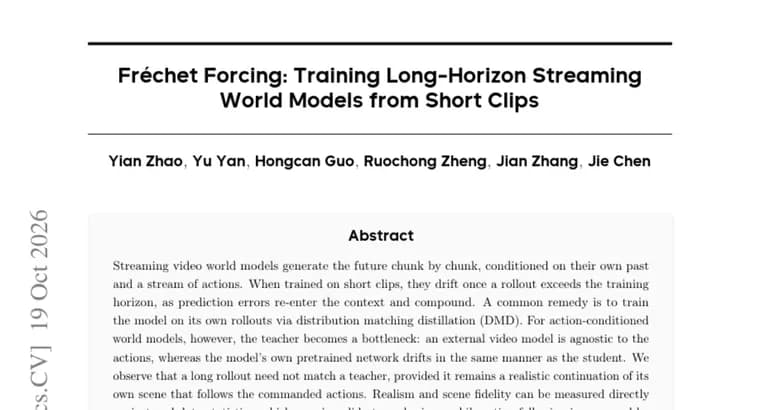
Streaming video world models generate the future chunk by chunk, conditioned on their own past and a stream of actions. The paper starts from a familiar problem: trained on short clips, these models drift once a rollout runs longer than the training horizon, because prediction errors re-enter the context and compound.
A common remedy is to train the model on its own rollouts via distribution matching distillation (DMD). The authors say this breaks down for action-conditioned world models, because the teacher becomes a bottleneck. An external video model is agnostic to the actions, while the model's own pretrained network drifts in the same manner as the student.
Their observation is that a long rollout need not match a teacher, provided it remains a realistic continuation of its own scene and follows the commanded actions. Realism and scene fidelity can be measured against real-data statistics, which remain valid at any horizon. Action following is preserved by the model's conditional generation loss.
On that basis they propose Fréchet Forcing. It fine-tunes a world model together with its deployed multi-step sampler under three constraints. First, generative anchoring applies the flow-matching loss after a self-generated history that ends on real data. Second, context fidelity is a Fréchet distance (FD) on latent statistics of the free rollout, centred on each clip's own ground truth, and it keeps every rollout faithful to its scene. Third, reality matching is an FD to real frames in a frozen perceptual space, and it keeps the generated frames realistic.
All three targets come from short real clips, and no rollout is compared against a long recorded future. So training needs no teacher, no online critic and no long videos.
The headline result: MiniWorld-1B, pretrained on 253-frame clips, was fine-tuned on 381-frame clips for at most 36 GPU-hours. Its rollouts remain stable beyond 4,000 frames and continue to follow their actions in both robot manipulation and camera-controlled exploration.
Key facts
- Fréchet Forcing fine-tunes a streaming, action-conditioned world model together with its deployed multi-step sampler, using only short real clips.
- Three constraints drive it: generative anchoring (flow-matching loss after a self-generated history ending on real data), context fidelity (an FD on latent statistics of the free rollout) and reality matching (an FD to real frames in a frozen perceptual space).
- Training needs no teacher, no online critic and no long videos, which sidesteps the teacher bottleneck of distribution matching distillation for action-conditioned models.
- MiniWorld-1B, pretrained on 253-frame clips, was fine-tuned on 381-frame clips for at most 36 GPU-hours.
- The fine-tuned rollouts remain stable beyond 4,000 frames and keep following actions in robot manipulation and camera-controlled exploration.
Why it matters
Drift on long rollouts is a core weakness of streaming world models: small prediction errors feed back into the context and pile up once generation passes the training horizon. The usual fix, DMD-style self-rollout training, needs a teacher, and the authors argue that for action-conditioned models no good teacher exists. An external video model ignores the actions, and the model's own pretrained network drifts just like the student. Fréchet Forcing replaces the teacher with statistics of real short clips, which stay valid at any horizon. The reported payoff is a jump from 381-frame fine-tuning clips to rollouts beyond 4,000 frames for a modest compute budget.
Who it affects
Researchers building action-conditioned, streaming video world models will find the method most relevant, in particular teams working on robot manipulation and camera-controlled exploration, the two settings named in the results. Anyone who has been held back by the lack of long training videos or by the cost of teacher-based distillation is the natural audience.
How to use it
The recipe, as described, is a fine-tuning stage on top of an already pretrained model. Take short real clips, fine-tune the world model together with the multi-step sampler it will be deployed with, and apply the three constraints: generative anchoring, context fidelity and reality matching. No teacher, online critic or long videos are required. For scale, the reported run used 381-frame clips and at most 36 GPU-hours on MiniWorld-1B. The source does not say whether the code, model or weights are released.
How solid is it
The paper reports a single setup: MiniWorld-1B. The source gives the clip lengths (253 frames for pretraining, 381 for fine-tuning), the compute ceiling (at most 36 GPU-hours) and the stability claim (beyond 4,000 frames). No quantitative metric values are reported, such as FD scores, success rates or baseline comparisons, and no comparison against DMD-based methods is quantified. Stability beyond 4,000 frames is stated as a lower bound, with no maximum tested rollout length given. No authors, institutions or affiliations are named.
Risks and caveats
The claims rest on the authors' own description of the results. The source does not say what MiniWorld-1B is, who built it, or what its frame rate or resolution is, and it does not say how 4,000 frames translate into seconds of video. The hardware used for the GPU-hours is not stated. Whether the approach carries over to other world models or longer horizons is not shown in the source.
“a long rollout need not match a teacher, provided it remains a realistic continuation of its own scene that follows the commanded actions”
— From the Fréchet Forcing paper abstract