Data-space iteration removes timestep discretization from few-step generation
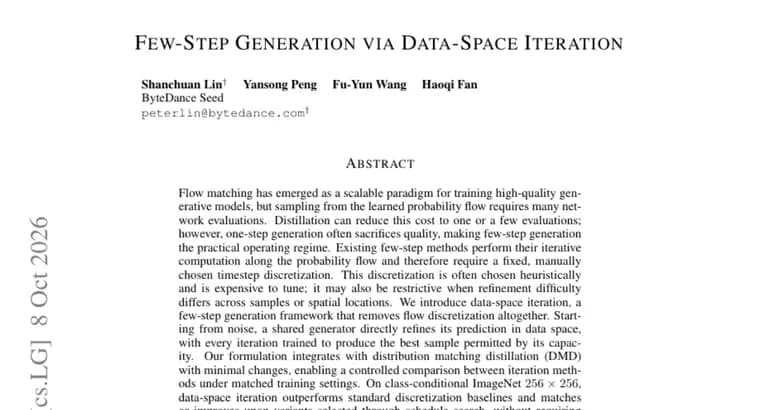
The paper "Few-Step Generation via Data-Space Iteration" targets a cost problem in flow-matching image generators. Flow matching trains high-quality generative models at scale, but sampling from the learned probability flow takes many network evaluations. Distillation can cut that to one or a few evaluations, yet one-step generation often sacrifices quality, which makes few-step generation the practical operating regime.
The authors point to a weakness in existing few-step methods. They run their iterative computation along the probability flow, so they need a fixed, manually chosen timestep discretization. That schedule is often chosen heuristically and is expensive to tune. It may also be restrictive when refinement difficulty differs across samples or spatial locations.
Their answer is data-space iteration, a few-step generation framework that removes flow discretization altogether. Starting from noise, a shared generator directly refines its prediction in data space, and every iteration is trained to produce the best sample permitted by its capacity. The formulation integrates with distribution matching distillation (DMD) with minimal changes, which allows a controlled comparison between iteration methods under matched training settings.
On class-conditional ImageNet 256x256, the authors report that data-space iteration outperforms standard discretization baselines. It also matches or improves upon variants selected through schedule search, without requiring schedule-specific training. They conclude that data-space iteration is a simple and effective alternative to discretized flow-space iteration for fast generation.
Key facts
- Data-space iteration is a few-step generation framework in which a shared generator refines its prediction directly in data space, starting from noise, with no flow timestep discretization.
- Every iteration is trained to produce the best sample permitted by its capacity.
- The formulation integrates with distribution matching distillation (DMD) with minimal changes, enabling controlled comparisons under matched training settings.
- On class-conditional ImageNet 256x256 it is reported to outperform standard discretization baselines and match or improve upon variants selected through schedule search, without schedule-specific training.
Why it matters
Few-step generation is where fast diffusion and flow-matching models actually operate, since one-step generation often loses quality. Today those few steps follow a fixed, hand-picked timestep schedule that is often chosen heuristically and is expensive to tune. This paper proposes dropping the schedule and iterating in data space instead, which would remove one tuning burden from fast generators.
Who it affects
Mainly researchers and engineers who distill flow-matching or diffusion models into few-step generators, especially those already using distribution matching distillation (DMD). The authors say the method plugs into DMD with minimal changes. It is a research result rather than a product, and the source names no company or product behind it.
How to use it
The source describes the method, not a packaged tool: the framework adds data-space iteration on top of DMD with minimal changes, which is the route a team with an existing DMD pipeline would explore. The source mentions no code release or model weights.
How solid is it
The claims come from the paper's abstract and are the authors' own. The evaluation named is class-conditional ImageNet 256x256, with comparisons against standard discretization baselines and schedule-search variants under matched training settings. No numerical results (FID, step counts, speedups, or margins over baselines) are given in the source, so the size of the improvement cannot be judged from it.
Risks and caveats
The only evaluation mentioned is class-conditional ImageNet 256x256; no other datasets, resolutions or modalities such as text-to-image are stated, so it is unclear how far the result carries. The source does not name which baselines or schedule-search variants were compared, and it gives no iteration or network-evaluation counts. The authors' conclusion is that the approach is an alternative to discretized flow-space iteration, not a proven replacement.
“data-space iteration provides a simple and effective alternative to discretized flow-space iteration for fast generation”
— From the paper's abstract