DiffusionART reports about 12x fewer GPU hours for RL on diffusion models
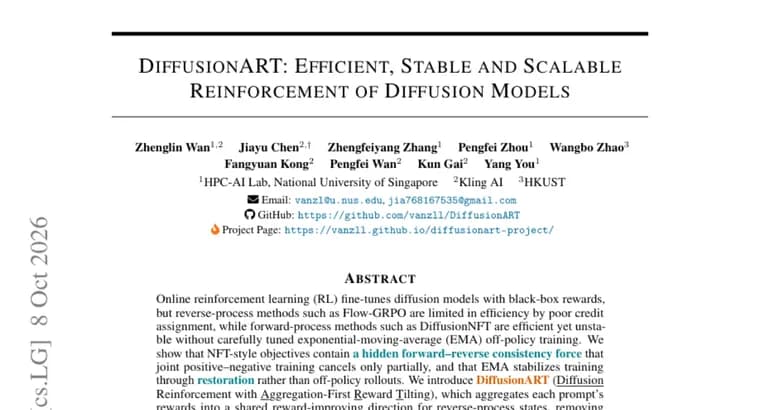
A paper listed on Hugging Face Papers introduces DiffusionART, short for Diffusion Reinforcement with Aggregation-First Reward Tilting. It is an online reinforcement learning method for fine-tuning diffusion models with black-box rewards.
The authors start from a trade-off between two existing families. Reverse-process methods such as Flow-GRPO are limited in efficiency by poor credit assignment. Forward-process methods such as DiffusionNFT are efficient, but unstable unless they use carefully tuned exponential-moving-average (EMA) off-policy training.
The paper then makes two analytical claims. First, NFT-style objectives contain a hidden forward-reverse consistency force that joint positive-negative training cancels only partially. Second, EMA stabilizes training through restoration rather than through off-policy rollouts.
DiffusionART is built around those two findings. It aggregates each prompt's rewards into a shared reward-improving direction for reverse-process states, which removes the consistency force by construction. It then adds a trust-region-masked second update that performs drift-adaptive restoration without any EMA tuning.
The abstract lists several practical properties. The method requires no differentiable reward model, remains effective with fewer samples per prompt, and supports pairwise reward models through a variant called DiffusionART-Pairwise. Across image and video generation, the authors say it trains efficiently and stably without per-task tuning.
The headline result is on HunyuanVideo-13B with equally weighted visual and motion quality rewards. There, DiffusionART reaches the late-stage mean reward levels of DiffusionNFT and Flow-GRPO-Fast with 12.02 and 11.72 times fewer GPU hours, respectively. It also achieves 28.8% and 53.0% higher mean training rewards than those two baselines.
Key facts
- DiffusionART (Diffusion Reinforcement with Aggregation-First Reward Tilting) is an online RL method for fine-tuning diffusion models with black-box rewards.
- On HunyuanVideo-13B with equally weighted visual and motion quality rewards, it reaches the late-stage mean reward levels of DiffusionNFT and Flow-GRPO-Fast with 12.02 and 11.72 times fewer GPU hours, respectively.
- It also reports 28.8% higher mean training reward than DiffusionNFT and 53.0% higher than Flow-GRPO-Fast on the same setup.
- Aggregating each prompt's rewards into a shared direction removes a hidden forward-reverse consistency force, and a trust-region-masked second update replaces EMA tuning.
- It needs no differentiable reward model, works with fewer samples per prompt, and has a pairwise-reward variant, DiffusionART-Pairwise.
Why it matters
Reinforcement learning on diffusion models is attractive because it can optimise against rewards that are not differentiable, but the abstract frames the existing options as a trade-off. Reverse-process methods such as Flow-GRPO are limited in efficiency by poor credit assignment, while forward-process methods such as DiffusionNFT are efficient yet unstable without carefully tuned EMA off-policy training. DiffusionART is pitched as a way out of that trade-off: efficient and stable, with no EMA tuning. The reported 12.02x and 11.72x reductions in GPU hours on a 13B-parameter video model are the kind of saving that would matter for anyone paying for RL fine-tuning runs.
Who it affects
The method targets people who fine-tune diffusion models for image and video generation with black-box rewards, including setups that mix several rewards such as visual and motion quality. Researchers working on Flow-GRPO-style or DiffusionNFT-style training are the most direct audience, since the paper positions itself against both and offers an explanation for why EMA helps in NFT-style training.
How to use it
The abstract describes what the method asks for rather than a recipe. It requires no differentiable reward model, stays effective with fewer samples per prompt, and supports pairwise reward models through DiffusionART-Pairwise. It also trains without per-task tuning and without EMA tuning. No code or model release, license, or link to a repository is mentioned in the source, so reproducing it would mean working from the paper itself.
How solid is it
This is a paper abstract on Hugging Face Papers, and every claim in it is the authors' own. The abstract names no authors or institutions. No independent replication or peer-review status is stated. The efficiency claim is specific and quantified, but it rests on one named setup: HunyuanVideo-13B with equally weighted visual and motion quality rewards.
Risks and caveats
The 28.8% and 53.0% figures are relative improvements in mean training reward over the baselines, not final evaluation scores or human preference results. The GPU-hour comparison is measured to the baselines' late-stage mean reward level, so it speaks to training speed, not to final output quality. No absolute reward values, GPU-hour totals or benchmark names beyond HunyuanVideo-13B are given, and the image-generation models and tasks used in the experiments are not named. The claim of working across image and video generation without per-task tuning is stated without those details.
“Across image and video generation, DiffusionART trains efficiently and stably without per-task tuning.”
— DiffusionART paper abstract