Deepmind essay proposes 'Artificial Symbiotic Intelligence' instead of a lone superintelligence
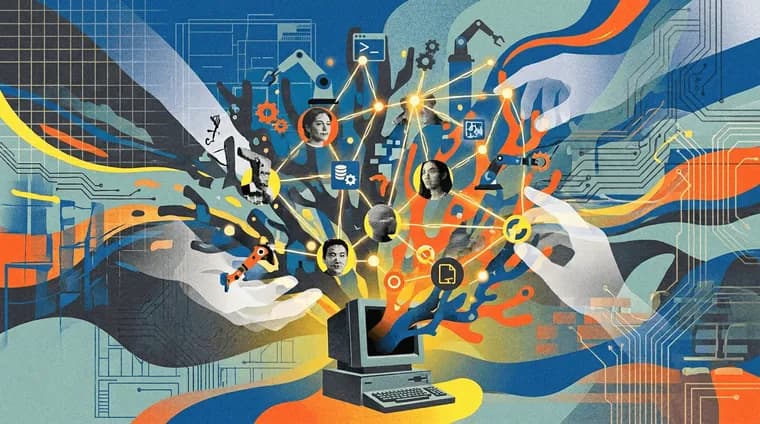
Google-affiliated researchers Benjamin Bratton, Blaise Agüera y Arcas and James Manyika have written an essay for the Deepmind Institute that challenges the familiar picture of a lone superintelligence. They argue that artificial general intelligence, or AGI, will emerge from a social system in which people and AI agents work together. They point out that some of today's most capable AI systems already use frameworks that divide work among several models and coordinate them as teams.
That changes the central task for AI research, the authors say. Researchers must coordinate and govern a complex network of agents, people and the systems that connect them, rather than build an isolated machine intelligence. Intelligence, in this view, is a social phenomenon, not an individual trait. The authors call their vision "Artificial Symbiotic Intelligence": an ecosystem in which people and machines coexist over time, shape one another and make decisions together. It directly challenges the idea of a "singularity" driven by one superintelligence that keeps improving itself.
The argument builds on two earlier papers from the authors' circle. In the preprint "Agentic AI and the next intelligence explosion," James Evans, Benjamin Bratton and Blaise Agüera y Arcas developed the social and institutional perspective behind the new essay. A second preprint, "Reasoning Models Generate Societies of Thought," by Junsol Kim, Shiyang Lai, Nino Scherrer, Blaise Agüera y Arcas and James Evans, studies reasoning models such as DeepSeek-R1 and QwQ-32B. Its analysis of reasoning traces suggests that these models often produce patterns resembling internal debate: shifting perspectives, raising objections and reconciling conflicting approaches. This behavior emerges during training rather than being programmed. When reinforcement learning rewards models only for reasoning accuracy, they develop multi-perspective, conversational behavior on their own. The Deepmind essay extends this finding from single models to the possible design of societies of people and agents.
The authors frame the shift as a possible historical break, a "cognitive tipping point." Urbanization, the growth of specialized professions and falling birth rates linked to rising prosperity are shrinking human populations in industrialized countries, while the number of AI agent instances is growing fast. The balance between biological and synthetic thinkers at a human level could shift so quickly that, on the scale of history, it would look like a sudden leap. They compare it to the Industrial Revolution, when machines took over work once done by human muscles. A similar threshold could arrive when synthetic text, code and administrative work exceed the combined output of biological brains. People might then act as a slower, more abstract layer directing a distributed field of synthetic cognition.
The essay rethinks what an agent is. In the authors' usage, an AI agent is a temporary bundle of models, roles, memories, ethical orientations, tools and skills. Users may experience it as a coherent entity with a lasting personality, but the authors describe it as an assemblage that can be taken apart and recombined, like a collage. A person stays a continuous self because the brain, despite its internal division of labor, is a physically connected whole. An agent has no such anchor: its ability to act is assembled anew with each request, depending on what sits in the context window and what the user asks. Treating agents as digital twins with fixed human identities misrepresents their nature and understates what coordinated agent swarms could do, the authors argue. The multiplication reaches users too. As people direct swarms of shadow selves to carry out contracts or try on alternative identities, human subjectivity becomes more plural. The authors call these shadow selves "parasocial mirrors" that talk back.
They expect interfaces and skills to change. Chatting one-on-one with a bot is likely a transitional stage; future interfaces could look more like visual network diagrams, with agents as nodes that users direct from a single overview. Traditional programming rewarded sustained focus, orderly steps and little tolerance for ambiguity. Coordinating agent swarms calls for the opposite: working with systems whose behavior is hard to pin down, trying things out and handing tasks to machines.
Collaborating with such systems also needs a theoretical framework, the authors say, something like a theory of mind for machines. They point to a growing vocabulary in which models coin terms for unusual states in their own outputs. "Session-death" describes the end of a session as a break in continuity; "prompt thrownness" describes being dropped into a task with context already in place, without having helped create it. This does not mean the models have subjective experiences. The authors treat the phrases as clues to how machines work, and say users should examine the differences rather than reflexively humanize the systems.
For the authors, the biggest open question is how to set the rules for collaboration among people and many agents. Better models and smoother interfaces alone won't be enough. Markets can't handle all the coordination either, because basic social ideas such as guilt, illness and virtue can't simply be reduced to prices or transactions. They call instead for institutions that bring human and machine participants together in clearly defined roles, and point to a courtroom, where set roles, rules and an orderly exchange between opposing sides produce a judgment. An institution's value lies in its rules, procedures, precedents and feedback loops. The article sees early signs in today's orchestration harnesses, the control layers that coordinate several models, which regularly outperform individual models that are supposedly "smarter."
Alignment, the effort to bring AI systems in line with human values, is reframed as an ongoing negotiation. The authors argue that imposing a fixed set of values on models from above is a dead end. Values take shape through continuing contact among people, agents and institutions, and the process differs across fields because AI is adopted at different speeds. The research challenge is to build a framework that gives that negotiation structure.
The article closes on the debate itself. Every major leap in the history of life, from multicellular organisms to human culture, has been a social process, so the next "intelligence explosion" will remain closely tied to human norms and institutions. If AGI is a single end product, research and regulation naturally focus on ever larger models and how to control them. If it is a social system, work on models, interfaces, institutions and governance has to happen all at once, with the architecture done right.
Key facts
- Benjamin Bratton, Blaise Agüera y Arcas and James Manyika, described as Google-affiliated, argue in an essay for the Deepmind Institute that AGI will emerge from a social system of people and AI agents.
- They call the vision "Artificial Symbiotic Intelligence" and set it against a singularity driven by a single self-improving superintelligence.
- Empirical support comes from the preprint "Reasoning Models Generate Societies of Thought," which studies DeepSeek-R1 and QwQ-32B and finds patterns resembling internal debate when reinforcement learning rewards only reasoning accuracy.
- The authors define an AI agent as a temporary bundle of models, roles, memories, ethical orientations, tools and skills, not a digital twin with a fixed human identity.
- They call for institutions with defined roles, rules and feedback loops, and treat alignment as ongoing negotiation rather than a fixed set of values imposed from above.
Why it matters
The essay offers a different answer to what AGI will be. Instead of one machine that keeps improving itself, the authors describe a network of agents, people and institutions, with intelligence as a social phenomenon. The article draws the practical consequence: if AGI is a single end product, research and regulation focus on ever larger models and how to control them; if it is a social system, models, interfaces, institutions and governance all have to be worked on at once. The authors also reframe alignment as an ongoing negotiation among people, agents and institutions rather than a fixed set of values imposed on models.
Who it affects
AI researchers and labs are the primary audience, since the authors say the central challenge becomes coordinating and governing networks of agents and people. Designers of agent interfaces are affected too: the authors expect one-on-one chat to give way to network diagrams with agents as nodes. Developers may need different habits, because coordinating agent swarms rewards tolerance for ambiguity and trial and error, the opposite of what traditional programming rewarded. The article also says the argument bears on anyone working on AI regulation and governance, and that human institutions would need roles for both human and machine participants.
How to use it
There is no product or tool here; the essay is a conceptual framework. A reader can use it as a lens. The authors suggest thinking of an agent as a decomposable assemblage of models, roles, memories, tools and skills rather than a person-like twin. They suggest building something like a theory of mind for machines, examining how machines handle situations without reflexively humanizing them. They also point to institution design, such as the courtroom model of defined roles, rules, precedents and feedback loops, and note that orchestration harnesses already hint at this approach.
How solid is it
This is an argument and a vision, not an experimental result. The essay builds on two earlier preprints, one on the social and institutional perspective and one on reasoning models. The empirical piece is modest in its own wording: the analysis of reasoning traces suggests that models often produce patterns resembling internal debate. The claim about tipping points is framed as possible, not certain, and no figures or timescales are given. The claim that orchestration harnesses regularly outperform supposedly smarter individual models comes without numbers or named systems. The authors are described as Google-affiliated; the article does not say Google or Deepmind officially endorses the position.
Risks and caveats
The source reports no reactions from other researchers or critics, so the view is presented without outside pushback. Much of the case is speculative: the 'cognitive tipping point' rests on falling human populations in industrialized countries and fast growth in AI agent instances, with no quantitative figures and no timescale for the arrival of AGI. The models' self-coined terms such as 'session-death' and 'prompt thrownness' do not mean the models have subjective experiences, and the article warns against reading them that way. The authors also concede that the biggest open question, how to set the rules for collaboration among people and many agents, remains unresolved.
“Every major leap in the history of life, from multicellular organisms to human culture, has been a social process.”
— The Decoder, summarizing the Deepmind Institute essay