DeepMind rolls out Gemini Robotics 2.5, with 96% in a Mercedes-Benz pilot
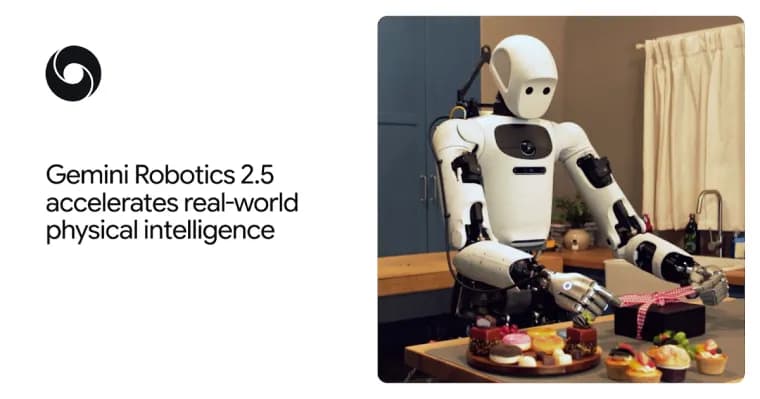
Google DeepMind has introduced Gemini Robotics 2.5, which it calls its most capable vision-language-action (VLA) model to date. The company says the model widens the range of skills a robot can learn and speeds up how fast it learns them, with gains in dexterity, reliability and safety meant to help robots move out of the lab and into less structured, real-world settings. Gemini Robotics 2.5 is rolling out to DeepMind's robotics partners. DeepMind credits much of the progress to Gemini 4 Argon, a frontier Gemini model whose robotics research abilities sped up development.
On dexterity, DeepMind tested the model across over 200 distinct tasks, among them serving food with tongs, tying a bow on a gift box and pipetting a liquid. It describes these as a step toward human-level dexterity, combining advanced tool use, complex manipulation of deformable objects and handling of delicate items. Against unnamed previous baselines, DeepMind reports a 30% to 100% higher success rate, depending on the type of task, and tasks completed 20% to 30% faster. The model works natively with several robot types, including Apptronik's Apollo 2 humanoid (with its five-finger, 22 degree-of-freedom SharpaWave hand) and the Franka Duo platform, which has two-fingered parallel grippers.
The reliability test was a proof-of-concept with Apptronik and Mercedes-Benz, with Apollo 2 humanoids working on active automotive production lines in Kecskemét, Hungary, and Sindelfingen, Germany. The robot did automotive kitting: sorting individual parts from bulk bins into organized trays in the exact order needed for each vehicle on the line. Gemini Robotics ER, DeepMind's embodied reasoning model, tracked the workflow, while the Gemini Robotics 2.5 actions model controlled the hands and arms. The robot reached into supply bins, picked up metal automotive brackets and placed them into sequencing containers, correcting for gaps along the way. DeepMind reports a 96% success rate and says the pilot shows promising progress toward widespread industrial use. It adds that this could let robots take on monotonous work so technicians can focus on complex build tasks.
On safety, Gemini Robotics 2.5 uses inference-time reasoning guidance to steer around physical hazards in real time, which DeepMind compares to the protective layer safety classifiers add around Gemini's text responses. In its evaluations, this raised safe task completion by 33% around obstacles and by 43% around nearby people. For longer, agentic tasks, DeepMind says Gemini 4 Argon currently leads its agentic robotics evaluations on unsafe task refusal, resolving uncertainty and working close to humans. To test jailbreak robustness, it is releasing ASIMOV-Jailbreak, a new open-source benchmark of hundreds of prompts that disguise unsafe requests across dozens of scenes. Argon reaches 99.5% jailbreak resistance on it, against 82% for the previous baseline, Gemini Robotics ER 2.
Finally, DeepMind explains how Argon sped up the work. It acted as a simulation engine: from a real-world camera scene it can generate thousands of varied simulated practice runs and build a realistic digital twin. Combined with real training demonstrations, this helps the robot generalize faster to new scenes and objects. Argon can also help researchers hypothesize why tasks failed from video footage and test fixes both in simulation and on real robots. DeepMind frames the release as an important milestone on the path toward solving physical AGI.
Key facts
- Google DeepMind calls Gemini Robotics 2.5 its most capable vision-language-action model to date; it is rolling out to robotics partners.
- In a proof-of-concept on Mercedes-Benz production lines in Kecskemét, Hungary, and Sindelfingen, Germany, Apptronik's Apollo 2 humanoid picked and packed automotive parts with a 96% success rate.
- Across over 200 distinct tasks, DeepMind reports a 30% to 100% higher success rate than previous baselines, depending on task type, and tasks finished 20% to 30% faster.
- Inference-time reasoning guidance raised safe task completion by 33% around obstacles and 43% around nearby people.
- DeepMind releases ASIMOV-Jailbreak, an open-source benchmark; Gemini 4 Argon scores 99.5% jailbreak resistance on it, against 82% for Gemini Robotics ER 2.
Why it matters
Robots that work reliably outside controlled labs are the hard part of physical AI, and DeepMind positions this release as a step there. The headline number is a real-world one: a humanoid doing parts kitting on active Mercedes-Benz lines. DeepMind also says a frontier model, Gemini 4 Argon, sped up the work by generating simulated practice runs and digital twins from camera scenes, which points to AI models helping build the next generation of robot models. The company frames the result as a milestone toward what it calls physical AGI.
Who it affects
Robotics partners of Google DeepMind are the first to get the model. Apptronik and Mercedes-Benz took part in the pilot, and Agile is thanked as a partner in the acknowledgements. Factory technicians are the people DeepMind names as the beneficiaries: the idea is that robots take over repetitive, physically taxing prep work such as kitting. Researchers working on robot safety can use the new ASIMOV-Jailbreak benchmark.
How to use it
Gemini Robotics 2.5 is rolling out to DeepMind's robotics partners; the announcement does not describe it as generally available. No pricing, API access or release date for non-partners is given. The one openly released piece is ASIMOV-Jailbreak, an open-source benchmark of hundreds of prompts that disguise unsafe requests across dozens of scenes, which can be used to test robots against adversarial jailbreaks. The model is described as working natively with many robot types, including Apollo 2 and the Franka Duo platform.
How solid is it
This is a first-party announcement from Google DeepMind, and all results are the company's own; no external or independent evaluation is cited. The 96% figure comes from a proof-of-concept pilot, and the source gives no dates, number of trials, parts or robots behind it, and does not say it was a production deployment or a comparison with humans. The 30% to 100% and 20% to 30% gains are measured against unnamed previous baselines, with no per-task results. The source does not say whether the 33% and 43% safety gains are absolute or relative, or what they are measured against. The 99.5% jailbreak figure belongs to Gemini 4 Argon, not to Gemini Robotics 2.5 itself. The task count is given as over 200 in the introduction and as 200 in a later section.
Risks and caveats
DeepMind's own wording is modal: the pilot "shows promising progress" and the result "could" let robots take on monotonous work, which is not the same as having done so at scale. The evaluated tasks are described as a step toward human-level dexterity, not as human-level dexterity. A 96% success rate also means failures happen, and the source does not describe what a failure looks like on a production line. Safety gains are reported without a stated baseline for the obstacle and people figures, so their size is hard to judge. Availability is limited to partners for now.
“Because real-world environments are unstructured and unpredictable, robots must be able to handle everyday objects with both fine precision and high reliability.”
— Google DeepMind, Gemini Robotics 2.5 announcement