Designer-RSI lifts AI graphic-design agent success to 99.3%
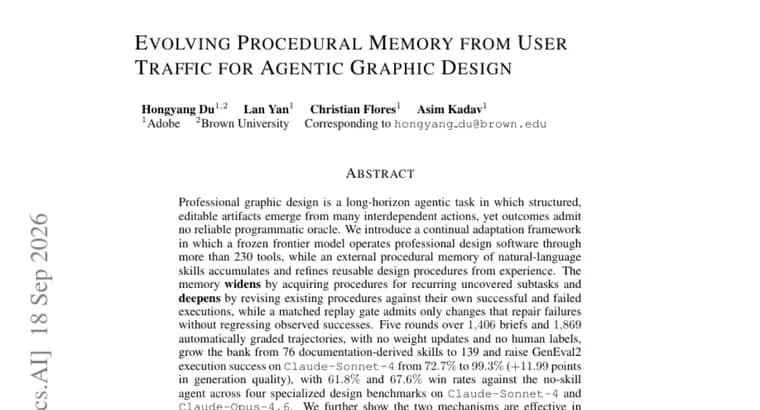
A paper introduces Designer-RSI, a continual-adaptation framework for agentic graphic design, a task the authors describe as long-horizon: many interdependent actions produce structured, editable files, but there is no reliable automatic way to check whether the result is correct. In the setup, a frozen frontier model operates professional design software through more than 230 tools, while a separate, external procedural memory holds natural-language descriptions of design skills. This memory grows in two ways: it widens by picking up procedures for recurring subtasks the agent has not yet handled, and it deepens by revising existing procedures against records of the agent's own successful and failed runs. A matched replay gate only lets a revision through if it fixes past failures without breaking cases that already worked. Over five adaptation rounds, run on 1,406 real user briefs and 1,869 automatically graded trajectories, with no weight updates to the underlying model and no human labels, the skill bank grew from 76 documentation-derived skills to 139. On the GenEval2 benchmark, execution success for a Claude-Sonnet-4-based agent rose from 72.7% to 99.3%, a separate generation-quality score improved by 11.99 points, and across four specialized design benchmarks the resulting agent won 61.8% of matchups against a no-skill baseline on Claude-Sonnet-4 and 67.6% on Claude-Opus-4.6. On 200 held-out briefs drawn from the same user-traffic benchmark, the widening mechanism alone reached a 49.4% win rate over the no-skill agent, deepening alone reached 48.6%, and the two combined reached 58.5% (p = 0.025), showing the two mechanisms are complementary rather than redundant. The paper frames procedural memory as a practical way to keep adapting an agent continually when feedback is noisy and cannot be verified by a program.
Key facts
- Designer-RSI pairs a frozen frontier model, operating design software through 230+ tools, with an external procedural memory of natural-language skills that grows from experience.
- Five adaptation rounds over 1,406 real user briefs and 1,869 automatically graded trajectories, with no weight updates and no human labels, grew the skill bank from 76 to 139 procedures.
- GenEval2 execution success on Claude-Sonnet-4 rose from 72.7% to 99.3%, alongside a separate 11.99-point rise in generation quality.
- Across four specialized design benchmarks, the agent beat a no-skill baseline 61.8% of the time on Claude-Sonnet-4 and 67.6% on Claude-Opus-4.6.
- On 200 held-out briefs, combining the two memory-growth mechanisms reached a 58.5% win rate versus 49.4% and 48.6% for either alone (p = 0.025).
Why it matters
Graphic design is a long-horizon agentic task: a single job chains many interdependent tool calls into a structured, editable file, and there is no program that can reliably score whether the output is good. Designer-RSI tackles that gap by leaving the underlying model untouched and instead growing an external, readable memory of design procedures from the agent's own experience, offering a way to keep improving an agent's competence at a task nobody can grade automatically, without retraining it and without collecting human labels.
Who it affects
The direct subjects are the design agents themselves, evaluated as a frozen frontier model operating through Claude-Sonnet-4 and Claude-Opus-4.6. The result speaks most to researchers and engineers building long-horizon agents over creative or professional software, where correctness cannot be checked by a script and continual improvement otherwise means either retraining or manual skill curation.
How to use it
Designer-RSI is presented as a research framework layered on top of an existing frontier model, not a released product: it requires the frozen base model to already operate the target software through a large tool set (more than 230 tools here), plus a pipeline to collect real user briefs and automatically grade trajectories so the procedural memory can widen and deepen. The paper does not state whether the code, the trained skill bank, or the 1,406 user briefs are released for others to use.
How solid is it
The evaluation is reasonably large: five adaptation rounds across 1,406 real user briefs and 1,869 automatically graded trajectories, with results reported on two different underlying models (Claude-Sonnet-4 and Claude-Opus-4.6) and a held-out set of 200 briefs where the combined-mechanism win rate carries a reported p = 0.025. All of the reported comparisons are against the paper's own no-skill agent baseline; the paper does not compare Designer-RSI against other continual-learning or agent-memory methods.
Risks and caveats
The abstract does not name the authors' institution, give a timeline for how long the five rounds took, or report any cost, compute, or latency figures for running the procedural-memory system alongside the agent, so the practical overhead of the approach is unknown from this material. The reliance on automatically graded trajectories to judge success in a domain the authors themselves say has no reliable programmatic oracle is worth keeping in mind when reading the win-rate numbers.
“Procedural memory offers a practical route to continual adaptation of agents under noisy, unverifiable feedback.”
— the paper's authors