DF26 benchmark finds deepfake video detectors near random chance
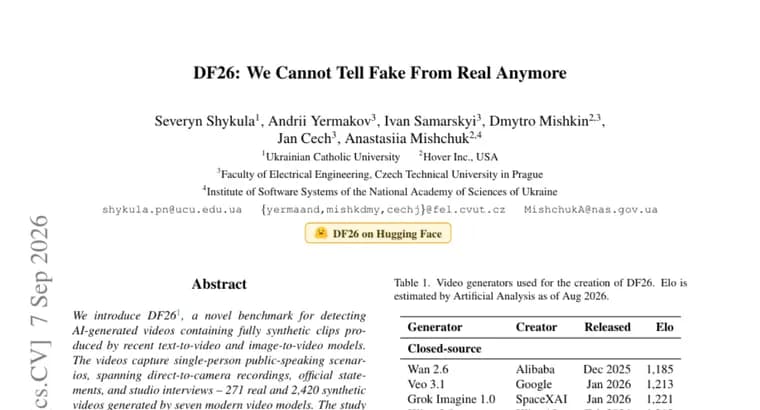
A study introduces DF26, a benchmark built to test how well deepfake detectors and human viewers can tell real videos from AI-generated ones. The set contains 271 real videos and 2,420 synthetic videos, with the synthetic clips generated by seven modern video-generation models. All the footage follows the same format: single-person public speaking, covering direct-to-camera recordings, official statements, and studio interviews, the kind of clip most likely to be mistaken for a genuine broadcast or announcement. Testing on DF26 found that human performance at spotting the fakes, and the performance of state-of-the-art deepfake detectors, both came out close to random chance. The authors argue this exposes a weakness in how deepfake detection is currently evaluated: existing test sets and detectors are not keeping pace with newer generative models, and evaluation protocols need to be redesigned to explicitly measure how well a detector holds up against the kind of videos today's generators actually produce, rather than the older, easier-to-spot fakes many detectors were tuned on.
Key facts
- DF26 contains 271 real videos and 2,420 AI-generated videos.
- The synthetic videos were produced by seven modern video-generation models.
- All videos show single-person public speaking: direct-to-camera recordings, official statements, and studio interviews.
- Both human viewers and state-of-the-art deepfake detectors performed close to random chance at telling real from fake on DF26.
- The authors say this shows current detection benchmarks do not capture the distribution shift caused by newer generative models.
Why it matters
Deepfake detection has been treated as a largely solved problem for older generation methods, but DF26 suggests that assumption breaks down against current text-to-video and image-to-video systems. If both trained detectors and human reviewers land near chance level on realistic public-speaking footage, the safety net that platforms, newsrooms and fact-checkers lean on to catch synthetic video is not holding up against the newest generators.
Who it affects
The result concerns anyone who relies on deepfake detection as a line of defense: social platforms moderating video uploads, journalists verifying footage of officials or public figures, and researchers building the next generation of detection tools. It also affects the broader public exposed to video of speeches, statements and interviews, the exact format DF26 targets because it is the one most often faked for impact.
How to use it
DF26 is offered as a benchmark that detector developers and researchers can test against, specifically to check whether a detection method still works when the fakes come from recent video-generation models rather than the older ones many existing test sets are built on. The point of the benchmark is to stress-test claims of detector accuracy against a distribution of fakes that matches what generators can produce now.
How solid is it
The benchmark is reasonably sized, 271 real videos against 2,420 synthetic ones spanning seven different generative models, which gives the result some breadth rather than resting on a single generator's quirks. That said, the source text does not give numeric accuracy or error-rate figures for either the human evaluators or the detectors, only that both landed close to random chance, so the precise margin above or below chance is not stated.
Risks and caveats
The source text does not name the seven video-generation models used, does not break down performance by model, and gives no author names, institutions, or publication venue for the study. That limits how much independent scrutiny is possible from the text alone. The core finding, that both humans and detectors struggle on this benchmark, still stands as reported, but it should be read as a single study's result rather than a fully audited consensus figure.