DPDM paper uses a frozen LimiX-2 predictor for agent decisions
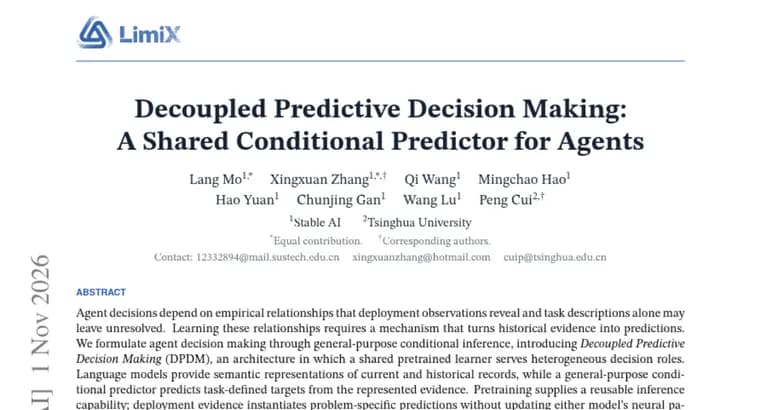
A paper listed on Hugging Face Papers introduces Decoupled Predictive Decision Making (DPDM), an architecture that treats heterogeneous agent decisions as conditional prediction with a shared pretrained learner. The starting argument is that agent decisions depend on empirical relationships that only deployment observations reveal, and that a task description alone may leave those relationships unresolved.
The design splits the work in two. Language models turn the current and historical records into semantic representations. A general-purpose conditional predictor then predicts task-defined targets from that represented evidence, and a decision rule maps the predictions to choices. Pretraining supplies reusable inference capability, while deployment evidence instantiates problem-specific predictions without updating either model's neural parameters. Tool judgments, candidate preferences and reasoning assessments all share the same evidence-and-query interface. A single frozen LimiX-2 predictor serves all five task categories. The paper frames this as two complementary sources of agent capability: semantic knowledge from language pretraining, and empirical inference from structured-data pretraining.
The reported results use Qwen3.5-27B as the semantic encoder. Across 50 benchmarks, DPDM raises mean accuracy from 78.80% with few-shot prompting to 84.92%, measured under each method's respective evaluated history budget. With identical histories and queries, DPDM reaches 82.33%. On ToolPRMBench, the absolute accuracy gains are 34.26% on the BFCL task and 28.87% on the ToolSandbox task, again at the methods' respective evaluated history budgets. Accuracy improves as history grows. With identical imbalanced histories, mean balanced accuracy improves by an absolute 14.51% across five reasoning-step assessment tasks and four encoders.
The authors conclude that DPDM makes learning from experience an independently improvable foundation-model capability, giving advances in conditional prediction a shared route to improve decisions across agent tasks.
Key facts
- DPDM splits an agent decision in two: language models encode current and historical records, and a frozen general-purpose conditional predictor, LimiX-2, predicts the task-defined target.
- With Qwen3.5-27B as the encoder, mean accuracy across 50 benchmarks goes from 78.80% (few-shot prompting) to 84.92% under each method's evaluated history budget, and to 82.33% with identical histories and queries.
- On ToolPRMBench, absolute accuracy gains are 34.26% on BFCL and 28.87% on ToolSandbox, at the methods' respective history budgets.
- No neural parameters of either model are updated at deployment; evidence supplied at run time shapes the prediction, and accuracy improves as history grows.
- With identical imbalanced histories, mean balanced accuracy on five reasoning-step assessment tasks improves by an absolute 14.51% across four encoders.
Why it matters
The paper argues for a different way to build agent decision making: instead of asking a language model to reason from a prompt, route the evidence through a separate predictor pretrained on structured data. The authors say this makes learning from experience an independently improvable capability, so progress in conditional prediction could lift decisions across many agent tasks without retraining the language model. The pitch rests on the claim that task descriptions alone can leave empirical relationships unresolved, and that deployment observations resolve them.
Who it affects
Teams building agents that make repeated judgments, such as checking tool calls, choosing between candidates or assessing reasoning steps, are the ones the design speaks to. It also concerns researchers working on structured-data and tabular-style foundation models, since the paper treats that pretraining as a source of agent capability alongside language pretraining.
How to use it
The source describes the architecture but does not mention code, a model release or a licence, so there is nothing to download or run from it. Conceptually, the recipe is: encode the current and historical records with a language model, feed the encoded evidence and a query to a frozen conditional predictor, and map its prediction to a choice with a decision rule. Because no parameters are updated, adapting to a new problem means supplying evidence, and the paper reports that accuracy improves as history grows.
How solid is it
The numbers are the authors' own, reported in the abstract of a preprint listing. The headline 84.92% is measured under each method's respective evaluated history budget, so it is not a like-for-like comparison; the matched comparison with identical histories and queries gives 82.33%, against 78.80% for few-shot prompting (a gap of 3.53 points, versus 6.12 points for the headline figure). The history budgets are not specified in the source, and the only baseline named is few-shot prompting. The source does not list the five task categories or name the four encoders in the reasoning-step result.
Risks and caveats
Treat the large gains with care. The 34.26% and 28.87% ToolPRMBench figures are absolute accuracy gains at differing history budgets, and the source gives no absolute accuracy levels on BFCL or ToolSandbox. The 14.51% balanced accuracy gain applies to reasoning-step assessment with imbalanced histories, not to agent tasks in general. Results depend on having useful history for the predictor to draw on. Independent replication is not mentioned in the source.
“DPDM makes learning from experience an independently improvable foundation-model capability, creating a shared route for advances in conditional prediction to improve decisions across agent tasks.”
— DPDM paper abstract, Hugging Face Papers