DreamX-Phi 1.0 ranks 1st and 2nd in WorldArena 2.0 Challenge tracks
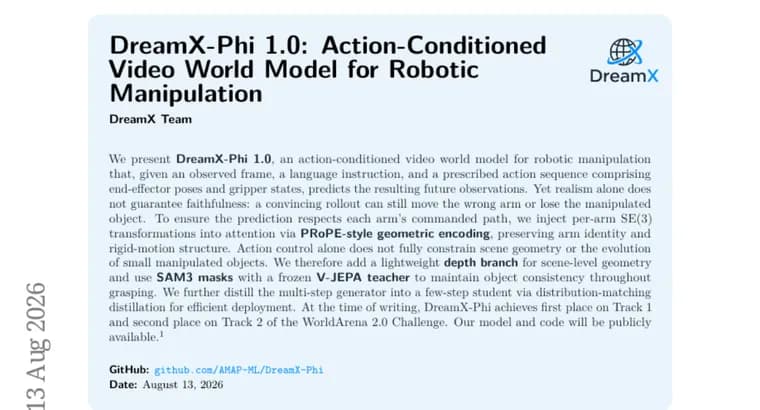
Researchers have presented DreamX-Phi 1.0, an action-conditioned video world model built for robotic manipulation. Given an observed frame, a language instruction and a prescribed action sequence, specifically a series of end-effector poses and gripper states, the model predicts the future video frames that should follow. The aim is a system that can forecast what a robot's planned moves will actually produce before or without running them on real hardware.
The authors' starting point is that a video prediction can look realistic while still being wrong: a convincing rollout can still move the wrong arm or lose track of the object being manipulated, so realism alone does not guarantee faithfulness to the commanded action. To close that gap, DreamX-Phi 1.0 injects per-arm SE(3) transformations, each arm's position and orientation in 3D space, into its attention mechanism using PRoPE-style geometric encoding. This preserves which arm is which and respects the structure of rigid-body motion, so a predicted rollout follows the correct arm's commanded path.
Conditioning on the action sequence alone still does not fully pin down the scene's geometry or how small manipulated objects change over the course of a rollout. To address that, the model adds a lightweight depth branch that predicts scene-level geometry, and uses SAM3 segmentation masks together with a frozen V-JEPA model acting as a teacher to keep the manipulated object consistent throughout a grasp.
For deployment, the authors distill the multi-step video generator into a few-step student model through distribution-matching distillation, aiming for faster inference without building a separate model from scratch.
At the time of writing, DreamX-Phi 1.0 held first place on Track 1 and second place on Track 2 of the WorldArena 2.0 Challenge. The text gives only these rankings, not the underlying benchmark scores, and does not describe what the challenge measures, who organizes it, or how many competitors or tracks it includes beyond the two named. The authors say the model and its code will be made publicly available, but no release date or license is given. The text does not name individual authors or an affiliated institution, and it draws no comparison to any other video world model, a baseline, or an earlier DreamX version.
Key facts
- DreamX-Phi 1.0 is an action-conditioned video world model: from a starting frame, a language instruction and a sequence of end-effector poses and gripper states, it predicts the resulting future video of a robotic manipulation attempt.
- It injects per-arm SE(3) transformations into attention via PRoPE-style geometric encoding, preserving arm identity and rigid-motion structure so predictions follow the correct arm's commanded path.
- A lightweight depth branch plus SAM3 masks guided by a frozen V-JEPA teacher keep scene geometry and small manipulated objects consistent through a grasp.
- The multi-step video generator is distilled into a few-step student model via distribution-matching distillation for faster deployment.
- At the time of writing, DreamX-Phi 1.0 held first place on Track 1 and second place on Track 2 of the WorldArena 2.0 Challenge; the authors say the model and code will be released publicly, though no date is given.
Why it matters
Robotic manipulation is exactly the setting where a video prediction that merely looks plausible is not good enough: a system used to plan, evaluate or train on predicted rollouts needs the video to actually track the commanded action, not just look smooth. The authors state the problem directly: a convincing rollout can still move the wrong arm or lose the manipulated object, so realism alone does not guarantee faithfulness. DreamX-Phi 1.0 targets that faithfulness gap directly, through per-arm geometric encoding, a depth branch and mask-guided object tracking, rather than treating visual quality as the end goal.
Who it affects
The direct audience is researchers building or evaluating action-conditioned video world models for robotics, and teams that plan or check a robot's moves by predicting what a manipulation attempt will look like before running it. DreamX-Phi 1.0's placement also puts it among the leading entries in the WorldArena 2.0 Challenge, on Track 1 and Track 2. The text does not name any individual authors or an institution behind the work.
How to use it
Nothing is available for public use yet: the text states only that the model and code will be released, without giving a date or a license. Once released, the intended users are robotics and simulation researchers who want to predict a manipulation rollout from a starting frame, an instruction and a planned sequence of end-effector poses and gripper states, rather than render or execute it directly.
How solid is it
The evidence offered is a competition placement rather than a published benchmark score: DreamX-Phi 1.0 holds first place on Track 1 and second place on Track 2 of the WorldArena 2.0 Challenge at the time of writing, but the text gives no numeric accuracy or success-rate figures for either track, and does not describe what the challenge measures, who organizes it, or how many competitors or tracks exist beyond the two named. There is also no comparison in the text to any other video world model, a baseline, or an earlier DreamX version, so the size of DreamX-Phi 1.0's advantage is not stated. Standings in an ongoing challenge can shift, which is presumably why the placement is qualified as holding only at the time of writing.
Risks and caveats
The text names no authors or affiliated institution, so the work cannot be independently attributed or weighed against a lab's track record. The promised public release of the model and code carries no date, and research announcements in this form sometimes slip or stall. The faithfulness claims, that the model tracks the correct arm and keeps objects consistent, rest on the authors' own description of the method rather than on a reported metric that isolates faithfulness from visual realism, and the WorldArena 2.0 placement is not accompanied by a score, so its margin over other entries is unknown.
“Yet realism alone does not guarantee faithfulness: a convincing rollout can still move the wrong arm or lose the manipulated object.”
— the paper's authors