Evoke world model generates open-ended video with external memory
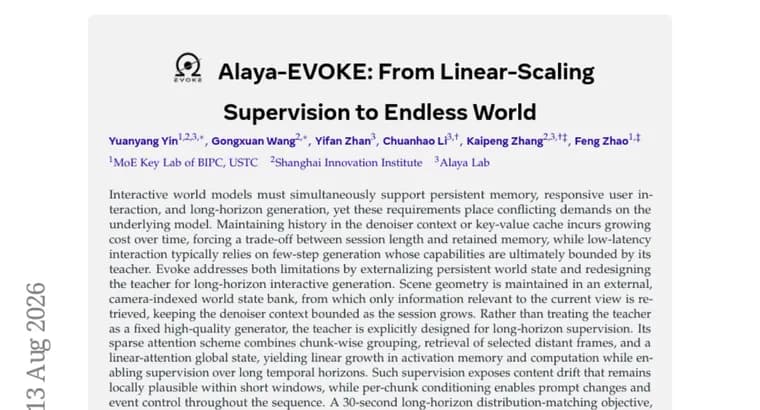
Yuanyang Yin, Gongxuan Wang, Yifan Zhan, Chuanhao Li, Kaipeng Zhang and Feng Zhao posted "Alaya-EVOKE: From Linear-Scaling Supervision to Endless World" to arXiv (arXiv:2608.13546, filed under Computer Vision and Pattern Recognition, submitted 13 August 2026). The paper introduces an interactive world model the authors call Evoke, built to solve a problem they lay out directly: an interactive world model needs persistent memory, low-latency response and long-horizon generation all at once, and those three requirements pull against each other. Keeping the full session history inside the denoiser's own context or key-value cache gets more expensive the longer a session runs, forcing a trade-off between how long a session lasts and how much of it the model can actually remember. Meanwhile, the few-step generation that low-latency interaction depends on is only as capable as whatever teacher model trained it.
Evoke's answer has two parts. First, it moves persistent scene geometry out of the generating model and into an external, camera-indexed "world state bank", retrieving only the information relevant to the current view; that keeps the denoiser's own context bounded no matter how long the session grows. Second, instead of treating the teacher model as fixed, the authors redesign it for long-horizon supervision: its sparse attention combines chunk-wise grouping, retrieval of selected distant frames and a linear-attention global state, so the teacher's own memory and compute grow only linearly even while it supervises much longer sequences. That longer supervision window exposes content drift: output that can look locally plausible inside a short window while still drifting over the course of a longer session. Per-chunk conditioning still lets prompts and events change as the sequence continues.
To make those gains usable interactively, the authors apply a 30-second distribution-matching training objective, run under self-forced rollouts, transferring them into a three-step "student" model that uses no classifier-free guidance. The paper reports this improves the student's resistance to long-term drift while preserving its responsive, per-chunk conditioning. With a bounded context and recurrent external memory, Evoke is described as supporting open-ended, continuously evolving generation.
On performance, the source gives one concrete timing figure: on a single H200 GPU at 384×640 resolution, each 1.5-second chunk takes 2.11 seconds to generate, about 1.4 times the chunk's own playback length. On benchmarks, the paper reports Evoke, run as this three-step system, as state-of-the-art on a benchmark it calls WBench, and only competitive, a weaker claim, on two others, VBench-Long and VBench-2.0. No numeric score, percentage or margin is given for any of the three, and the abstract does not name what Evoke is being compared against. It also does not say how long a session can actually run in practice: the open-ended claim rests on the architecture rather than a demonstrated long-run test, and neither the abstract nor the fetched arXiv page mentions any code, model checkpoint, dataset or project page being released.
Key facts
- Yuanyang Yin, Gongxuan Wang, Yifan Zhan, Chuanhao Li, Kaipeng Zhang and Feng Zhao introduce Evoke, an interactive world model, in "Alaya-EVOKE: From Linear-Scaling Supervision to Endless World" (arXiv:2608.13546, submitted 13 August 2026).
- Evoke keeps scene geometry in an external, camera-indexed "world state bank" and retrieves only view-relevant information, so the denoiser's own context stays bounded no matter how long a session runs.
- The teacher model is redesigned with sparse attention, chunk-wise grouping, retrieval of distant frames and a linear-attention global state, giving it linear rather than growing memory and compute cost while it supervises over long horizons and exposes content drift that short-window training would miss.
- A 30-second distribution-matching training objective, run under self-forced rollouts, distills those gains into a three-step student model that uses no classifier-free guidance, improving resistance to long-term drift while keeping responsive, per-chunk prompt and event control.
- On a single H200 GPU at 384×640 resolution, each 1.5-second chunk takes 2.11 seconds to generate; the paper reports Evoke as state-of-the-art on a benchmark called WBench and only competitive on VBench-Long and VBench-2.0, without numeric scores or a named baseline for any of the three.
Why it matters
Interactive world models sit at an awkward intersection: they need persistent memory, low-latency response and generation that keeps going for a long time, and the usual ways of satisfying one requirement break another. Keeping the full session history inside the model's own context or key-value cache gets more expensive as the session grows, forcing a trade-off between how long it can run and how much it remembers; and the few-step generation that low latency requires is only as capable as the teacher model that trained it. Evoke attacks both sides at once: an external, retrieval-based memory bank keeps the model's own working context from growing with session length, while a teacher redesigned around linear-cost sparse attention, chunk-wise grouping, distant-frame retrieval and a linear-attention global state, can be supervised over long horizons without its own cost exploding. That is what lets the training process expose and correct drift that would otherwise only surface once a session has run for a long time.
Who it affects
This is a research paper, not a shipped product. Its immediate audience is researchers and engineers building interactive world models and few-step video generation systems, people who run into the exact memory-versus-latency trade-off the paper describes. The source names no company, product or institution adopting or affiliated with Evoke, and no author's institutional affiliation is given, so beyond the six named authors the source does not say who else, if anyone, is currently working with it.
How to use it
There is nothing to install, license or buy: the source is the arXiv preprint itself, filed under Computer Vision and Pattern Recognition (cs.CV) and submitted 13 August 2026. Neither the abstract nor the fetched arXiv page mentions a code release, model checkpoint, dataset or project page, so for now "using" Evoke means reading the paper; the world state bank, the redesigned teacher and the distillation objective described above are what the source makes public.
How solid is it
The evidence mixes one named benchmark win with vaguer comparisons. The paper reports Evoke, evaluated as the three-step system, as state-of-the-art on a benchmark called WBench, but only competitive, a weaker claim, on two others, VBench-Long and VBench-2.0. No numeric score, percentage or margin is given for any of the three, and the abstract never names what Evoke is being compared against, so neither claim can be checked from the source alone. The one concrete performance number is a single-GPU timing test: on one H200 at 384×640 resolution, each 1.5-second chunk took 2.11 seconds to generate, about 1.4 times the chunk's own length, so this particular configuration ran slower than real time despite the three-step design meant for low-latency use. The paper also does not report how long a session can actually run in practice; the open-ended, continuously evolving claim rests on the bounded-context architecture rather than a demonstrated long-run test.
Risks and caveats
The source gives no institutional affiliation for any of the six authors, and does not explain what "Alaya" in the paper's title, "Alaya-EVOKE", refers to; the abstract body itself calls the system only "Evoke", never "Alaya-EVOKE", so the relationship between the two names is not stated. No code, model checkpoint, dataset or project page is mentioned, and the source gives no training-data source, dataset size or number of training steps for either the teacher or the student, so none of the claims above can be independently run, reproduced or verified. The drift problem the paper sets out to address, output that can look fine inside a short window while still drifting over a longer session, is described as a real, exposed issue once training supervises over long horizons; the source says the fix improves resistance to it, not that the problem is eliminated.
“Evoke addresses both limitations by externalizing persistent world state and redesigning the teacher for long-horizon interactive generation.”
— the authors