DreamX turns a video diffusion model into a universal latent action learner
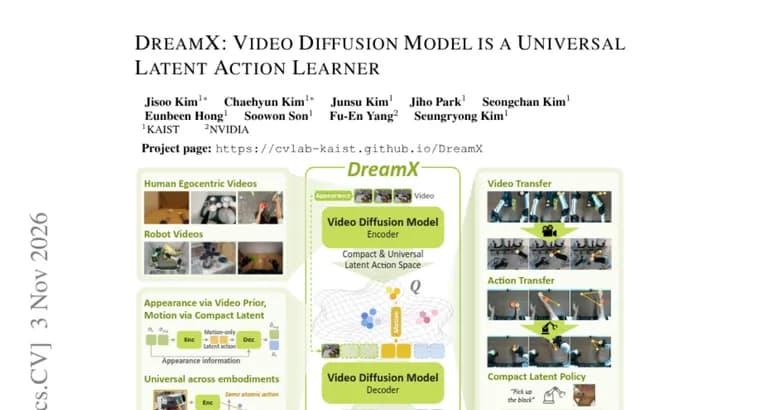
DreamX is a method that takes a pretrained video diffusion model and uses it as a universal latent action learner. The goal is an action representation learned from video that stays consistent across different executions of the same action, yet does not change with the body doing it or the way the scene looks.
The authors start from a weakness in existing latent action models. Those models infer actions from visual transitions, but their representations often entangle the underlying action with irrelevant visual variations, which limits how well they transfer across embodiments.
DreamX instead extracts compact latent actions from the video model's rich spatiotemporal features. Each latent video frame is compressed by 300 times, from 1,200 tokens down to 4, as the paper writes it. Because the approach leans on the video model's generative prior, the authors say the resulting latent actions capture action-relevant dynamics disentangled from visual appearance.
The latent space then works as a shared action interface across embodiments (human and robot), environments and action parameterizations. On LARY-Bench, the authors report that DreamX achieves state-of-the-art performance among latent action models. They also say actions encoded in one setting remain effective in another: the latent space supports any-to-any video transfer and zero-shot action transfer across diverse embodiments and environments.
Finally, the shared interface enables policy learning in a compact latent action space, which the authors say reduces the computational cost of video-diffusion-based policies.
Key facts
- DreamX repurposes a pretrained video diffusion model as a universal latent action learner.
- Latent actions compress each latent video frame by 300 times, from 1,200 tokens to 4.
- The authors report state-of-the-art results among latent action models on LARY-Bench.
- The latent space supports any-to-any video transfer and zero-shot action transfer across embodiments (human and robot) and environments.
- Learning policies in the compact latent action space is said to cut the computational cost of video-diffusion-based policies.
Why it matters
Latent action models try to learn what is being done in a video, not just what it looks like. The authors argue that existing ones tangle the action with irrelevant visual detail, which hurts transfer between embodiments. DreamX tries to fix this by borrowing the generative prior of a pretrained video diffusion model, so the action representation separates from appearance. If it holds up, one shared action interface could link human video and robot control.
Who it affects
Mainly researchers working on latent action models, video-based policy learning and robot learning from human video. The paper's framing covers both human and robot embodiments, so work that tries to reuse human footage for robots is the closest audience.
How to use it
The abstract describes three uses of the latent space: encoding an action in one setting and reusing it in another through any-to-any video transfer, zero-shot action transfer across embodiments and environments, and policy learning in the compact latent action space. It gives no code, model release or usage instructions.
How solid is it
This is a preprint, and everything above comes from the authors' own description. The state-of-the-art claim on LARY-Bench is stated without scores or margins over other latent action models. The size of the computational saving for video-diffusion-based policies is not quantified. The 300 times figure refers to token compression per latent video frame (1,200 to 4 tokens).
Risks and caveats
The transfer and efficiency claims are unquantified in the available text, so how large the gains are remains unclear. Real-robot experiments, success rates and training details are not reported in the abstract. Claims of zero-shot transfer across diverse embodiments and environments need independent testing before being treated as general.