LoCo teaches reasoning models to stop earlier, cutting length 23% to 45%
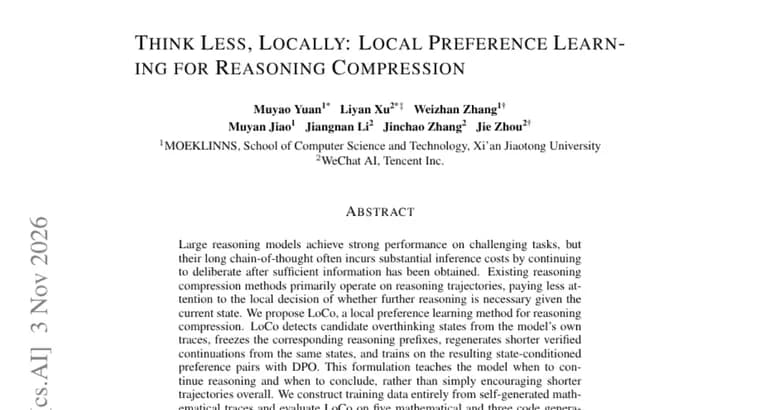
Large reasoning models do well on hard tasks, but their long chain-of-thought often keeps deliberating after the model already has enough information, which drives up inference cost. The paper argues that existing reasoning compression methods mostly work on whole reasoning trajectories and pay less attention to a local question: given the current state, is more reasoning actually needed?
The authors propose LoCo, a local preference learning method for reasoning compression. It works in four steps. LoCo detects candidate overthinking states in the model's own reasoning traces. It freezes the reasoning prefix up to each such state. It then regenerates shorter continuations from that same state and keeps the ones that are verified. Finally, it trains on the resulting state-conditioned preference pairs with DPO. According to the authors, this teaches the model when to keep reasoning and when to conclude, rather than simply pushing it toward shorter trajectories overall.
Training data is built entirely from self-generated mathematical traces. Evaluation covers five mathematical and three code generation benchmarks. The reported results: LoCo reduces completion length by 41.7% to 45.4% on mathematics and by 23.4% to 36.3% on code, while maintaining or improving accuracy and achieving the best AUC across all code benchmarks. The authors say LoCo consistently improves the accuracy-efficiency trade-off on mathematics and transfers effectively to code despite the math-only training, which they take as evidence of cross-domain generality for local preference learning. The code and model are to be publicly released at https://github.com/MuyaoYuan/LoCo.
Key facts
- LoCo is a local preference learning method for reasoning compression: it finds overthinking states in a model's own traces, freezes the prefix, regenerates shorter verified continuations, and trains on the pairs with DPO.
- Reported completion-length reductions are 41.7% to 45.4% on mathematics and 23.4% to 36.3% on code, as ranges across benchmarks.
- Evaluation uses five mathematical and three code generation benchmarks; training data comes only from self-generated math traces.
- The authors report maintained or improved accuracy and the best AUC across all code benchmarks.
- The code and model are promised at github.com/MuyaoYuan/LoCo; the abstract describes them as to be released.
Why it matters
Long chain-of-thought is a main cost of large reasoning models, and part of it is deliberation that continues after the model has what it needs. The paper's angle differs from methods that work on whole trajectories: it targets the local decision of whether further reasoning is needed at a given state. The authors say this teaches the model when to continue and when to conclude, not just to be brief.
Who it affects
Anyone who trains or runs large reasoning models on math or code and pays for long completions. The paper reports length cuts on both domains, so researchers working on reasoning efficiency and on preference optimisation with DPO are the nearest audience.
How to use it
Nothing is usable yet. The authors say the code and model will be publicly released at https://github.com/MuyaoYuan/LoCo, and no release date is given. The recipe as described: take a model's own reasoning traces, mark candidate overthinking states, freeze the prefixes, sample shorter verified continuations from those states, and run DPO on the resulting preference pairs. Training data in the paper is self-generated math traces only.
How solid is it
This is a preprint, and the account here rests on its abstract. The headline numbers are length reductions of 41.7% to 45.4% on mathematics and 23.4% to 36.3% on code across eight benchmarks (five math, three code), with accuracy maintained or improved. The abstract gives no base models or model sizes, no benchmark names, no per-benchmark or absolute accuracy figures, and does not say whether the reductions are means or medians or relative to which baseline. The AUC metric is not defined and no AUC values are given.
Risks and caveats
The claims are the authors' own and the abstract carries few specifics, so the size of the gains on any particular model or benchmark cannot be checked from it. The length reductions are ranges across benchmarks, not a single figure. No inference-cost or latency savings are quantified beyond completion length. The code transfer result comes from math-only training, and the code and model are not yet released.
“This formulation teaches the model when to continue reasoning and when to conclude, rather than simply encouraging shorter trajectories overall.”
— LoCo paper abstract