GameVerse dataset gives world models 1,655 hours of minute-scale gameplay
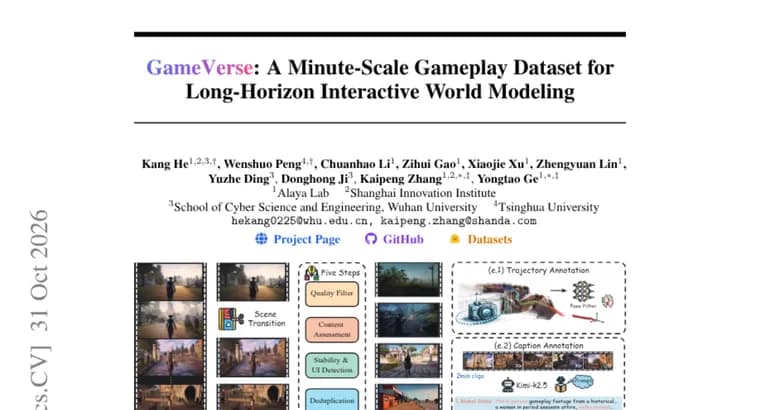
A paper listed on Hugging Face Papers introduces GameVerse, a gameplay video dataset built for what it calls long-horizon interactive world modeling. Interactive world models generate controllable, dynamic environments from action inputs. The authors say current models struggle to stay coherent beyond roughly one minute of rollout, and that the cause is not model capacity but the scarcity of long-horizon training data.
They point to two weaknesses in existing gameplay video datasets. The clips are typically under ten seconds long, and the captions describe whole clips in coarse, undifferentiated text, which the authors call insufficient for controllable long-horizon generation.
GameVerse contains 69.7K clips spanning 1,655 hours and 349.6 million frames, drawn from diverse first- and third-person gameplay. Of that total, 1,358 hours are continuous two-minute sequences, which the authors describe as an order of magnitude longer than prior datasets.
Every clip goes through a unified pipeline of scene-consistent segmentation, quality filtering, camera pose estimation and event-based caption annotation. Each clip is paired with a temporally stable camera trajectory that stays coherent across minutes. The captions separate static scene context from dynamic foreground events, and they align to event boundaries rather than fixed time windows.
The authors report that a comprehensive analysis shows GameVerse surpasses existing public datasets in scale, diversity and annotation quality. They also say experiments demonstrate that training on GameVerse substantially extends the temporal horizon of interactive world models.
Key facts
- GameVerse holds 69.7K clips totalling 1,655 hours and 349.6 million frames of first- and third-person gameplay.
- 1,358 of those hours are continuous two-minute sequences, which the authors call an order of magnitude longer than prior datasets, whose clips are typically under ten seconds.
- Each clip comes with a camera trajectory that stays coherent across minutes, plus event-based captions that separate static scene context from dynamic foreground events.
- The authors argue current interactive world models lose coherence beyond roughly one minute because of scarce long-horizon data, not limited model capacity.
- The authors say training on GameVerse substantially extends the temporal horizon of interactive world models.
Why it matters
The paper's argument is that the one-minute coherence barrier in interactive world models comes from the data, not from model size or design. If that holds, longer and better-annotated video is a direct route to longer-lasting generated environments. The authors contrast GameVerse with existing gameplay datasets, whose clips are typically under ten seconds and whose captions cover a whole clip in coarse text. GameVerse offers two-minute continuous sequences, camera trajectories and captions tied to event boundaries.
Who it affects
Mainly researchers and teams training interactive world models that generate controllable environments from action inputs, and anyone building gameplay video datasets or captioning pipelines for long clips. The source describes the work only at the level of the dataset and its construction.
How to use it
The source does not state any release, licence, download link or availability of the dataset. What a practitioner can take from it now is the recipe: scene-consistent segmentation, quality filtering, camera pose estimation, and captions that split static scene context from dynamic events and follow event boundaries instead of fixed time windows.
How solid is it
These are the authors' own claims. They say a comprehensive analysis shows GameVerse beats existing public datasets in scale, diversity and annotation quality, and that experiments show a substantially longer temporal horizon after training on it. The source gives no numeric results for those experiments: no new horizon length, no metrics, no model names. It also does not name the datasets it is compared against. The dataset statistics themselves (69.7K clips, 1,655 hours, 349.6 million frames, 1,358 hours of two-minute sequences) are stated directly.
Risks and caveats
The size of the improvement is not quantified in the source, so how far the horizon actually extends is unknown. No authors or institutions are named, and neither are the games or the sources of the footage. The source does not say how the remaining hours beyond the 1,358 hours of two-minute sequences are structured. The claim that data scarcity, not capacity, is the bottleneck is the authors' framing.
“a limitation rooted not in model capacity but in the scarcity of long-horizon training data”
— GameVerse paper abstract, on why interactive world models lose coherence beyond roughly one minute