DTCA assigns token-level credit in RL for diffusion language models
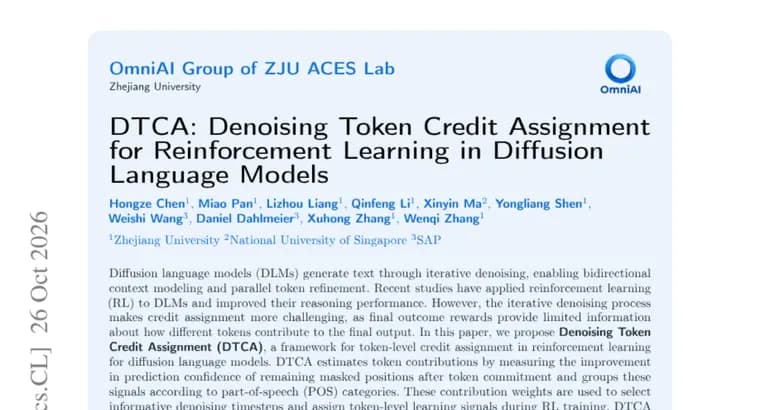
A preprint listed on Hugging Face Papers introduces Denoising Token Credit Assignment (DTCA), a framework for token-level credit assignment in reinforcement learning (RL) for diffusion language models (DLMs).
The background is this. DLMs generate text through iterative denoising, which allows bidirectional context modeling and parallel token refinement. Recent studies have applied RL to DLMs and improved their reasoning performance. The authors point to a problem: the iterative denoising process makes credit assignment harder, because a final outcome reward gives limited information about how individual tokens contributed to the final output.
DTCA works in several steps. It estimates each token's contribution by measuring how much the prediction confidence of the remaining masked positions improves after that token is committed. It then groups these signals by part-of-speech (POS) category. The resulting contribution weights do two jobs during RL training: they select informative denoising timesteps, and they assign token-level learning signals. DTCA also calibrates those learning signals according to token-level entropy changes caused by policy updates.
For evaluation, the authors ran experiments on LLaDA-8B-Instruct. They report that DTCA consistently improves mathematical reasoning across different generation budgets, with gains of up to 9.0 points on MATH500 and 5.3 points on GSM8K over the base model. The abstract does not give absolute scores, does not say which generation budget produced each figure, and does not say whether the 5.3-point GSM8K gain is a maximum or a typical value.
Key facts
- DTCA (Denoising Token Credit Assignment) is a framework for token-level credit assignment in RL for diffusion language models.
- It scores a token by how much the prediction confidence of the remaining masked positions improves after the token is committed, then groups the signals by part-of-speech category.
- The weights select informative denoising timesteps and assign token-level learning signals; the signals are further calibrated by token-level entropy changes from policy updates.
- On LLaDA-8B-Instruct, the authors report gains of up to 9.0 points on MATH500 and 5.3 points on GSM8K over the base model.
- The reported improvement is described as consistent across different generation budgets.
Why it matters
RL has already improved reasoning in diffusion language models, but outcome rewards say little about which tokens earned them. Denoising makes that harder, since text is refined over many steps rather than written left to right. DTCA targets this gap by turning the model's own confidence signals into per-token credit. If the approach holds up, it gives RL training of DLMs a finer learning signal than a single reward at the end.
Who it affects
Mainly researchers and engineers training diffusion language models with reinforcement learning, especially for mathematical reasoning. The evaluation covers one model, LLaDA-8B-Instruct, so the direct relevance is to that model family and similar setups.
How to use it
The abstract gives no code release or training recipe. A practitioner would read the full paper for the details of the confidence-improvement measure, the POS grouping, the timestep selection and the entropy-based calibration before trying to reproduce it.
How solid is it
This is a preprint abstract with reported results on two benchmarks, MATH500 and GSM8K, using one model, LLaDA-8B-Instruct. The gains are stated against the base model. The figure of 9.0 points on MATH500 is an upper bound ("up to"). The abstract gives no absolute scores, and the tested generation budgets are not specified.
Risks and caveats
Evidence in the abstract is limited to one model and two math benchmarks, so it says nothing about other domains or model sizes. No comparison against other credit-assignment or RL methods for diffusion language models is stated, so the size of the advantage over alternatives is unknown. It is also unclear whether the 5.3-point GSM8K gain is a maximum or a typical value.