Edit-Ready Training prepares vision models for LLM weight edits
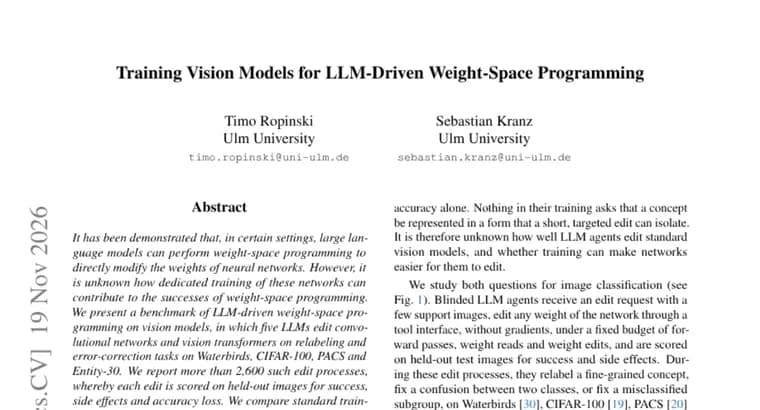
Earlier work has shown that, in certain settings, large language models can perform weight-space programming: they directly modify the weights of a neural network. What nobody knew, according to the paper, is how dedicated training of those networks contributes to the success of such edits.
To test this, the authors built a benchmark of LLM-driven weight-space programming on vision models. Five LLMs edit convolutional networks and vision transformers on two kinds of task, relabeling and error-correction. The tasks run on four datasets: Waterbirds, CIFAR-100, PACS and Entity-30. The benchmark reports more than 2,600 such edit processes. Each edit is scored on held-out images for success, side effects and accuracy loss.
Three training regimes are compared: standard training with label smoothing, gradient-based editable training, and the authors' own Edit-Ready Training (ERT). The authors call ERT a novel method that rehearses the direct, closed-form weight edits LLMs perform.
The main finding is that preparing networks for editing raises the success of LLM edits substantially where standard networks are hard to edit. ERT also achieves the highest mean score for GPT-6 Astra and Claude Opus 5.5 across all evaluated baselines. The authors say they will release their LLM testing framework alongside all tasks, editing trajectories and scores. A project page is at viscom.uni-ulm.de/wsp.
Key facts
- The benchmark has five LLMs edit convolutional networks and vision transformers directly in weight space, on relabeling and error-correction tasks.
- It covers four datasets (Waterbirds, CIFAR-100, PACS and Entity-30) and reports more than 2,600 edit processes, each scored on held-out images for success, side effects and accuracy loss.
- Edit-Ready Training (ERT) rehearses the direct, closed-form weight edits LLMs perform during training.
- Preparing networks for editing raises LLM edit success substantially where standard networks are hard to edit.
- ERT achieves the highest mean score for GPT-6 Astra and Claude Opus 5.5 across all evaluated baselines; the authors plan to release the testing framework, tasks, trajectories and scores.
Why it matters
Weight-space programming means an LLM changes a network's weights directly instead of retraining it. The paper starts from a gap: it was unknown how dedicated training of the target network affects whether such edits succeed. This work gives a benchmark for that question on vision models and proposes ERT, a training method aimed at making networks easier for an LLM to edit.
Who it affects
The work is most relevant to researchers studying model editing and LLM-driven modification of neural networks, particularly on vision models such as convolutional networks and vision transformers. The benchmark's relabeling and error-correction tasks also point at people who need to fix a trained classifier's mistakes without a full retraining run.
How to use it
The authors say they will release their LLM testing framework alongside all tasks, editing trajectories and scores, so others can run their own models through the same tests. The project page is at viscom.uni-ulm.de/wsp. The abstract gives no release date for the framework.
How solid is it
The evidence is broad in scale: more than 2,600 edit processes, five LLMs, two architecture families, four datasets and three training regimes, with each edit scored on held-out images. The source here is the paper's abstract, which gives no numeric success rates, score values or effect sizes, so the size of the gains cannot be judged from it. The ERT result for the highest mean score is stated only for GPT-6 Astra and Claude Opus 5.5; it does not say whether ERT is best for the other three LLMs.
Risks and caveats
The claim that edit preparation helps is limited by the authors' own wording to settings "where standard networks are hard to edit". The abstract does not list the five LLMs beyond GPT-6 Astra and Claude Opus 5.5, and it names no authors, only the project page. The released framework is a promise, not yet a deliverable in the source. Findings are for vision models on the four named datasets and may not carry over elsewhere.
“We show that preparing networks for editing raises the success of LLM edits substantially where standard networks are hard to edit.”
— Paper abstract