Eden GeoPower zaps rock to chase underground hydrogen
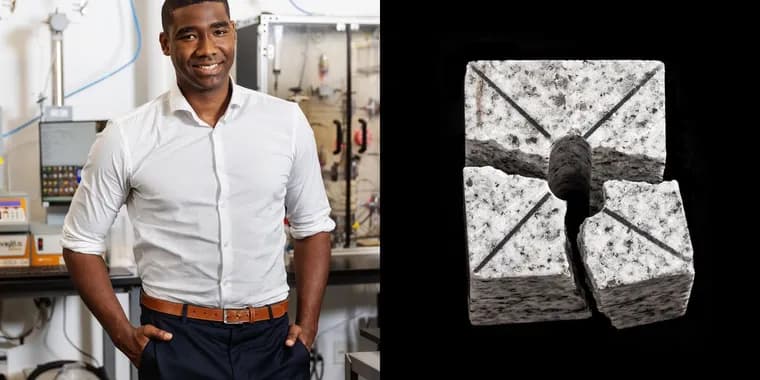
On a horse farm outside Boston, the startup Eden GeoPower is running a field test of a technique it calls electrical reservoir stimulation. A crane lowers a half-meter-long, copper-tipped electrode down a borehole that runs hundreds of meters deep, through sandstone into hard, ancient bedrock, while a second electrode sits in a twin borehole nearby. High-voltage generators on the surface fire pulses between the two electrodes: each pulse heats the rock, builds pressure, and splits it into a web of fractures, in effect a miniature underground lightning strike. Eden's own tagline is blunt: it breaks rocks with electricity.
The company sees several uses for controlled underground fracturing, including mineral mining, geothermal heat extraction and carbon storage, but the application driving this story is hydrogen. Clean hydrogen made by splitting water with renewable-powered electrolyzers is usually too expensive to compete with hydrogen made from methane, the cheapest and most common production method today, even though methane is itself a potent greenhouse gas. Global hydrogen demand reached roughly 100 million tonnes in 2024, an amount whose energy content comes to only about 3 percent of the world's total annual energy use, and most of that hydrogen goes into oil refining, fertilizer and plastics rather than fuel. That cost problem, combined with growing evidence that Earth's crust already produces hydrogen naturally through water-rock reactions, has pushed a wave of entrepreneurs to look underground instead of at electrolyzers.
Natural, or geologic, hydrogen has been documented since the 19th and 20th centuries, when researchers in the former Russian Empire and the Soviet Union reported it seeping from mines and wells, though the observations were largely dismissed until recently. The clearest proof came in 1987 in Bourakébougou, Mali, where villagers drilling a water well noticed gas escaping from the hole; according to local lore, a worker's lit cigarette ignited it in a blue flame. The well was capped for 25 years until a Malian prospector confirmed in 2012 a large hydrogen reservoir beneath it; the company now known as Hydroma built a small power plant to run on the gas. Startups in Australia, Canada, the United States and elsewhere joined the search afterward, and by 2025 large multinational petroleum and mining companies had entered the field too. Dozens of companies worldwide have spent about five years hunting for natural hydrogen deposits, drilling hundreds of exploratory wells to date, but none has proved capable of producing the gas at the rates and volumes commercial operation would require. Douglas Wicks, a former ARPA-E program director who now advises geologic-hydrogen companies, sums it up bluntly: prospectors have drilled plenty of holes without finding the gusher, or at least without anyone admitting to it.
Natural deposits require a rare combination of conditions: iron-rich source rock, a porous reservoir to hold the gas and a solid cap rock to trap it. Stimulated, or engineered, geologic hydrogen sidesteps that requirement by treating hydrogen generation not as a lucky accumulation to be found but as a chemical reaction that can be triggered on demand, in principle wherever iron-bearing rock exists within drilling range. Proponents say that if the idea works, and the article is candid that this remains a big if, it could supply almost unlimited energy for the indefinite future. Wicks, credited as the first person to direct major funding toward the idea though not the first to propose it, argues that tapping even 1 percent of the iron-rich rock within US drilling range could power the country's economy for thousands of years, and that a rough, back-of-the-envelope calculation suggests stimulated hydrogen could end up cost-competitive with hydrogen made from methane. Under his leadership, ARPA-E awarded $20 million in 2024 to 16 teams pursuing different stimulation methods, including fracturing rock with fluid or mechanical force, applying catalysts to speed the hydrogen-generating reaction, and manipulating microbes that live in the rock. Eden GeoPower's rock-fracturing project was the only electricity-based approach funded, and it received $900,000 of that total.
Eden GeoPower was founded in 2017 by Paris Smalls, then a 23-year-old MIT graduate student working toward a PhD in civil and environmental engineering, researching how electricity affects rock strength for enhanced geothermal systems, which need fractured hot rock to circulate water through for heat extraction. The conventional method, hydraulic fracturing or fracking, is controversial, since it can trigger earthquakes and contaminate groundwater and many regions have banned it, and it is imprecise too, since injected fluid tends to keep flowing through the same cracks rather than opening new ones. Smalls saw electricity as a way to build a more extensive, more controllable fracture network, one the company says is more permeable than conventional fracking can achieve. He quickly saw other uses for the same approach, in mineral mining, carbon sequestration and extending the life of oil and gas wells, but had not considered hydrogen; when Wicks invited him to apply for ARPA-E's hydrogen program, his first reaction was confusion at how a rock-breaking company could generate hydrogen.
That changed after Smalls met Alexis Templeton, a geomicrobiologist at the University of Colorado Boulder who had become an expert in geologic hydrogen by studying the microbes that consume the gas and the mineral transformations that create it. Templeton joined Eden part-time as lead geochemist from 2023 to 2025, and during that period the company ran its first pilot, in an Oman oil field near where she was already doing her own hydrogen research. The test sent a steady direct-current flow of tens of kilowatts between two wells: in soft, chalky carbonate rock it worked well, lifting oil output by 30 percent, but on harder rock, the kind needed for hydrogen and geothermal work, it barely fractured at all.
So Eden's engineers switched to pulsed power, short concentrated bursts of electricity, an approach with roots in a mid-20th-century discovery in Soviet-era Russia: the physicist and inventor Lev Yutkin, after watching lightning shatter a submerged log rather than burn it, reproduced the effect in his lab by running a high-voltage pulse between electrodes in a water tank, and found the spark ionized the water into a rapidly expanding plasma channel that shattered a submerged plate, an effect he described in a 1955 book. Eden adapted the principle to dry rock: instead of submerging samples, engineers led by vice president of research and development Rafael Villamor-Lora generate a plasma channel directly inside the rock, in the moist pockets between mineral grains, which then expands fast enough to fracture the surrounding material with a shock wave. To scale up for field use, Eden built two custom Marx generators, devices that convert low-voltage DC power into high-voltage bursts by charging and rapidly discharging banks of capacitors; the pair, named Zeus and Thor, can together discharge a surge of several hundred kilovolts. In 2025, Thor fractured a column of hard igneous rock in an abandoned gold-and-silver mine in Colorado, increasing its permeability tenfold. Setup at the Massachusetts site began in March 2026 to refine the equipment and gather data on how the technique performs in different geology, but fracturing there did not start until June, after a snowstorm and equipment problems pushed the schedule back. The generators draw very little power, comparable to running a toaster or two, and take about a minute to charge for a maximal pulse; penetrating roughly 10 meters of hard rock takes about 100 pulses, so a job can run hours to days, which is why Eden's largest cost is labor, not electricity.
Smalls says Eden has signed an agreement with an undisclosed geologic-hydrogen startup to demonstrate electrical fracturing in a field pilot of stimulated hydrogen that could begin in late 2027. In lab tests, Eden researchers measured up to four times more hydrogen released from fractured rock samples than from unfractured ones, though the company cautions that gain alone may not be enough to make the technology commercially viable without further advances; no hydrogen output figures have been reported from any of Eden's field tests, including the Massachusetts site. There is no single recipe for stimulating hydrogen: laboratory studies put the ideal temperature for maximizing production at around 200 to 300 degrees Celsius, and acidity, rock and water chemistry, and the resident microbial community all shape the outcome too, on top of whatever fracturing or heating is applied.
Other groups are betting on different mechanisms entirely. Houston-based GeoKiln, led by CEO Alexei Tcherniak, plans to use underground heaters borrowed from heavy-oil and shale extraction to warm rock formations that are already water-saturated but too cool to react quickly, and says it is ready to field-test as soon as it raises the capital. Another Houston company, Vema Hydrogen, is drilling pilot wells in Canada to test a proprietary, undisclosed catalyst mixed with heated water that chief science officer Florian Osselin describes as non-toxic, cheap and safe, and says its numerical simulations give it confidence in reaching commercial production without fracturing at all. The Denver startup Koloma, whose method was developed and patented by CTO Tom Darrah while he was a professor at Ohio State University, injects carbon-dioxide-laden water to chemically erode more rock surface, a process Darrah calls micro-pitting. Independent research adds a note of caution to all of these approaches: Rita Esuru Okoroafor, an energy resources engineer at Texas A&M University, has run lab tests and built numerical models suggesting that fracturing, catalysts or carbon dioxide injection alone will not sustain hydrogen production at commercially useful rates over time, because the reaction consumes the readily available iron in exposed rock and then declines quickly, leaving mineral debris that clogs the new cracks; she expects the field will ultimately need fracturing, catalysts and repeated restimulation together, and has found that hydrochloric acid can help clear that debris and restore flow.
Beyond the science, purification, storage, transport, regulation, environmental impact and cost for stimulated hydrogen are all still open questions that nobody in the piece answers, and it remains too early to know which stimulation method, if any, will actually be needed for geologic hydrogen to become a viable industry. Smalls, whose Massachusetts timeline has already slipped by months, treats delay as a fact of life in the business and frames the wider push in geopolitical terms, arguing that rising conflict and energy prices make it urgent to prepare alternative domestic energy sources now.
Key facts
- Eden GeoPower is field-testing electrical reservoir stimulation at a horse farm outside Boston: paired electrodes lowered hundreds of meters into boreholes fire high-voltage pulses that fracture rock, with actual fracturing beginning in June 2026 after months of weather and equipment delays.
- The goal is stimulated, or engineered, geologic hydrogen: injecting water into fractured iron-rich rock to oxidize the iron and release hydrogen, an alternative to natural hydrogen deposits that dozens of companies have spent about five years and hundreds of wells searching for without reaching commercial production.
- ARPA-E awarded $20 million in 2024 to 16 teams developing stimulation techniques; Eden's rock-fracturing project, the only electricity-based approach funded, received $900,000 of that total.
- Eden's custom Marx generators, Zeus and Thor, together discharge surges of several hundred kilovolts; a 2025 test in an abandoned Colorado mine increased hard-rock permeability tenfold, and lab tests found the pulsed-power technique yielded up to four times more hydrogen from rock samples than unfractured ones.
- Eden has signed an undisclosed partner for a field pilot of stimulated hydrogen that could begin in late 2027, but rivals GeoKiln, Vema Hydrogen and Koloma are pursuing heat, catalyst and carbon-dioxide alternatives, and Texas A&M researcher Rita Esuru Okoroafor's models suggest no single method will sustain commercial-rate production alone.
Why it matters
Clean hydrogen has a cost problem: splitting water with renewable-powered electrolyzers is usually too expensive to beat hydrogen made from methane, the dominant method today, even though methane is itself a greenhouse gas. Natural geologic hydrogen looked like a shortcut, but after about five years of searching and hundreds of wells worldwide, nobody has found a natural deposit that produces at commercial rates; it depends on a rare combination of source rock, reservoir rock and cap rock all lining up. Stimulated hydrogen reframes the problem entirely: instead of hunting for that lucky combination, it treats hydrogen generation as an on-demand chemical reaction that ordinary iron-rich rock can be made to perform. If it works, and the piece is candid that this remains a big if, backers like Douglas Wicks argue the resource base is large enough to matter for centuries, not just a niche experiment.
Who it affects
Eden GeoPower, run by founder and CEO Paris Smalls with R&D led by Rafael Villamor-Lora, is one of 16 teams that ARPA-E funded in 2024 while Douglas Wicks was a program director there; Wicks himself became interested after ARPA-E Fellow Emily Yedinak pushed colleagues to take geologic hydrogen seriously starting in 2022. Geomicrobiologist Alexis Templeton, of the University of Colorado Boulder, worked with Eden part-time from 2023 to 2025. Three rival startups, Houston-based GeoKiln and Vema Hydrogen and Denver-based Koloma, are chasing the same goal with heat, catalysts and carbon dioxide instead of electricity, while Texas A&M's Rita Esuru Okoroafor studies all these approaches independently. Longer term, industries that already consume hydrogen as feedstock, chiefly refining, fertilizer and plastics, stand to gain most from a cheaper supply.
How to use it
There is no product to buy yet. Eden's work is a field pilot meant to refine its equipment and gather data on how electrical fracturing behaves in different rock, not a commercial service, and the company has not published a price. What is known about the economics is indirect: Eden's pulse generators, Zeus and Thor, draw very little power, comparable to running a toaster or two, and need about a minute to charge before firing a maximal pulse; penetrating roughly 10 meters of hard rock takes about 100 pulses, so a job can run from hours to days, which makes labor Eden's largest cost, not electricity. On the roadmap, Smalls says Eden has signed an undisclosed geologic-hydrogen partner for a dedicated field pilot of stimulated hydrogen that could begin in late 2027.
How solid is it
The evidence is real but stops short of the headline claim. A direct-current version of Eden's method raised oil output 30 percent in soft rock in an Oman test but barely fractured hard rock; the pulsed-power version that followed increased permeability tenfold in hard igneous rock at a 2025 Colorado test; and lab tests on rock samples showed up to four times more hydrogen released after fracturing than without it. None of that is a field measurement of hydrogen actually produced, and no such figure has been reported from any Eden field test, including the ongoing Massachusetts one. Villamor-Lora frames the open question as speed and cost, not feasibility: producing hydrogen this way is not in doubt, producing it fast enough to be profitable is. Independent modeling by Rita Esuru Okoroafor adds caution, suggesting fracturing, catalysts or carbon dioxide injection alone will not sustain useful output over time, and that the field will likely need all three combined with repeated restimulation.
Risks and caveats
Big questions sit past the science: the piece lists purification, storage, transport, regulation, environmental impact and cost for stimulated hydrogen as open questions that nobody in it answers. No dollar figure for stimulated hydrogen's cost appears anywhere; Wicks' claim that it could compete with methane-based hydrogen rests on what he calls a back-of-the-envelope calculation, not a published model. Eden's planned field pilot depends on an undisclosed partner and a timeline that has already slipped once: the Massachusetts test was delayed for months by a snowstorm and equipment failures before fracturing began in June 2026. Conventional hydraulic fracturing, the method Eden's technique is meant to improve on, carries documented risks including induced earthquakes and groundwater contamination serious enough that many regions have banned it; whether Eden's electrical method avoids those risks at commercial scale is untested, since nothing in this field has reached commercial scale yet.
“I got the epiphany that geologic hydrogen is not just an accumulation; it's a chemical reaction. And if it's a chemical reaction, then it can be stimulated.”
— Douglas Wicks, former ARPA-E program director