SpaceX catches Starship upper stage with launch tower arms
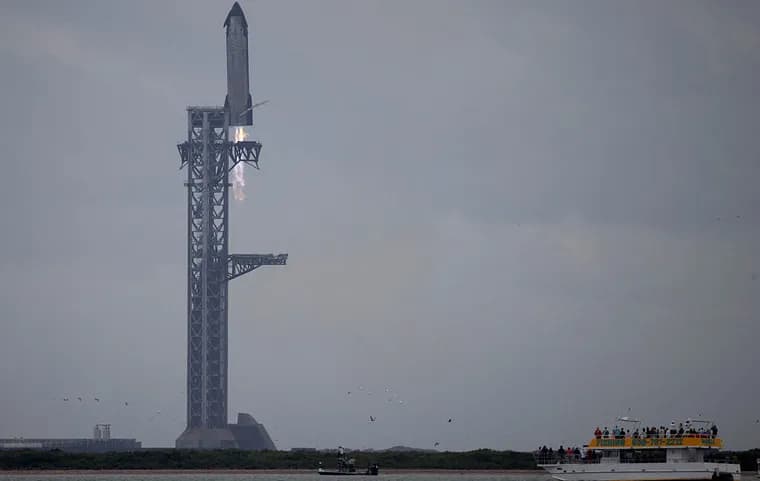
SpaceX has caught a Starship upper stage as it came back from orbit. Ars Technica, reporting from Starbase, Texas, describes the moment: the black and silver ship emerged from the cloud deck near the very end of its flight, flying horizontally until the last moment. Then three Raptor engines ignited and swung it into a vertical position.
The stage eased slowly toward the launch tower, where two arms extended outward to receive it. The margins were narrow. Two nubs on either side of the rocket, each protruding only about one foot, were the only purchase it would have on the arms. Less than a minute after the stage came into view, the tower snagged it "as snug as you like", in the author's words.
The catch happened on Saturday evening, after a handful of practice runs into the Indian Ocean. The author had watched Starship launch from Starbase a little less than a day earlier. Knowing the vehicle had orbited the planet multiple times, he says, added to the sense of unreality of seeing it return under its own power and be captured by the tower.
The piece calls the result a breathtaking feat and a brilliant technical achievement that took the best engineering minds working through a million difficult problems. It says SpaceX, nearly a quarter of a century after its founding, has taken a hugely significant step toward developing and optimizing a massive, rapidly reusable rocket.
The author sets the catch against SpaceX's earlier achievements, landing rockets on barges and returning humans to space with Crew Dragon, and says this flight took things to another level. Starships are huge and carry a huge amount of energy coming back from orbit. Until a few years ago, he writes, it seemed beyond fantastical to think of capturing a rocket with what are essentially outsized chopsticks.
The text then turns to history. Humans have built reusable spacecraft that flew into orbit before. In the 1970s, flush with confidence after the Moon landings, NASA designed and built several Space Shuttles. Their solid rocket boosters were fished from the ocean and reused. The large orange external tank was not recovered after each flight, but the orbiters spent two weeks or even longer in space before landing on a runway.
Key facts
- SpaceX's Starship upper stage came back from orbit and was caught by the launch tower's two arms at Starbase, Texas, on a Saturday evening.
- Just before the catch, three Raptor engines ignited to flip the stage from horizontal to vertical; the tower snagged it less than a minute after it came into view.
- The rocket's only purchase on the arms was two nubs, each protruding only about one foot.
- The catch followed a handful of practice runs into the Indian Ocean; the vehicle had launched a little less than a day earlier and orbited the planet multiple times.
- Ars Technica calls it a hugely significant step toward a massive, rapidly reusable rocket, and compares it with the Space Shuttle, whose external tank was not recovered after each flight.
Why it matters
Catching a returning upper stage with the launch tower is, in Ars Technica's account, a hugely significant step toward a massive, rapidly reusable rocket. The author places it above SpaceX's earlier feats of landing rockets on barges and returning humans to space with Crew Dragon, because Starships are huge and carry a huge amount of energy coming back from orbit. The comparison offered is the Space Shuttle: its solid boosters were reused, but the large orange external tank was not recovered after each flight.
Who it affects
The story is chiefly about SpaceX and its Starship program. It also bears on anyone following the push for fully reusable launch vehicles. The article cites NASA's 1970s Space Shuttles as the earlier example of reusable spacecraft that flew into orbit.
How to use it
There is nothing to use here; this is an eyewitness news report. What to take from it: the catch was done with a tower's arms and a roughly one-foot nub on each side of the stage, after practice runs into the Indian Ocean. Readers tracking rapid reuse can watch for follow-up flights. No cost, payload or schedule for rapid reuse or upcoming flights is stated in the source text.
How solid is it
The account is first-hand: the Ars Technica author was at Starbase, watched the launch a little less than a day earlier, and saw the catch. The physical details (three Raptor engines, the two arms, the roughly one-foot nubs) are described as observed. The judgments, such as "breathtaking" and "hugely significant", are the author's own. No quotations from SpaceX officials, Elon Musk, NASA or anyone else appear in the source text.
Risks and caveats
The source text gives no calendar date for the flight or the catch, only "Saturday evening", and no Starship flight number or version name. It does not say whether the Super Heavy booster was also caught or recovered. It does not say how many practice runs were made beyond "a handful". The author notes the margins were incredibly narrow, with only about a foot of nub on each side to rest on the arms. Rapid reuse is described as on the horizon, not as achieved.
“This was a breathtaking feat; a brilliant technical achievement that required the best engineering minds to think through a million different, difficult problems.”
— Ars Technica, reporting from Starbase, Texas