FreeSolo sparse attention extrapolates to longer contexts without long-context fine-tuning
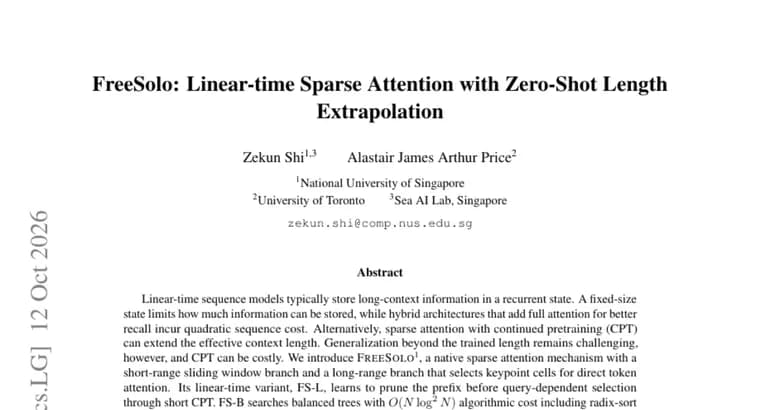
The paper starts from a familiar trade-off in long-context modelling. Linear-time sequence models usually keep long-context information in a recurrent state, but a fixed-size state limits how much information can be stored. Hybrid architectures that add full attention for better recall bring back quadratic cost in sequence length. A third route, sparse attention with continued pretraining (CPT), can extend the effective context length. Yet generalization beyond the trained length remains challenging, and CPT can be costly.
The authors introduce FreeSolo, a native sparse attention mechanism with two branches. A short-range sliding window branch handles nearby tokens. A long-range branch selects keypoint cells, and tokens attend to them directly.
There are two variants. FS-L, the linear-time one, learns to prune the prefix before query-dependent selection, and it does this through short CPT. FS-B instead searches balanced trees, at an algorithmic cost of O(Nlog^2 N) in sequence length N, including the radix-sort construction of the trees.
The headline claim is that FreeSolo shows better zero-shot length extrapolation than the baselines, without long-context fine-tuning. The abstract gives no benchmark names, model sizes, context lengths or numeric results, and it does not say which baselines were used.
Key facts
- FreeSolo is a native sparse attention mechanism that combines a short-range sliding window branch with a long-range branch that selects keypoint cells for direct token attention.
- The linear-time variant, FS-L, learns to prune the prefix before query-dependent selection through short continued pretraining (CPT).
- The FS-B variant searches balanced trees at O(Nlog^2 N) algorithmic cost, including radix-sort construction.
- The authors claim better zero-shot length extrapolation than the baselines, without long-context fine-tuning.
- The motivation: fixed-size recurrent states limit stored information, hybrids with full attention bring back quadratic cost, and CPT for sparse attention can be costly.
Why it matters
Long-context models face a three-way trade-off. Recurrent states are cheap but cap how much can be remembered. Adding full attention improves recall but costs quadratic time. Sparse attention with continued pretraining stretches context length but struggles beyond the length it was trained on. FreeSolo targets that last weakness: it aims to keep attention sparse and to work on sequences longer than those seen in training without a long-context fine-tuning stage.
Who it affects
The work is aimed at researchers and engineers building or adapting long-context language models, especially those weighing recurrent, hybrid and sparse-attention designs. The abstract does not describe a product or a deployed model.
How to use it
There is nothing to use yet from the abstract alone. It describes two variants for different needs: FS-L, which is linear-time and relies on a short CPT stage to learn prefix pruning, and FS-B, which searches balanced trees at O(Nlog^2 N) cost. Anyone wanting to try it would need the full paper for implementation details.
How solid is it
This is an abstract-level account of a preprint listed on Hugging Face Papers. The extrapolation claim is the authors' own, stated as "better than the baselines", and it is not quantified in the text. The baselines are not identified, and no benchmarks, model sizes or context lengths are given. Treat it as an unverified claim until the results can be checked.
Risks and caveats
FS-L still needs short CPT, so it is not entirely training-free, and the amount of CPT is not specified. FS-B's O(Nlog^2 N) cost is above linear. The source gives no explicit complexity expression for FS-L beyond calling it linear-time. Without named baselines or numbers, the size of any improvement and its generality are unknown.