EditBridge makes high-fidelity 4K image editing practical
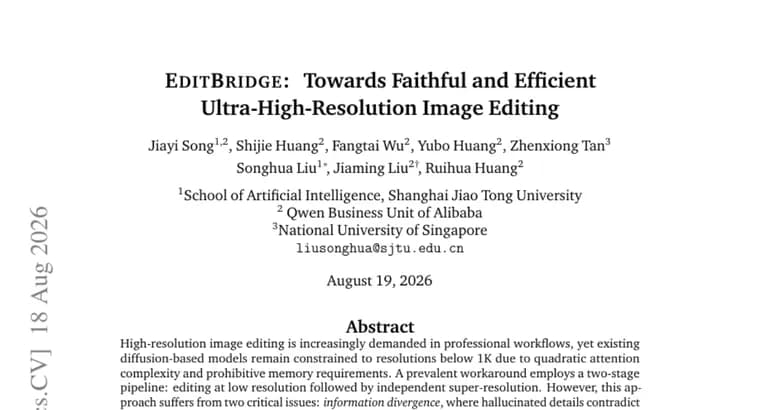
High-resolution image editing is increasingly needed in professional workflows, but diffusion-based editing models have stayed capped below 1K resolution because of two limits: the attention mechanism they rely on scales quadratically with image size, and memory requirements become prohibitive as resolution rises. The usual workaround is a two-stage pipeline: edit the image at low resolution, then run a separate super-resolution pass to scale the result up. The researchers say this approach has two recurring problems. One is information divergence, where the upscaling step hallucinates details that contradict the original high-resolution source image. The other is texture degradation, where the final image comes out either over-smoothed or over-sharpened.
To fix this, the researchers built EditBridge, a diffusion bridge framework for high-resolution editing. Instead of regenerating the image from noise the way conventional diffusion models do, EditBridge treats the refinement step as a structured translation directly from the low-resolution edited result to its high-resolution counterpart, explicitly conditioned on the original high-resolution source so added detail stays faithful to it instead of invented. To keep this efficient at high resolution, the framework adds a prior-guided block-wise sparse attention mechanism: it reuses the semantic correspondence already computed during the first, low-resolution edit to restrict cross-image attention to spatially aligned regions rather than comparing every region of the image against every other region, cutting the computational overhead that the quadratic attention cost otherwise creates.
The authors report that EditBridge achieves high-fidelity editing with superior perceptual quality at resolutions up to 4K, delivers a 3.6 to 8.4 times speedup at 2K resolution, and completes a practical 4K edit in 61 seconds.
Key facts
- Diffusion-based image editing models have been capped below 1K resolution because attention cost scales quadratically with image size and memory requirements become prohibitive at higher resolutions.
- The usual workaround, editing at low resolution and then running a separate super-resolution pass, causes hallucinated details that contradict the source image and textures that come out over-smoothed or over-sharpened.
- EditBridge treats high-resolution refinement as a direct translation from the low-resolution edited result to its high-resolution counterpart, conditioned on the original high-resolution source, instead of regenerating the image from noise.
- A prior-guided block-wise sparse attention mechanism reuses correspondence from the first editing pass to limit cross-image attention to spatially aligned regions, cutting computational overhead.
- The authors report high-fidelity editing up to 4K resolution, a 3.6 to 8.4 times speedup at 2K, and a full 4K edit completed in 61 seconds.
Why it matters
Diffusion-based editing models get quadratically more expensive as image size grows, which is what has kept them capped below 1K resolution, short of what professional workflows increasingly need. Editing at low resolution and upscaling afterward is the common patch, but it introduces exactly the kind of visible defects, invented detail and texture artifacts, that make an edit unusable for professional work. EditBridge's contribution is to treat the jump from low to high resolution as a guided translation problem rather than a second, independent generation pass, which is what lets it keep the original image's authentic detail while still working at up to 4K.
Who it affects
Builders of AI-powered image and photo editing tools, and researchers working on efficient high-resolution diffusion models. The paper frames the underlying demand broadly, as coming from professional editing workflows, without naming specific industries or products.
How to use it
This is a research paper, not an announced product or feature. The text gives no information about released code, model weights, or a public demo, and it does not mention pricing or availability, so there is currently no way to run EditBridge outside the authors' own experiments.
How solid is it
The headline results, a 3.6 to 8.4 times speedup at 2K resolution and a 61-second 4K edit, are the authors' own reported figures. The text does not name the baseline the speedup is measured against, nor the benchmark, dataset, or evaluation metric behind what it calls its 'extensive experiments.' It also does not name the authors, their institutions, or a publication venue or date, so there is no way from this text alone to check the claims against independent review.
Risks and caveats
All of the performance numbers are self-reported, and since the comparison point for the speedup claim is not stated, the size of that speedup is hard to judge without knowing what it is measured against. Without released code or weights, none of the fidelity or speed claims can be independently reproduced yet. Avoiding hallucinated detail is one of the two problems EditBridge is designed to fix, but the text gives no separate metric for how often that goal is met, only the general claim of 'superior perceptual quality.'