Entity disambiguation: reasoning pays off for small LLMs under domain shift
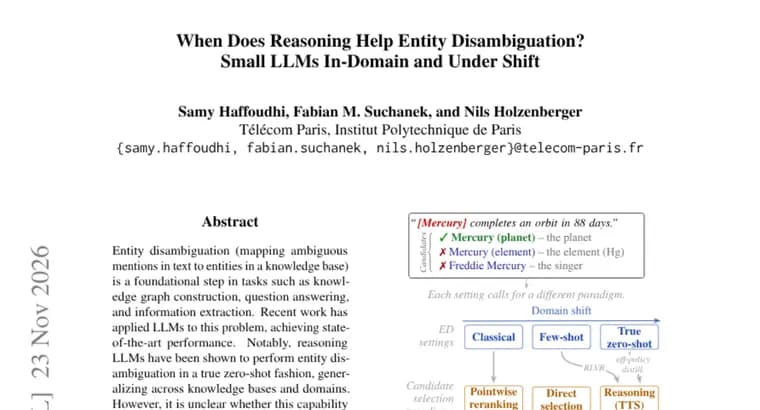
A paper listed on Hugging Face Papers asks when reasoning is worth its cost for entity disambiguation with smaller language models. Entity disambiguation means mapping ambiguous mentions in text to entities in a knowledge base. The authors call it a foundational step in tasks such as knowledge graph construction, question answering and information extraction.
The starting point is earlier work. LLMs applied to the problem have achieved state-of-the-art performance, and reasoning LLMs have been shown to disambiguate entities in a true zero-shot fashion, generalizing across knowledge bases and domains. What the authors consider unclear is whether that ability survives, or stays competitive, in smaller LLMs, where the task has typically relied on reranking rather than reasoning.
To find out, they compare three kinds of candidate-selection component: pointwise, listwise and reasoning-based. Each is placed within a classical coarse-to-fine entity disambiguation pipeline and examined across classical, few-shot and true zero-shot settings. The reasoning approach is trained with distillation and reinforcement learning recipes.
The headline result is that the benefit of reasoning grows with domain shift. It is negligible in-domain and decisive in the true zero-shot setting. The authors also report that two separate factors are at work. The reranker's uncertainty over the candidates locates the cases where the paradigms disagree, while domain shift governs which paradigm is right when they do.
Key facts
- The study asks when reasoning is worth its cost for entity disambiguation with smaller LLMs.
- It compares pointwise, listwise and reasoning-based candidate selection inside a classical coarse-to-fine pipeline.
- Tests span classical, few-shot and true zero-shot settings, with the reasoning approach trained using distillation and reinforcement learning.
- The reported benefit of reasoning is negligible in-domain and decisive in the true zero-shot setting.
- The reranker's uncertainty locates where the paradigms disagree, and domain shift governs which one is right in those cases.
Why it matters
Reasoning LLMs have already been shown to handle entity disambiguation on a true zero-shot basis across knowledge bases and domains. The open question for the authors was whether smaller models keep that ability or remain competitive, given that reranking has been the usual method at that scale. Their answer depends on conditions: how much reasoning helps rises with the distance from the familiar domain.
Who it affects
The work is most relevant to researchers and engineers who resolve ambiguous mentions against a knowledge base with smaller models. The authors name knowledge graph construction, question answering and information extraction as tasks that build on this step.
How to use it
The practical reading is to look at domain shift before paying for reasoning. In-domain, the authors found its benefit negligible. In the true zero-shot setting, they found it decisive. The reranker's uncertainty over candidates points to where the two approaches part ways, but it does not by itself settle which is right: the authors tie that to domain shift. The source text describes no concrete method for routing cases between a reranker and a reasoning model, and mentions no release of code, models or data.
How solid is it
These are the authors' own findings, summarized in a short abstract. The text gives no accuracy scores, no size of the gain from reasoning and no cost, latency or token measurements. It also names no models, parameter sizes, datasets, knowledge bases or evaluation domains, and it does not mention peer review or a conference venue.
Risks and caveats
"Smaller LLMs" is not defined in the text, so it is hard to tell which model sizes the conclusion covers. A negligible in-domain benefit is a statement about the gain from reasoning in that setting, not proof that reasoning is useless there in every respect. The text also does not say whether pointwise or listwise selection performs better. Without figures, readers cannot judge whether the zero-shot advantage justifies the extra cost in their own case.
“The benefit of reasoning grows with domain shift: negligible in-domain, decisive in the true zero-shot setting.”
— The paper's authors, in the abstract