Epic reworks Unreal Engine 6 around AI agents, drops Blueprints
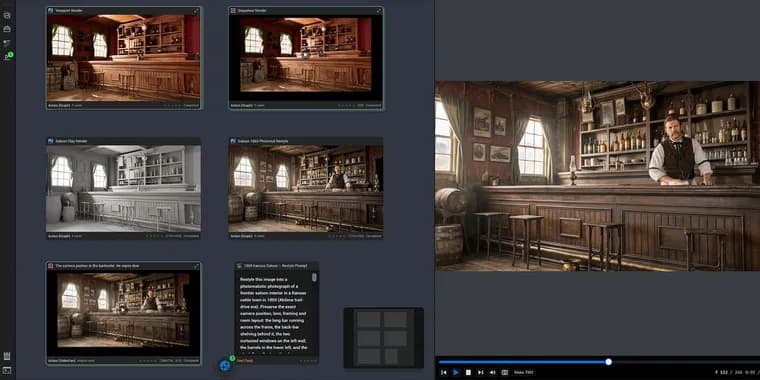
When Seeker Entertainment ran out of funding in September, its online game KinForge went down with it. The game was built in Unreal Engine 5.7 and designed to run on Amazon Web Services servers. With nobody left to pay the server bill, it became unplayable, even for the few people who had the code, including studio co-founder Travis McGeathy. On a whim, McGeathy pointed Anthropic's Claude Code at the project and asked it to make KinForge playable without AWS. After four hours of mostly hands-off work he had a build that let players host their own games. Claude added peer-to-peer play over both the Internet and a local area network, and, to McGeathy's surprise, persistent save states that let players resume a game if they are disconnected.
IEEE Spectrum's Matthew S. Smith argues that this kind of result should worry engine makers. The conversion used an agentic workflow that partly bypasses the polished editor UI companies like Epic Games have spent decades refining. Anthropic's Fable 5.2, released November 9, raises the stakes: the article says the model can generate a 3D game with a custom engine in the style of Call of Duty. The question is whether engines can evolve fast enough to keep pace. Epic's chief operating officer Daniel Vogel says the company is 'pivoting hard towards velocity': if Unreal Engine were static, he asks, what would it be worth at the end of next year? He adds that any fixed set of features can eventually be replicated.
The most concrete consequence is the fate of Blueprints, the visual system introduced in Unreal Engine 4 that lets designers script gameplay by wiring boxes together. The award-winning Clair Obscur: Expedition 33 from Sandfall Interactive leaned heavily on it. Even so, the article says Epic will remove Blueprints in Unreal Engine 6 (UE6), and puts the blame on LLMs. Blueprints are stored as binary files that LLMs cannot read directly. McGeathy says AI doesn't handle them well and would much rather work with code.
Today, LLMs drive Unreal mainly through a Model Context Protocol server. MCP is an open standard created by Anthropic that lets AI send commands to software. Engineer Ryan Barker, who has worked on projects for Amazon Games and Sony Online Entertainment, says it is not actually moving the mouse; it sends signals the editor understands.
UE6 will lean into that. All code moves to Verse, a text-based language that replaces both Blueprints and the UE5 C++ gameplay framework. Unreal's object-oriented actor framework gives way to Scene Graph, which resembles an entity component system (ECS). Barker says an ECS is typically a lot harder to code around, but it can deliver better game performance and less duplicate code, and an LLM can help manage the complexity. Verse debuted in Unreal Editor for Fortnite in 2023 and Scene Graph arrived in 2024. Verse was designed to let millions of creators run code side by side in Fortnite, so it is strict: the compiler catches mistakes before code runs and limits what each function can do. Because Scene Graph is built on Verse, an AI can work with a game world through code.
Epic's executive vice president of development, Marcus Wassmer, adds that UE6 will be more modular and expose its systems through an API so AI tooling can reach them without falling back on slow computer use. An internal effort called 'Python All The Things' aims to make everything in the editor scriptable. More assets will be stored as text so an LLM can edit them directly, and for the binary assets that remain, Epic is building a command-line tool that lets agents work with the files without loading the full UE6 interface.
The traditional editor is not going away, but Vogel expects it to change. 'You're not going to move stuff visually in the editor. Those times are gone,' he says, expecting developers to use it more to visualise the context needed for decisions and tweaks. Unreal Engine 5.9, released as a developer preview on 9 November, previews this with Unreal Canvas, a collaboration feature Vogel says is inspired by visual workspace software like Miro.
The article then asks why anyone would buy an engine when they could build one. Unreal is the second most commonly used engine after Unity, and first by number of games sold. McGeathy sees benefits in owning your engine, since you are not reliant on a third party who could pull it out from under you, but he is skeptical that many developers will go that route: a developer's goal is to make a game, not an engine. What LLMs do change, he says, is the cost of switching engines. An Unreal veteran, he used Claude to start building in Godot, an open-source engine he had never touched, and calls the transition trivial. Barker used an LLM to build physics test scenes in both Unreal and Godot to judge which suited a game concept. Wassmer accepts that AI makes it easier to pick up a new standard or convert projects, says Epic will not try to block that, and says UE6's explicit goal is to interoperate with other ecosystems and games. He is confident that building an engine from scratch, even with LLMs, still burns a lot of tokens to reach something optimised that runs on all platforms, a price most developers will not want to pay.
Key facts
- Travis McGeathy used Claude Code to make his defunct studio's AWS-dependent game KinForge (built in Unreal Engine 5.7) playable without AWS; after four hours of mostly hands-off work he had a build where players host their own games, with peer-to-peer play over the Internet and a LAN plus persistent save states.
- Epic will remove Blueprints in Unreal Engine 6, moving all code to Verse, a text-based language, and replacing the actor framework with Scene Graph, which resembles an entity component system.
- UE6 will be more modular with an API for AI tooling; Epic has an internal effort called 'Python All The Things' to make the editor scriptable, will store more assets as text, and is building a command-line tool for agents to handle remaining binary assets.
- LLMs lower the cost of switching engines: McGeathy called moving from Unreal to Godot trivial, and Epic's Marcus Wassmer says Epic won't try to block that shift.
- Epic's Daniel Vogel says the company is 'pivoting hard towards velocity'; Unreal Engine 5.9 developer preview (9 November) adds Unreal Canvas, a collaboration feature inspired by Miro.
Why it matters
Unreal Engine is the second most commonly used engine after Unity and first by number of games sold, so a decision by Epic to reshape it around LLMs is a signal for the whole engine market. The article's central worry is that agentic coding partly bypasses the editor UI that engine makers spent decades perfecting, and that a model like Anthropic's Fable 5.2 can reportedly generate a Call of Duty style 3D game with a custom engine. Epic's answer is to drop the visual Blueprints system in UE6 in favour of text-based Verse and Scene Graph, which an AI can read and edit.
Who it affects
Game developers who rely on Blueprints will lose them in UE6, and designers who script gameplay by wiring boxes will need to work in Verse or with AI help. Studios choosing an engine are affected too: McGeathy and Barker both say LLMs make it cheaper to try or switch to engines like Godot. Rival engine makers such as Unity and Godot are named in the article, though no reaction from them is given. Epic itself is betting on speed and interoperability to stay relevant.
How to use it
The article describes a practical pattern rather than a product. Today, developers can point an agent such as Claude Code at an Unreal project, with LLMs reaching the engine mainly through a Model Context Protocol server that sends commands the editor understands. McGeathy used it to rework KinForge's networking, and Barker used an LLM to build physics test scenes in both Unreal and Godot to compare engines for a game concept. For UE6, Epic plans an API, a scriptable editor and a command-line tool for binary assets. The Unreal Engine 5.9 developer preview, released 9 November, includes Unreal Canvas.
How solid is it
The piece is a feature article by freelance journalist Matthew S. Smith, an IEEE Spectrum Contributing Editor, built on interviews with Epic's chief operating officer Daniel Vogel and executive vice president of development Marcus Wassmer, plus developers McGeathy and Barker. The KinForge conversion is a single anecdote told by the developer himself, and the 'mostly hands-off' four hours is not described as fully autonomous. The Fable 5.2 claim is stated as a capability with no benchmark or evidence beyond that. No release date or timescale for Unreal Engine 6 is given. The article states the Blueprints removal as fact in its own voice.
Risks and caveats
Moving all code to Verse and Scene Graph is a big shift, and Barker notes an ECS is typically a lot harder to code around, with LLMs expected to manage that complexity. No figures on ECS or Scene Graph performance gains are given. Both McGeathy and Wassmer doubt that many developers will build their own engine: Wassmer says doing so still burns a lot of tokens to reach something optimised for all platforms. The source does not say KinForge was released again after the conversion or that Seeker Entertainment revived. Easier engine switching also cuts both ways for Epic, which says it will not block it.
“I think with any fixed set of features or functionality, it can eventually be replicated.”
— Daniel Vogel, chief operating officer at Epic Games