EVR reward model trains image editors to keep multi-reference edits consistent
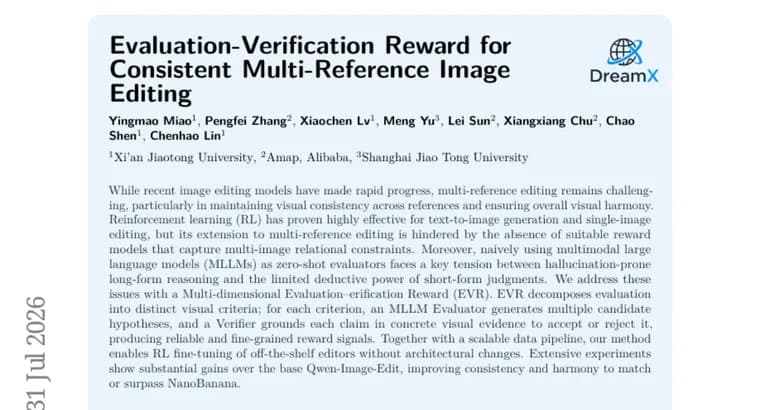
Image editing models have gotten much better recently, but the authors say multi-reference editing, where an edit must draw on and stay consistent with several reference images at once, is still hard: keeping visual consistency across the references and overall visual harmony remains a weak point. Reinforcement learning has worked well for text-to-image generation and single-image editing, but extending it to multi-reference editing has been blocked by a specific gap: there was no reward model able to capture the relational constraints between multiple images. The obvious fix, using a multimodal large language model (MLLM) as a zero-shot judge, runs into a tension the authors describe directly: long-form reasoning from an MLLM is prone to hallucination, while short-form judgments have limited deductive power. Their answer is a Multi-dimensional Evaluation-Verification Reward (EVR). EVR splits evaluation into separate visual criteria; for each criterion, an MLLM Evaluator proposes multiple candidate hypotheses, and a separate Verifier checks each claim against concrete visual evidence, accepting or rejecting it. That evaluator-verifier split is meant to produce reward signals that are both reliable and fine-grained, avoiding the hallucination-versus-shallow-judgment trade-off. Paired with a scalable data pipeline, EVR lets the authors fine-tune existing, off-the-shelf image editors with reinforcement learning without changing their architecture. The authors report extensive experiments showing substantial gains over their base model, Qwen-Image-Edit, in both consistency and harmony, to the point of matching or surpassing NanoBanana. The source text does not give the size of these gains in numbers, name any benchmarks, or provide author affiliations, publication venue, or code and dataset availability; NanoBanana itself is named only as the comparison point, without further description.
Key facts
- The paper introduces Evaluation-Verification Reward (EVR), a reward model built specifically for reinforcement learning fine-tuning of multi-reference image editing.
- EVR splits judgment into an MLLM Evaluator, which generates multiple candidate hypotheses per visual criterion, and a separate Verifier, which grounds each claim in concrete visual evidence before accepting or rejecting it.
- The design targets a specific known problem with using MLLMs as zero-shot judges: long-form reasoning tends to hallucinate, while short-form judgments lack deductive power.
- Combined with a scalable data pipeline, EVR lets off-the-shelf image editors be fine-tuned with RL without any architectural changes.
- The authors report substantial gains over base model Qwen-Image-Edit, with consistency and harmony reaching or surpassing NanoBanana, though no numeric results or benchmark names are given.
Why it matters
Multi-reference image editing, producing an edit that respects several source images at once, has lagged behind single-image editing and text-to-image generation partly because reinforcement learning had no reward model that could judge relationships across multiple images. EVR's evaluator-verifier split is a direct attempt to close that gap by resolving a known failure mode of using MLLMs as judges: unconstrained reasoning hallucinates, while terse judgments miss nuance. If the reported gains hold up, it gives a path to RL-tune existing editors for multi-reference consistency without redesigning them.
Who it affects
The work targets researchers and engineers building or fine-tuning image editing models, particularly anyone working on multi-reference editing where consistency across source images is the bottleneck. It is a training methodology paper, not a released consumer product, so it has no direct effect on end users of image editing tools unless the technique is adopted into a shipped model.
How to use it
EVR is described as a reward model plus a scalable data pipeline that plugs into reinforcement learning fine-tuning of an existing image editor, applied here to Qwen-Image-Edit, without requiring architectural changes to the base model. The source text does not mention a code or dataset release, licensing terms, or pricing.
How solid is it
The authors describe their experiments as extensive and report substantial gains over the Qwen-Image-Edit base model, with consistency and harmony matching or surpassing NanoBanana. The source text gives no specific numeric results, benchmark names, or details of the evaluation setup, so the magnitude of the improvement cannot be independently verified from what is available here.
Risks and caveats
The source provides no percentages, scores, or other quantitative benchmark values for the reported gains, no author names or institutional affiliations, no publication venue or release date, and no information on code or dataset availability. NanoBanana is used only as a comparison point without any description of what it is. All performance claims come from the authors' own paper, with no independent replication described.