Explorative Modeling picks the best of K guesses, cuts training data 6.2x
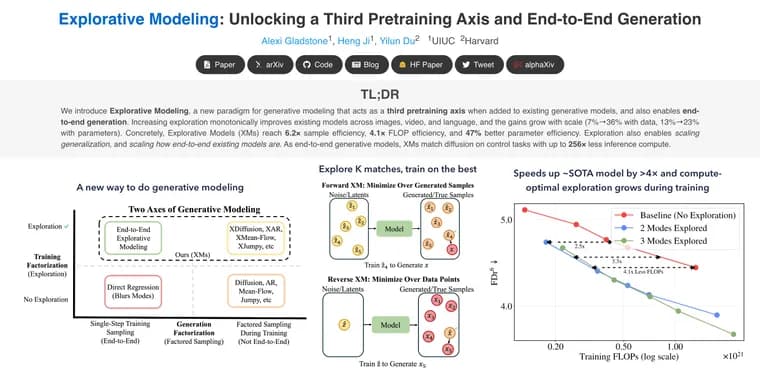
A blog post submitted to Hacker News lays out a problem with generative models: when a prompt has many valid answers (there are effectively billions of correct images for "generate a dog"), the single prediction that minimizes training error is the average of all of them, which looks like nothing real, a brown blur rather than a dog. Every scalable generative model today avoids this by factoring generation into many small steps, so each individual step has close to one right answer: autoregressive models like LLMs predict one piece at a time, and diffusion models take hundreds of tiny denoising steps. The post argues this fix carries two costs. First, models train on a single step but run hundreds or thousands of steps at inference, so their own imperfect outputs feed back in as inputs, errors compound, and generations drift from anything seen in training, a failure mode called exposure bias that the authors say is why video models degrade after roughly ten seconds and why LLMs lose coherence over long generations. Second, this training-inference mismatch means these models are never end-to-end, unlike most of the rest of deep learning since AlexNet.
The proposed fix, called Explorative Modeling, keeps the generation process untouched and instead changes the training objective: at each step, the model produces K candidate outputs, computes the loss of each against the real data, and only backpropagates through the single best-matching candidate. The authors describe it as literally a short for loop around an existing training step. With more candidates K, the best possible prediction moves off the average and onto the actual data, because the model can commit to K different specialized answers instead of blending all of them into one. The authors call this capacity "generative expressivity," the number of distinct answers a model can produce, and argue it has been fixed by model design for over a decade, unlike parameters and data, which have been actively scaled; exploration turns it into a third axis that can be scaled the same way.
Added on top of existing generative models without changing their recipes or hyperparameters, exploration is reported to improve them monotonically, with gains from 7% to 36% as data scale increases and from 13% to 23% as parameter scale increases. As standalone Explorative Models, the authors report 6.2x sample efficiency, 4.1x FLOP efficiency, and 47% better parameter efficiency versus the underlying models, and say that as end-to-end generators, Explorative Models match diffusion models on control tasks using up to 256x less inference compute. In concrete experiments, adding exploration to RAE, described as a near-state-of-the-art ImageNet generation recipe, reaches RAE's own final performance with 6.2x less data and 4.1x fewer FLOPs, and hits an approximately state-of-the-art FID of 1.43 on ImageNet 256 without guidance; the resulting XRAE converges 6.2x faster than plain RAE, which itself converges 47x faster than the standard SiT recipe, making XRAE almost 300x faster to converge than SiT overall. On a separate, optimally tuned SiT baseline trained at a third of full compute, exploration improves FLOP efficiency by up to 52% and reaches the same performance with 2.5x less data.
The post says the authors also tested exploration on video generation and on masked diffusion language models, but the excerpt available cuts off mid-sentence right after introducing that comparison, so no specific numbers from those domains are included here. A separate paper on the underlying theory, which the authors call "Mode Forcing" and say predicted almost every result in advance, is described as forthcoming. No author name or institutional affiliation appears anywhere in the article text; a project website and a GitHub repository are linked for further detail.
Key facts
- Explorative Modeling trains a model by generating K candidate outputs per step and backpropagating only through the lowest-loss candidate, rather than predicting a single average output.
- Layered on top of existing generative models with no change to their recipes or hyperparameters, exploration reportedly improves them by 7% to 36% as data scale increases and 13% to 23% as parameter scale increases.
- Applied to the RAE ImageNet-generation recipe, exploration reaches RAE's own final performance with 6.2x less data and 4.1x fewer FLOPs, hitting an approximately state-of-the-art FID of 1.43 on ImageNet 256 without guidance.
- As a standalone, end-to-end approach, Explorative Models are reported to match diffusion models on control tasks using up to 256x less inference compute.
- The available text cuts off mid-sentence before showing the referenced video-generation and masked-diffusion-language-model results, and a full paper on the underlying "Mode Forcing" theory is still described as forthcoming.
Why it matters
The post frames a problem common to every generative model: when many outputs are valid for one input, the training-error-minimizing prediction is their average, which looks like none of them. Current models dodge this by factoring generation into many small steps (one token at a time for LLMs, hundreds of denoising steps for diffusion), each with close to one right answer. The authors argue that fix has a hidden cost, exposure bias: models train on a single step but run many steps at inference, so their own errors compound and generations drift from what they saw in training, which they link to video models degrading after several seconds and LLMs losing coherence over long outputs. It also keeps generation from being end-to-end. Explorative Modeling instead scores K candidate outputs per training step and trains only on the best match, leaving the generation process itself untouched; the authors present this as a third axis to scale alongside parameter count and data, distinct from picking a bigger model or more training data.
Who it affects
Researchers and engineers building generative models across images, video, and text: users of diffusion pipelines and recipes such as RAE and SiT, teams working on autoregressive language models, and anyone dealing with exposure bias or degraded coherence over long generations. Because the authors report adding exploration on top of existing models without changing their recipes or hyperparameters, it is positioned as a technique layered onto current training setups rather than a new architecture to adopt wholesale.
How to use it
The post links a project website (explorative-modeling.github.io) and a GitHub repository (github.com/alexiglad/XM). Mechanically, at each training step the model produces K candidate generations, computes each one's loss against the real data, and backpropagates only through the lowest-loss candidate, described in the post as a short for loop wrapped around an existing training step. The authors say this requires no change to an existing model's recipe or hyperparameters, only running the generate-and-score step K times per training iteration, which adds training-time compute in exchange for the reported efficiency gains; the generation process at inference is left untouched. No price or license terms are mentioned.
How solid is it
The headline evidence comes from the authors' own experiments applying exploration to RAE, which they call a near-state-of-the-art ImageNet generation recipe, reaching an approximately state-of-the-art FID of 1.43 on ImageNet 256 without guidance, plus a separately tuned SiT baseline trained at a third of full compute. No third-party benchmark, replication, or peer review is referenced in the text, and the post says a full paper on the underlying "Mode Forcing" theory is still forthcoming, making this writeup a preview rather than a published result. The excerpt available also cuts off mid-sentence right after the authors say they tested exploration on video generation and masked diffusion language models, so those results are not present here. Discussion on Hacker News was modest at the time of writing, 34 points and 8 comments.
Risks and caveats
Running K candidate generations per training step adds training-time compute that the post does not quantify in aggregate; the efficiency figures describe reaching the same end performance faster or with less data, not the per-step cost of scoring K candidates. No author name or institutional affiliation appears anywhere in the article text, so the claims above should be read as the authors' own, pending the promised full paper and any outside replication. The dartboard example using twenty guesses is a toy illustration that the post says a model was trained on, not part of the headline RAE and SiT experiments reported above.
“the average of thousands of dogs looks nothing like a dog, it's a brown blur”
— from the blog post introducing Explorative Modeling