FAPL trains video diffusion models to use MLLM latents for cinematic generation
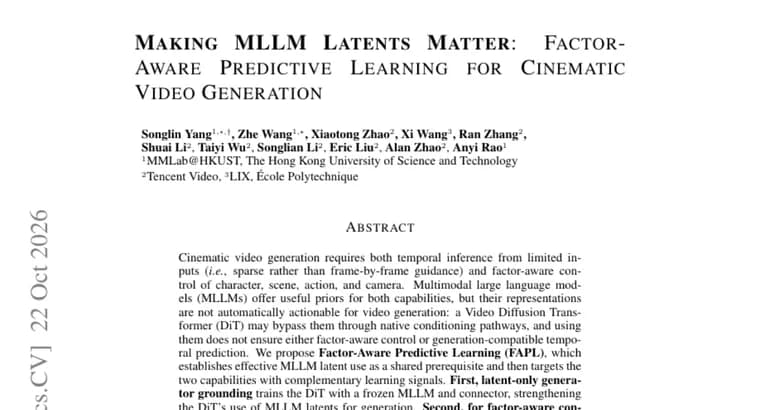
A paper on Hugging Face Papers introduces Factor-Aware Predictive Learning, or FAPL, a training method for cinematic video generation. The authors start from two requirements. Cinematic generation needs temporal inference from limited inputs, meaning sparse guidance rather than frame-by-frame guidance. It also needs factor-aware control over character, scene, action and camera.
Multimodal large language models (MLLMs) offer useful priors for both, the authors say, but their representations are not automatically actionable for video generation. A Video Diffusion Transformer (DiT) may bypass them through its native conditioning pathways. Using MLLM features also does not by itself ensure factor-aware control or generation-compatible temporal prediction.
FAPL first establishes effective MLLM latent use as a shared prerequisite, then targets the two capabilities with complementary learning signals. In the first stage, latent-only generator grounding trains the DiT with a frozen MLLM and connector, which strengthens the DiT's use of MLLM latents for generation.
For factor-aware control, paired videos specify a change in a target factor and preservation of the non-target factors. Factor-span replacement then trains the DiT to realize that relationship in its output.
For temporal inference, text-only observations and text-plus-complete-video observations share a single video target. The trained DiT is then frozen, and the MLLM and connector are optimized through it. This final stage trains limited-input representations for generation while keeping complete-observation reconstruction as a complementary training mode.
The authors say extensive experiments show consistently better performance than baselines on three cinematic video generation tasks: sparse-to-video, factor-aware editing and multi-shot generation. They also say the experiments validate FAPL's contributions to MLLM feature use, temporal control and factor coordination. The abstract gives no scores or percentages.
Key facts
- FAPL (Factor-Aware Predictive Learning) is a training method meant to make a Video DiT actually use latents from a multimodal LLM instead of bypassing them through native conditioning pathways.
- Stage one, latent-only generator grounding, trains the DiT with a frozen MLLM and connector.
- Factor-aware control uses paired videos (target-factor change, non-target preservation) and factor-span replacement; temporal inference freezes the DiT and optimizes the MLLM and connector through it.
- The authors report consistently better performance than baselines on three tasks: sparse-to-video, factor-aware editing and multi-shot generation.
- The abstract does not give quantitative results or name the baselines.
Why it matters
Cinematic video generation needs a model to infer timing from sparse input and to control character, scene, action and camera separately. The paper's central point is that plugging an MLLM into a video generator does not guarantee the generator uses it: the Video DiT may route around the MLLM latents. FAPL is an attempt to force that use and then train specific skills on top.
Who it affects
Mainly researchers working on video diffusion and on connecting MLLMs to generators. The three tasks, sparse-to-video, factor-aware editing and multi-shot generation, point at people building tools for directed or edited video, but the abstract does not discuss any product use.
How to use it
The abstract describes a recipe rather than a release. The sequence is: ground the DiT on MLLM latents with the MLLM and connector frozen; train factor-aware control from paired videos with factor-span replacement; then freeze the DiT and optimize the MLLM and connector for limited-input temporal inference, keeping complete-observation reconstruction as a complementary mode. No code or model release is mentioned.
How solid is it
The claims come from the authors' own abstract. They say extensive experiments show consistently better performance than baselines on three tasks and validate each contribution. The abstract gives no scores, no named baselines, and no details on models, datasets or compute, so the size of the gain cannot be judged from it.
Risks and caveats
The abstract reports no limitations or failure cases. Without numbers or named baselines, "consistently better" is an unquantified claim. Results on the three tasks may not carry over to other models or settings, and the abstract does not say.