Flight data and machine learning take on airplane turbulence
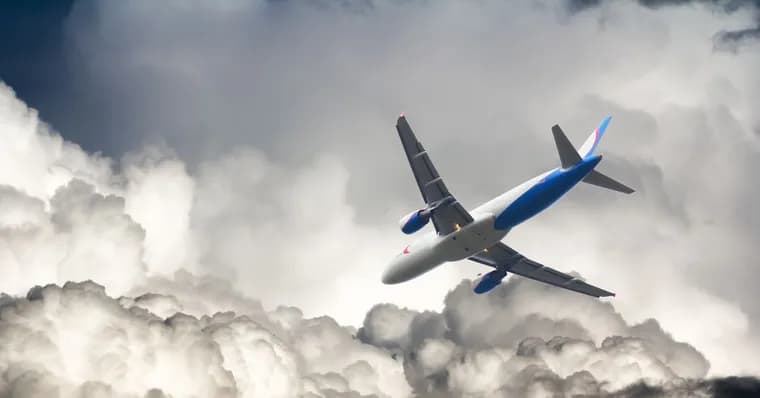
Science still does not know exactly how turbulence works, Wired reports, although Leonardo da Vinci was already studying it in the early 1500s, making hundreds of drawings of swirling eddies in water. "It’s the hardest remaining problem in classical physics, and it’s one we need to fly through," says Michael Murillo, a professor of theoretical and computational physics at Michigan State University. A large crop of data-driven efforts to predict and avoid turbulence could now get fliers closer to a smooth ride.
The raw material is plentiful. According to the International Air Transport Association, an airplane's engine creates 20 terabytes of data in one hour of commercial flying. Aircraft broadcast more in midflight, including GPS position, altitude and speed. Electronic flight bags, essentially specialized iPads holding navigation charts and manuals, can transmit their own information when the plane's internet connection cooperates, and satellites collect it all. "Air traffic has gone up, and communication costs and the costs of putting computers on aircraft have come down," says Larry Cornman, a physicist with the National Science Foundation's National Center for Atmospheric Research who has studied turbulence for decades. "The time is now to work on these things because we can do them."
The safety stakes are real: FAA data shows more than 200 people were seriously injured on US airplanes in turbulence-related incidents between 2009 and 2023. Wired also reports that turbulence is getting worse, as climate change alters conditions around the jet streams and creates destabilizing wind shear. For pilots, that means sudden clear-air turbulence that is hard to see or predict. Historically, their only way to avoid rough air was to heed warnings from those who had already flown through it and hope nothing had changed.
In the past two years, Cornman's work has been put into the field in new ways through several projects coordinated by the federal government and the airline industry. In one breakthrough, he and an FAA air traffic controller determined that the position, altitude and speed broadcasts that aircraft are federally required to send can be used to spot unexpected turbulence, with no new onboard hardware or software. Researchers can use this crowdsourced public data to predict when and where it will appear.
In September, the National Science Foundation announced a $30 million award to nine universities for a new center on predicting turbulence in air, in the charged particles inside fusion reactors and in gas clouds in space. Murillo heads the center, called Transformative Explorations in Multi-Physics and Engineering of Scientific Turbulence, or Tempest. "Turbulence is the reason we don’t have fusion energy yet," he says: chaotic swirling of superhot plasma lets heat leak out, so the material cannot get hot enough for nuclei to fuse.
Perfect forecasts remain out of reach, scientists say. Eddies break into ever smaller eddies that all interact, producing too many fast-changing variables to account for mathematically. Tiny shifts in wind speed or temperature can also dramatically change air movement. Murillo says increasingly sophisticated machine learning could still get scientists closer to knowing what will happen and when. Wired adds that while brute computing force cannot solve the problem, AI agents might help, and that OpenAI's announcement this fall that it had resolved the Navier-Stokes problem (the equations at the start of all turbulence models) suggests large language models could contribute. "Turbulence has been a problem only human minds could work on; as of this year, that's no longer true," Murillo says.
Aviation may not need to solve turbulence, only to better understand the conditions that create it and keep planes away. SkyPath, a company in Tel Aviv, uses cockpit iPads and their accelerometers to collect crowdsourced data and share it between aircraft, even across airlines, saying it anonymizes the data first. CEO Maya Shpak says more than 40,000 devices have SkyPath installed, and the company says several major airlines, including American, use it. SkyPath combines this data with other information such as weather forecasts and uses machine intelligence to predict the state of the air, helping pilots avoid rough patches and warn passengers and crew 10 to 15 minutes ahead. A pilot identified as Eric calls it helpful but notes that crowdsourced software only works if everyone uses it. Cornman cautions that predictive accuracy of 100, 90 or even 80 percent is not coming anytime soon.
Key facts
- FAA data shows more than 200 people were seriously injured on US airplanes in turbulence-related incidents between 2009 and 2023.
- Larry Cornman and an FAA air traffic controller determined that required aircraft broadcasts of position, altitude and speed can reveal unexpected turbulence without new onboard hardware or software.
- The National Science Foundation announced a $30 million award to nine universities for Tempest, a turbulence prediction center headed by Michigan State's Michael Murillo.
- SkyPath, based in Tel Aviv, says its app is on more than 40,000 cockpit devices and helps pilots warn of turbulence 10 to 15 minutes ahead.
- Cornman says predictive accuracy of 100, 90 or even 80 percent is not coming anytime soon.
Why it matters
Turbulence injures people: FAA data counts more than 200 serious injuries on US airplanes between 2009 and 2023. Wired reports that it is also getting worse as climate change alters conditions around the jet streams. What has changed, according to Cornman, is that air traffic has grown while communication and onboard computing have become cheaper. The science reaches beyond aviation too, since the new Tempest center will also study turbulence in fusion plasma and in space gas clouds.
Who it affects
Nervous fliers, passengers and flight attendants feel turbulence directly. Pilots stand to gain earlier warnings than the traditional method of hearing from whoever flew through the rough air first. Airlines are involved as data sources and users, and sharing data between competitors can be a sensitive topic. Fusion researchers also have a stake, because plasma turbulence lets heat escape from reactors.
How to use it
The tools described here are mainly for flight crews. SkyPath runs on electronic flight bags, using their accelerometers to gather data, then combines it with weather forecasts and other information to predict conditions. Pilots can use it to steer around rough air and to warn passengers and crew 10 to 15 minutes in advance. The broadcast-based method developed with Cornman draws on public data that aircraft already send, so it needs no new hardware or software onboard.
How solid is it
This is a Wired feature that draws on FAA and International Air Transport Association figures and on interviews with researchers, a company chief and a pilot. The device count comes from SkyPath's CEO, and the airline adoption and data anonymization claims come from the company. The pilot spoke without giving his full name because he was not authorized to talk to the media. No accuracy figures are given for any turbulence prediction method. The article does not say OpenAI's Navier-Stokes result was independently verified and gives no details of it; the link to better turbulence work is presented only as a suggestion that large language models could help.
Risks and caveats
Scientists say turbulence cannot be predicted perfectly: it unfolds on many small scales at once, and tiny changes in wind speed or temperature can upset a forecast. A perfect forecast would require a perfect picture of the atmosphere at all times. Crowdsourced tools have their own limit, since measurements cannot be taken everywhere at once and, as Eric puts it, such software only works if everyone uses it. Cornman expects progress but calls the problem too complicated for very high accuracy anytime soon.
“It’s the hardest remaining problem in classical physics, and it’s one we need to fly through”
— Michael Murillo, professor of theoretical and computational physics at Michigan State University