G-STAR paper claims 20x faster discrete autoregressive image generation
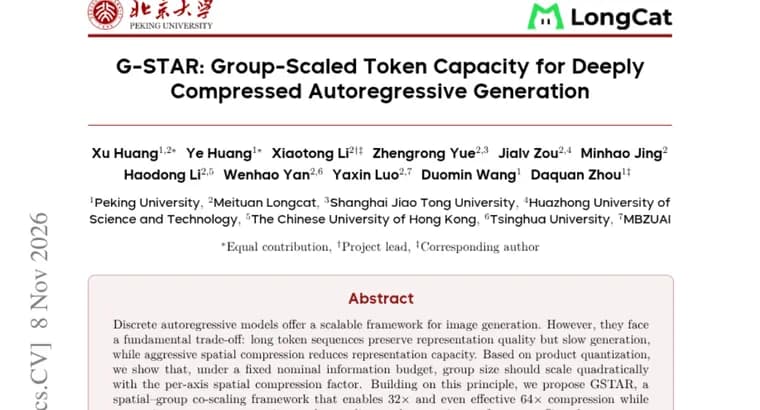
Discrete autoregressive models are a scalable way to generate images, but the paper starts from a trade-off the authors say they cannot escape. Long token sequences preserve representation quality but slow generation down. Aggressive spatial compression shortens the sequence but reduces the capacity of the representation.
The authors' answer starts from product quantization. They show that, under a fixed nominal information budget, group size should scale quadratically with the per-axis spatial compression factor. Building on that principle, they propose GSTAR (the paper is titled G-STAR), a spatial and group co-scaling framework. According to the abstract, it enables 32x and even effective 64x compression while preserving strong reconstruction, understanding and generation performance.
Larger groups bring a new problem: dependencies inside each group that have to be modeled efficiently. The authors analyze how those dependencies affect inference latency and generation quality. They then introduce a semi-autoregressive decoder that combines parallel feature computation with lightweight causal modeling.
With these designs, the authors say their highly compressed models perform competitively with leading models across five text-to-image benchmarks: GenEval, DPG-Bench, PRISM, LongText-Bench and Qwen-Image-Bench. At 1024x1024 resolution, the model delivers a 20x speedup over prior discrete autoregressive models, generating each image in 2.5 seconds on a single NVIDIA H200.
The authors conclude that highly compressed discrete representations can enable high-quality autoregressive generation at low latency.
Key facts
- GSTAR is a spatial and group co-scaling framework for discrete autoregressive image generation, built on a product-quantization argument that group size should scale quadratically with the per-axis spatial compression factor.
- It enables 32x and even effective 64x compression of image tokens while, per the authors, preserving reconstruction, understanding and generation performance.
- A semi-autoregressive decoder combines parallel feature computation with lightweight causal modeling to handle the dependencies inside larger groups.
- The compressed models are said to perform competitively with leading models on five text-to-image benchmarks: GenEval, DPG-Bench, PRISM, LongText-Bench and Qwen-Image-Bench.
- At 1024x1024 the authors report a 20x speedup over prior discrete autoregressive models, at 2.5 seconds per image on a single NVIDIA H200.
Why it matters
Speed is the usual complaint about autoregressive image generation, because every extra token adds a step. This work attacks the token count directly. It claims that very heavy compression, 32x and effectively 64x, need not cost quality if the group size grows in step with the spatial compression. If the claim holds, discrete autoregressive models become much more practical at 1024x1024, where the paper reports 2.5 seconds per image on one H200 and a 20x speedup over prior discrete autoregressive models.
Who it affects
Mainly researchers and engineers working on image tokenizers and autoregressive image generators, who face the same trade-off between sequence length and representation capacity. The authors also report results on reconstruction and understanding, not only generation, so the work touches anyone building unified models on discrete visual tokens.
How to use it
There is nothing to run yet from the source: no code, weights or release plans are mentioned. What a practitioner can take from the abstract is the design rule (group size scaling quadratically with the per-axis spatial compression factor) and the idea of a semi-autoregressive decoder that computes features in parallel and keeps the causal part lightweight.
How solid is it
This is a preprint listed on Hugging Face Papers, and the evidence in the abstract is the authors' own. The compressed models are said to be competitive with leading models on five text-to-image benchmarks, but no benchmark scores are given, only the phrase "competitively with leading models". The abstract does not name the prior discrete autoregressive models used as the baseline for the 20x speedup, nor their latency.
Risks and caveats
The abstract does not say whether the 2.5 second figure applies to the 32x or the effective 64x setting. It gives no model size, parameter count or training cost. It also names no authors or institutions. The 64x figure is described as "effective" compression, and the 20x speedup is measured against prior discrete autoregressive models, not against every kind of image generator.
“Together, these results show that highly compressed discrete representations can enable high-quality autoregressive generation at low latency.”
— G-STAR paper abstract